
Accident trauma legally affects employment by activating federal protections that shield injured workers from unfair dismissal and require employers to provide reasonable workplace accommodations. The Family and Medical Leave Act (FMLA) and the Americans with Disabilities Act (ADA) are the two statutes that define why accident trauma affects employment legally in the United States. Together, they create binding obligations for employers and concrete rights for workers recovering from physical and psychological injuries. Ignoring these laws exposes employers to discrimination claims, wrongful termination suits, and significant financial liability.
What federal laws protect employees experiencing trauma after an accident?
The FMLA and the ADA form the legal foundation for workers whose trauma affects their ability to perform their jobs. FMLA provides up to 12 weeks of unpaid, job-protected leave per year for serious health conditions, including trauma-related impairments such as post-traumatic stress disorder (PTSD) and anxiety disorders. That protection means your employer cannot legally terminate you or eliminate your position while you are on qualifying leave.
The ADA adds a second layer of protection. It requires employers with 15 or more employees to provide reasonable accommodations for workers whose trauma qualifies as a disability. A reasonable accommodation is any adjustment to the job or work environment that allows the employee to perform their essential duties without imposing undue hardship on the employer.
Key protections under these two statutes include:
- FMLA leave eligibility: You must have worked for your employer for at least 12 months and logged at least 1,250 hours in the past year at a location with 50 or more employees within 75 miles.
- ADA disability definition: Trauma qualifies as a disability when it substantially limits one or more major life activities, including concentrating, sleeping, or interacting with others.
- Reasonable accommodations: Examples include modified schedules, remote work options, reassignment to a less stressful role, or additional breaks.
- At-will employment limits: Even in at-will states, employers cannot fire a worker for reasons that violate FMLA, ADA, or anti-retaliation statutes. North Carolina's at-will doctrine, for example, does not override these federal protections.
- Interactive process obligation: Employers must engage in a good-faith dialogue with the employee to identify workable accommodations before denying a request.
Understanding which law applies to your situation determines the type of claim you can file and the remedies available to you.
How does trauma from an accident affect job performance and attendance legally?
Trauma from an accident produces measurable changes in brain function that directly affect work output. Trauma triggers a threat response that degrades prefrontal cortex activity, the part of the brain responsible for decision-making, focus, and emotional regulation. The result is a real, physiological productivity gap that managers often misread as a bad attitude or poor work ethic.
Studies show a strong correlation between trauma indicators and poor job performance, along with elevated turnover intentions among affected workers. That correlation matters legally because it supports the argument that performance problems stem from a medical condition, not personal failings. An employer who disciplines or terminates a worker for trauma-related performance issues without first exploring accommodations risks a disability discrimination claim under the ADA.
| Trauma symptom | Work impact | Legal relevance |
|---|---|---|
| Cognitive impairment | Missed deadlines, errors | Supports ADA disability claim |
| Hypervigilance or anxiety | Conflict with coworkers | Grounds for accommodation request |
| Fatigue and sleep disruption | Absenteeism, tardiness | Triggers FMLA leave eligibility |
| Emotional dysregulation | Disciplinary incidents | Protects against wrongful termination |
| Avoidance behaviors | Inability to perform specific tasks | Justifies modified duty assignment |
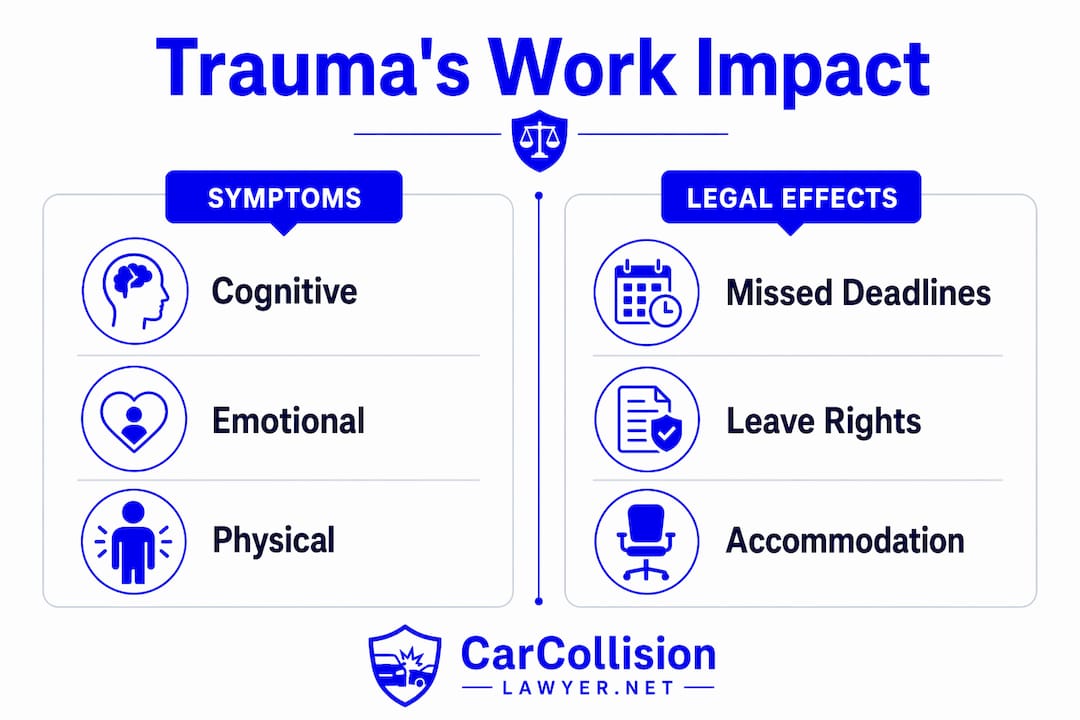
Wrongful termination based on trauma-related absences or behavioral changes is one of the most common legal claims following an accident. The employer's failure to recognize the medical basis for those changes, and to initiate the interactive accommodation process, is what converts a performance issue into an illegal act.
Pro Tip: Keep a personal log of every symptom that affects your work, including dates, specific tasks impacted, and any communications with your supervisor. This record becomes critical evidence if you later file an ADA or FMLA complaint.
What are employers' responsibilities for supporting employees with trauma?
Employers carry both legal and practical obligations when a worker experiences trauma after an accident. The legal duty centers on the good-faith interactive process required under the Fair Employment and Housing Act (FEHA) in California and mirrored by ADA guidance nationwide. Refusing to engage in that process, or denying accommodations without demonstrating undue hardship, constitutes illegal disability discrimination.

Beyond the legal minimum, trauma-informed workplace practices reduce absenteeism and disengagement. Barriers like stigma, fear of re-traumatization, and lack of psychological safety prevent many workers from disclosing their condition, which delays the accommodation process and worsens outcomes for everyone. Employers who build confidential disclosure pathways and train managers to recognize trauma symptoms remove those barriers before they become legal liabilities.
Practical steps employers should take include:
- Train managers to distinguish trauma symptoms from conduct issues before initiating any disciplinary process.
- Establish a confidential reporting channel so employees can disclose medical conditions without fear of stigma or retaliation.
- Offer flexible scheduling as a first-line accommodation, since many trauma symptoms are time-sensitive and worsen under rigid time pressure.
- Modify duties temporarily rather than placing an employee on indefinite leave, which preserves productivity and demonstrates good faith.
- Document every accommodation discussion in writing, including the date, parties involved, options considered, and the final decision.
Trauma is an organizational responsibility, not a personal problem the employee must manage alone. Employers who treat it as such build stronger teams and face fewer legal claims.
Pro Tip: If your employer denies an accommodation request, ask for the denial in writing and request a specific explanation of the undue hardship claimed. Vague denials rarely satisfy the legal standard.
How can employees protect their rights after accident trauma discrimination?
Medical documentation is the single most powerful tool for protecting your employment rights after an accident. Linking physical and psychological symptoms explicitly to the accident in clinical records strengthens both insurance claims and legal cases. A doctor's note that says "anxiety disorder" is weaker than one that says "anxiety disorder caused by a motor vehicle accident on [date], resulting in impaired concentration and inability to perform [specific job tasks]."
Employees who face discrimination or wrongful termination based on trauma-related issues have several legal avenues:
- File an EEOC charge: The Equal Employment Opportunity Commission (EEOC) handles ADA discrimination complaints. You generally have 180 days from the discriminatory act to file, or 300 days if your state has its own anti-discrimination agency.
- File an FMLA complaint: The U.S. Department of Labor's Wage and Hour Division investigates FMLA interference and retaliation claims. Retaliation for taking protected leave is illegal regardless of your state's at-will employment rules.
- Pursue workers' compensation retaliation claims: If your employer fires you for filing a workers' comp claim related to your accident, most states provide a separate wrongful termination cause of action.
- Gather evidence systematically: Collect performance reviews from before the accident, medical records, written communications with your employer, and any documentation of the accommodation request and denial.
- Consult an attorney early: Legal timelines for these claims are strict. Missing a filing deadline can permanently bar your claim, regardless of its merit.
A common misconception is that trauma must be visible or severe to qualify for legal protection. PTSD, adjustment disorder, and even subclinical anxiety can qualify as ADA disabilities if they substantially limit a major life activity. The threshold is functional impact, not diagnostic label.
How do state laws and workplace sectors affect the legal implications of trauma?
Federal law sets the floor for employee protections, but many states build significantly higher ceilings. California's FEHA, for example, applies to employers with five or more employees, compared to the ADA's threshold of 15. New York and New Jersey have similarly expanded protections that cover smaller employers and broader definitions of disability.
| Jurisdiction | Employer size threshold | Key additional protection |
|---|---|---|
| Federal (ADA/FMLA) | 15+ employees (ADA); 50+ (FMLA) | Baseline reasonable accommodation duty |
| California (FEHA) | 5+ employees | Broader disability definition, stronger interactive process rules |
| New York (NYSHRL) | 4+ employees | Covers more workers; includes trauma-related mental health conditions |
| At-will states (e.g., NC) | Follows federal thresholds | Federal anti-retaliation laws still apply fully |
Certain industries carry higher trauma exposure and face additional regulatory scrutiny. Healthcare workers, first responders, and construction workers encounter traumatic events at rates far above the general workforce. Workers' compensation systems in most states cover psychological injuries, but the standard of proof varies. Some states require a physical injury to accompany a psychological claim. Others allow standalone mental health claims if the trauma is work-related and documented by a licensed clinician.
Consulting a local attorney who understands your state's specific rules is not optional. It is the only way to know which protections apply to your exact situation. Resources like the Carcollisionlawyer legal support blog offer starting points for understanding accident-related employment rights across different contexts.
Key Takeaways
Accident trauma activates federal protections under the FMLA and ADA that legally obligate employers to provide leave, accommodations, and protection from retaliation, making medical documentation and early legal consultation the most critical steps for any injured worker.
| Point | Details |
|---|---|
| Federal law creates firm obligations | FMLA and ADA require leave and accommodations for qualifying trauma-related conditions. |
| Trauma symptoms are legally recognized disabilities | Cognitive and emotional impairments from accidents can qualify under the ADA's functional impact standard. |
| Documentation determines claim strength | Linking symptoms explicitly to the accident in medical records is the most effective way to protect your rights. |
| State laws often exceed federal protections | States like California and New York cover smaller employers and broader disability definitions. |
| Early legal consultation is critical | Filing deadlines for EEOC and FMLA complaints are strict; missing them can forfeit your claim permanently. |
What I've learned about trauma and employment law that most people get wrong
Gerard here. After years of watching people navigate the aftermath of serious accidents, the pattern I see most often is this: workers wait too long to assert their rights because they assume their employer is acting in good faith.
That assumption is expensive. The productivity gap caused by trauma is real and measurable, but most managers have no training to recognize it. They see missed deadlines and emotional reactions, and they reach for the performance improvement plan before they ever think about the ADA. By the time the employee realizes what is happening, disciplinary records have accumulated and the legal picture has gotten complicated.
The second mistake I see is incomplete documentation. People get a diagnosis but never ask their doctor to connect it explicitly to the accident. That connection is what transforms a general mental health claim into a legally protected disability claim tied to a specific event. Without it, the employer's defense attorney has room to argue the condition is unrelated to the workplace or the accident.
My honest advice: treat documentation like evidence from day one, because it might become exactly that. And do not wait for your employer to offer accommodations. Request them in writing, keep copies of everything, and consult an attorney before you assume the situation is unresolvable. The law gives you more leverage than most people realize.
— Gerard
How Carcollisionlawyer connects trauma survivors with legal support
Recovering from an accident is hard enough without also fighting for your employment rights alone. Carcollisionlawyer specializes in connecting people injured in car, motorcycle, and truck accidents with attorneys who understand both the physical and legal dimensions of trauma recovery.
The free evaluation process at Carcollisionlawyer lets you understand your compensation entitlement without any upfront commitment. Whether your situation involves wrongful termination, denied accommodations, or a workers' compensation dispute, the right attorney can assess your specific circumstances and identify the strongest path forward. Start your free injury evaluation today and get clarity on what you are legally owed.
FAQ
What is the legal definition of trauma as a disability?
Under the ADA, trauma qualifies as a disability when it substantially limits one or more major life activities, such as concentrating, sleeping, or interacting with others. The standard is functional impact, not a specific diagnostic label.
Can my employer fire me while I am on FMLA leave for trauma?
No. FMLA provides job-protected leave for up to 12 weeks, meaning your employer cannot terminate you or eliminate your position solely because you took qualifying leave.
How do I request a workplace accommodation for trauma?
Submit a written request to your employer or HR department explaining that you have a medical condition affecting your work and that you are requesting a reasonable accommodation. You do not need to disclose a specific diagnosis.
What evidence do I need to file an ADA discrimination complaint?
You need medical records linking your trauma to the accident, documentation of your accommodation request and the employer's response, and any performance records or communications showing adverse treatment after your injury.
Does workers' compensation cover psychological trauma from an accident?
Coverage varies by state. Most states cover psychological injuries tied to a physical accident, but some require a concurrent physical injury. A licensed clinician's documentation connecting the trauma to the workplace event is required in nearly every jurisdiction.