
Mental injuries caused by accidents, such as PTSD, anxiety, and depression, are legally recognized compensable harms that entitle victims to financial restitution. The standard legal term for these claims is "psychiatric injury" or "psychological harm," and courts across the United States, United Kingdom, Canada, and beyond have accepted them as real, measurable damages. Understanding why mental injuries deserve compensation requires knowing how legal systems validate these claims, what medical evidence courts demand, and what practical steps you can take to protect your rights after a traumatic event.
Why mental injuries deserve compensation under the law
Mental and psychiatric injuries are compensable even without visible physical harm, provided claimants prove both diagnosis and causation. This is the foundational rule in personal injury law. Ontario courts, for example, weigh duration of symptoms, interference with employment, damage to relationships, and overall quality of life when calculating damage awards. The fact that a broken leg shows up on an X-ray while PTSD does not does not make PTSD less real or less deserving of compensation.
Psychological trauma after an accident can include anxiety, depression, and PTSD, and all three are recognized legally when caused by negligence. These conditions interfere with work, social life, and family responsibilities in ways that courts classify as loss of amenity and general damages. Courts and insurers are increasingly recognizing mental injuries as functionally disabling, not merely emotional, which has led to broader acceptance of mental health compensation claims. That shift matters because it means your claim has a stronger legal foundation in 2026 than it would have had a decade ago.

What types of mental injuries qualify for compensation?
The most commonly recognized conditions in compensation claims are PTSD, generalized anxiety disorder, major depressive disorder, and acute stress disorder. Each must be formally diagnosed by a licensed mental health professional, typically a psychiatrist or clinical psychologist, using established criteria such as the DSM-5. A self-report or a general practitioner's note alone rarely satisfies legal standards.
Qualifying conditions share one critical feature: they must be directly caused by the incident in question, not by a pre-existing condition or an unrelated life stressor. Courts draw a clear line between a mental injury triggered by a car accident and a pre-existing anxiety disorder that the accident may have worsened. That said, if an accident aggravates a pre-existing condition, you may still recover compensation for the aggravation portion. The key is precise clinical documentation that separates the two.
Common qualifying mental injuries include:
- PTSD: Flashbacks, nightmares, hypervigilance, and avoidance behaviors directly tied to the traumatic event.
- Anxiety disorders: Persistent, excessive worry or panic attacks that began after the incident.
- Depression: Persistent low mood, loss of motivation, and withdrawal from daily activities following trauma.
- Emotional distress: Documented psychological suffering that falls short of a full clinical diagnosis but still causes measurable functional impairment.
Pro Tip: Start treatment immediately after the incident. A gap between the event and your first psychiatric appointment gives insurers grounds to argue your symptoms were not caused by the accident.
How do compensation systems legally value mental injuries?
Legal systems use structured frameworks to assign monetary value to psychiatric injuries. In England and Wales, the Judicial College Guidelines provide anchor ranges that courts, solicitors, and insurers use to estimate general damages for pain, suffering, and loss of amenity. These guidelines map clinical severity into recognized damage bands, creating consistency across cases. Singapore's Work Injury Compensation Act treats mental conditions as functionally disabling, allowing compensation for wage losses and permanent incapacity, not just emotional distress.
The table below compares how different jurisdictions approach valuation of psychiatric injury claims.
| Jurisdiction | Valuation Method | Key Damage Components |
|---|---|---|
| England and Wales | Judicial College Guidelines damage bands | General damages, pain and suffering, loss of amenity |
| Ontario, Canada | Judicial discretion based on functional impact | Employment interference, relationship damage, quality of life |
| Singapore | Work Injury Compensation Act schedules | Wage loss, permanent incapacity, medical expenses |
| United States | Jury-determined with expert testimony | Emotional distress, lost earnings, future treatment costs |
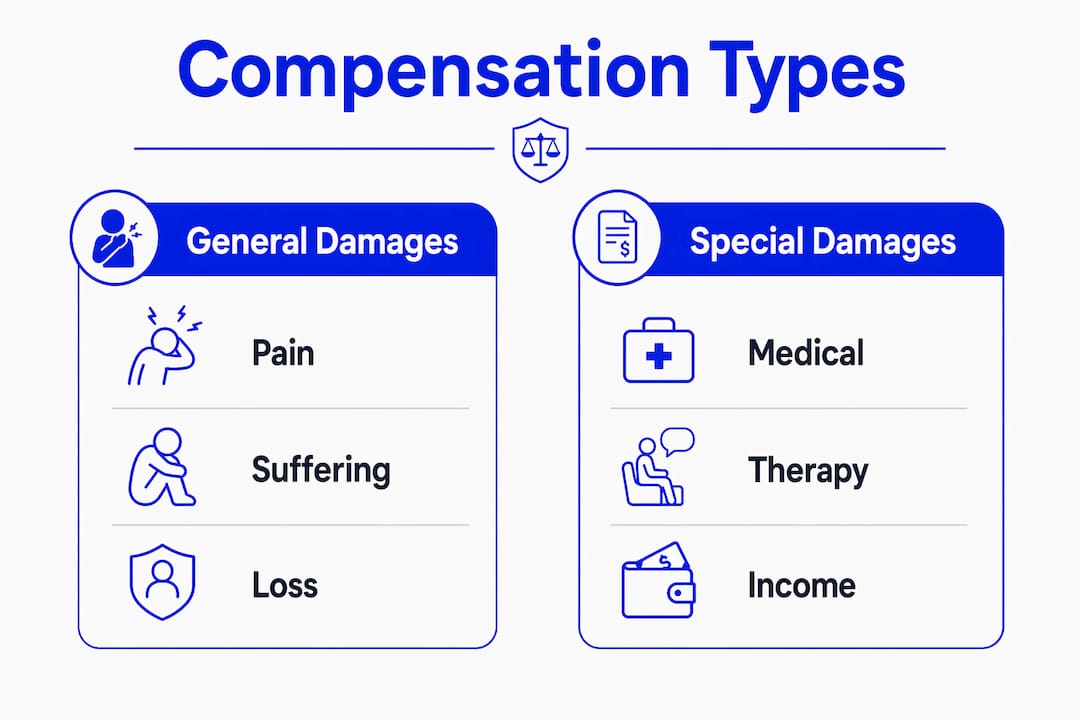
Compensation for emotional trauma typically splits into two categories. General damages cover the pain, suffering, and reduced quality of life caused by the psychiatric injury. Special damages cover concrete financial losses such as therapy costs, lost wages, and future medical expenses. Both categories require solid documentation to survive insurer scrutiny.
Pro Tip: Ask your attorney to obtain a copy of the applicable damage guidelines for your jurisdiction before your first settlement discussion. Knowing the anchor ranges prevents you from accepting a lowball offer.
What evidence strengthens a mental injury compensation claim?
Compensation legitimacy for mental injuries depends on careful documentation and credible expert evidence linking diagnosis and impact to the incident. Without that chain of proof, even a genuine psychiatric injury becomes difficult to value or defend. The following steps build the strongest possible evidentiary record.
- Obtain a formal psychiatric or psychological evaluation. A licensed psychiatrist or psychologist must diagnose your condition using recognized criteria. This report forms the backbone of your claim.
- Preserve all medical and therapy records. Every appointment, prescription, and treatment note creates a timeline that corroborates your symptoms and their onset.
- Document functional impact in writing. Keep a daily journal recording how your symptoms affect your ability to work, maintain relationships, and perform routine tasks.
- Commission an expert medico-legal report. Expert psychiatric reports must connect diagnosed mental conditions causally to the incident, address prior issues, and discuss severity and prognosis. Without this causal linkage, claims are far easier for insurers to minimize.
- Address alternative causes directly. Your expert should rule out or account for other potential triggers, including pre-existing conditions, so the defense cannot shift blame elsewhere.
Pro Tip: A psychiatric record review by a medico-legal specialist can identify gaps in your documentation before the defense does. Fixing those gaps early is far less costly than losing credibility at trial.
Common challenges in claiming compensation for mental injuries
Proving a psychiatric injury claim is harder than proving a broken bone, and you should expect resistance. The core challenges fall into predictable patterns, and knowing them in advance lets you prepare.
- Symptom onset delays: PTSD symptom onset can span weeks to months post-incident, which complicates causation proof. Insurers argue that a delayed presentation means the accident was not the real cause. Your expert must explain the clinical basis for delayed onset and rule out alternative triggers.
- Skepticism about invisible injuries: Psychological injuries are often viewed as hard to establish because they are invisible. Consistent, credible reporting of day-to-day impact is the primary tool for overcoming that skepticism.
- Inconsistent symptom reporting: Inconsistency in symptom reporting or failure to follow recommended treatments weakens credibility and can undermine your entire claim. Courts and insurers treat inconsistency as evidence of exaggeration or fabrication.
- Pre-existing condition disputes: If you had prior mental health treatment, the defense will argue your current symptoms are unrelated to the accident. A well-prepared expert report addresses this directly by distinguishing baseline function from post-incident deterioration.
- Choosing the wrong legal counsel: Mental injury claims require attorneys who understand both personal injury law and psychiatric evidence. A generalist attorney without this background may fail to engage the right experts or present the evidence effectively.
The solution to most of these challenges is the same: early evaluation, consistent treatment, thorough documentation, and experienced legal representation.
What are the practical steps to pursue mental health compensation?
If you believe you have a psychiatric injury claim following an accident, the process follows a clear sequence. Skipping steps or delaying action weakens your position significantly.
- Seek immediate medical evaluation. Visit a doctor or mental health professional as soon as symptoms appear. Early records establish onset timing and connect your condition to the incident.
- Document every impact. Record missed workdays, canceled social engagements, and changes in family relationships. These details translate directly into special damages.
- Consult a specialized attorney early. Personal injury attorneys who handle accident injury claims understand the evidentiary standards for psychiatric harm. Early consultation prevents procedural mistakes that can bar your claim.
- Engage a qualified mental health expert. Your attorney should retain a psychiatrist or psychologist experienced in medico-legal work to prepare a formal expert report.
- Understand your limitation period. Most jurisdictions impose strict deadlines for filing personal injury claims, often two to three years from the date of the incident. Missing that window eliminates your right to compensation entirely.
- Prepare for mediation or litigation. Many mental injury claims settle before trial, but you must be ready to litigate if the insurer refuses a fair offer. A well-documented claim with strong expert support gives you real leverage at the negotiating table.
Key takeaways
Mental injuries deserve full legal compensation because they impose real, measurable harm on victims' lives, and the law provides structured frameworks to recognize and value that harm.
| Point | Details |
|---|---|
| Legal recognition is established | PTSD, anxiety, and depression qualify for compensation when causally linked to an incident. |
| Expert diagnosis is non-negotiable | A formal psychiatric evaluation and medico-legal report are required to substantiate any claim. |
| Documentation drives claim value | Medical records, therapy notes, and functional impact journals directly determine damage awards. |
| Challenges are predictable and beatable | Delayed onset, skepticism, and inconsistency disputes all have documented defenses with the right expert. |
| Act fast to protect your rights | Limitation periods are strict; early legal consultation protects your right to file. |
The case for taking mental injuries seriously
I have spent years reviewing personal injury cases, and the pattern I see most often is this: claimants with genuine psychiatric injuries undercut themselves before they ever reach a courtroom. They wait too long to see a doctor. They downplay symptoms because they feel embarrassed about a condition no one can see. They accept the first settlement offer because they do not realize their claim is worth substantially more.
The legal system has moved in the right direction. Courts now treat PTSD, anxiety, and depression as functionally disabling conditions, not character weaknesses. The Judicial College Guidelines in England and Wales, Ontario's judicial discretion framework, and Singapore's Work Injury Compensation Act all reflect a consensus that mental harm carries real monetary weight. The problem is not the law. The problem is that most claimants do not know how to use it.
My strongest advice is this: treat your mental injury with the same urgency you would give a fractured spine. Get diagnosed. Follow your treatment plan without gaps. Write down how your symptoms affect your daily life, every single day. Then find an attorney who has actually handled psychiatric injury claims, not just physical ones. The difference in outcome between a prepared claimant and an unprepared one is not marginal. It is often the difference between a fair settlement and nothing at all.
— Gerard
Start your mental injury claim with the right support
If you suffered a psychiatric injury after a car accident, motorcycle crash, or truck collision, you do not have to navigate the claims process alone. Carcollisionlawyer connects accident victims with trusted attorneys who understand the specific evidentiary demands of mental health compensation claims.
The free evaluation process at Carcollisionlawyer lets you understand your entitlement to compensation without any upfront commitment. Whether your claim involves PTSD, anxiety, depression, or emotional distress, the right legal support can make the difference between a dismissed claim and a full recovery. Start your injury claim assessment today and connect with an attorney who specializes in exactly your situation.
FAQ
Do mental injuries qualify for compensation without physical harm?
Yes. Mental and psychiatric injuries such as PTSD, anxiety, and depression are compensable without physical injuries, provided you prove a formal diagnosis and a direct causal link to the incident.
What forms of mental injury compensation are available?
Compensation typically includes general damages for pain, suffering, and loss of amenity, plus special damages covering therapy costs, lost wages, and future treatment expenses.
How long do i have to file a mental injury claim?
Most jurisdictions impose a two to three year limitation period from the date of the incident. Consult a specialized attorney as soon as possible to avoid losing your right to file.
Why does expert testimony matter so much in mental injury claims?
Expert forensic psychiatric reports clarify diagnosis timelines and causation to satisfy legal standards, directly addressing common insurer defenses related to delayed symptom onset and alternative triggers.
Can a pre-existing mental health condition affect my claim?
A pre-existing condition does not automatically disqualify you. If the accident aggravated your condition, you can recover compensation for that aggravation, provided your expert clearly documents the difference between your baseline and post-incident function.