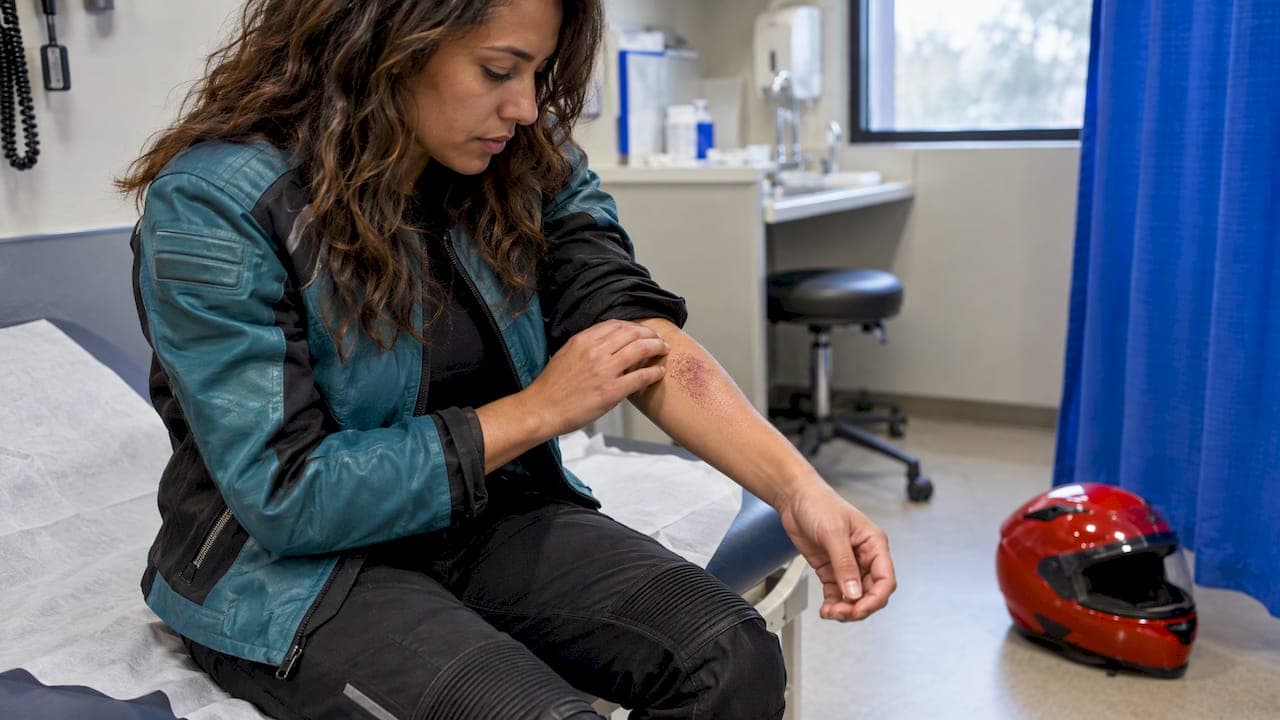
There is no standard dollar figure for a motorcycle road rash settlement. The value depends on how deep the wounds are, how much treatment you need, whether you are left with scars, how much work you miss, who was at fault and how much insurance is available. A shallow scrape that heals in days is a very different claim from a graft and months of recovery. This guide explains what moves the number, what evidence matters, and when it makes sense to have an attorney look at your case.
TL;DR
- No set amount exists for road rash. Severity, permanent scarring, medical costs, lost income, fault and insurance limits shape the value.
- Deeper burns heal slowly and scar more often, so the injury's depth and long-term effects carry the most weight.
- Your own share of fault can reduce a settlement, and in a few jurisdictions it can bar recovery entirely.
- Photos, medical records and wage records built early are the strongest support. Settling before you know how the scars will mature can cost you.
- You can request a free case evaluation to see whether your crash may support a claim.
Table of Contents
- What road rash is and why severity matters to a claim
- How long road rash takes to heal
- Can you get compensation for road rash?
- What a road rash settlement can cover
- What factors set the value of a road rash settlement
- How fault rules can cut a settlement
- Filing deadlines depend on your state
- Evidence that supports a road rash claim
- Why timing matters before you settle
- Our perspective: treat road rash as a long injury, not a scrape
- Get your case looked at for free
- What an attorney does in a road rash case
- FAQ
- Sources
What road rash is and why severity matters to a claim
Road rash is a friction burn. According to Cleveland Clinic, it happens when asphalt, cement or concrete rubs against your skin hard enough to damage it and generate heat. Severity depends mainly on how deep the burn goes and how much skin it covers.
Cleveland Clinic classifies road rash from superficial to full-thickness. Severe cases can reach muscle or bone. Complications include infection, scarring and traumatic tattooing, where dirt or debris becomes embedded in the skin.
That medical picture is the backbone of a claim. Insurers and attorneys read the same things from your records:
- Depth: superficial, partial-thickness or full-thickness.
- Surface area: a single patch versus an arm, hip and leg.
- Location: hands, face and joints cause more disruption to work and daily life.
- Treatment: cleaning, dressings, debridement, grafts, antibiotics, follow-up visits.
- Outcome: healed cleanly, or left with permanent marks or limited movement.
How long road rash takes to heal
Healing time matters because it sets how long your losses run. Cleveland Clinic says superficial road rash should heal within a couple of days, while deeper burns can take weeks or more. Deeper burns are also more likely to scar.
For a claim, the healing timeline shows how long you needed care, how long you missed work and whether the injury is still changing. A wound that looks closed at six weeks may still be maturing, and the scar you have at the end is not the scar you have in the first month.
Can you get compensation for road rash?
Generally, yes, when another party's negligence caused the crash and your injuries and losses are documented. Typical examples are a driver who turned left across your path, changed lanes without looking, or ran a light. A road hazard, a defective part or a negligent property owner can also be involved, depending on the facts.
Four questions decide whether recovery is realistic:
- Liability: can the other party's fault be shown?
- Comparative fault: did anything you did contribute to the crash?
- Insurance: is there enough coverage, from the at-fault driver or your own policy?
- Timing: are you inside your state's filing deadline?
Motorcycles raise a common objection: insurers sometimes argue that the rider took on the risk. That is a negotiating position, not a legal rule. What counts is who acted carelessly and what the evidence shows.
What a road rash settlement can cover
A settlement is built from categories of loss. Not every category applies to every case, but these are the ones to look for:
Economic damages
- Ambulance and emergency care
- Wound cleaning, debridement and skin grafts
- Prescriptions, including antibiotics and pain medication
- Follow-up visits, physical therapy and counseling
- Future care, such as scar revision procedures
- Lost wages and, if the injury limits your work, reduced earning capacity
- Repair or replacement of your motorcycle and damaged gear
Non-economic damages
- Pain and suffering
- Permanent scarring or disfigurement
- Emotional distress, including anxiety about riding again
- Loss of enjoyment of life
Long-term effects can go beyond the visible mark. Reported effects of serious road rash include pigmentation changes, numbness, limited joint movement, chronic pain or hypersensitivity, and difficulty returning to riding. If you have any of these, your doctor should record them. For a broader look at how these categories fit together, see our guide to motorcycle injury compensation categories and how motorcycle accident compensation works.
What factors set the value of a road rash settlement
You will see websites quote tidy ranges by degree of burn. Treat them as marketing, not a prediction. Settlements are negotiated case by case, and the same wound can be worth very different amounts depending on the facts below.
| Factor | Raises value | Lowers value |
|---|---|---|
| Burn depth | Full-thickness, grafts, surgery | Superficial, healed in days |
| Scarring | Permanent, visible, on face, hands or arms | Fades fully, hidden by clothing |
| Medical costs | Extended, documented treatment | Gaps in care, no records |
| Work impact | Missed weeks, lost income, reduced capacity | Minimal time off |
| Fault | Other driver fully responsible | You share blame |
| Insurance | High limits, or strong uninsured motorist coverage | Minimum limits |
| Evidence | Photos, records, witnesses, video | Little proof of how it happened |
Two items deserve a closer look.
Scarring and disfigurement
Permanent scarring is often the largest non-economic part of a road rash claim, and it is the part that is hardest to measure early. Scars change for months. A fair valuation looks at where the scar is, how visible it is, whether it limits movement and whether revision treatment is likely.
Insurance limits
A strong claim can still be capped by the coverage available. Major auto policy coverages include liability, medical payments, uninsured and underinsured motorist and physical damage, and no-fault where it applies, according to NAIC and ISO materials, which also cover motorcycles rated as private passenger vehicles. Check your own policy early. Your underinsured or uninsured motorist coverage may matter if the other driver carried little or no insurance.
How fault rules can cut a settlement
Most states reduce your recovery by your share of fault. Cornell Law School's Legal Information Institute explains that under pure comparative negligence, you can recover the portion of damages you did not cause. Modified systems add a bar at 50% or 51%, after which you recover nothing.
A few places follow a harsher rule. The same source identifies Alabama, Maryland, North Carolina, Virginia and the District of Columbia as recognizing contributory negligence, where any fault on your part can bar recovery.
A simple example of the math: if a jury would value your damages at $100,000 and finds you 20% at fault, a comparative system would reduce your recovery to $80,000. Insurers know this, and they look for any reason to assign you a share, such as speed, lane position or missing protective gear. If you want a deeper walk-through, read how 1% can cost you in comparative negligence claims and our piece on motorcycle gear and settlement examples.

Filing deadlines depend on your state
Every state sets a statute of limitations for personal injury lawsuits, and the period differs by state. Many fall in the range of a couple of years from the date of the crash, and exceptions exist, for example for minors or for claims against government bodies that may require much earlier notice. Because a missed deadline can end a claim no matter how strong it is, confirm your state's deadline with a licensed attorney in your state as soon as you can, and do not wait for your treatment to finish before asking.
Evidence that supports a road rash claim
Insurers tend to underestimate road rash because wounds look minor in a photo taken a day later. Your job is to show the whole course of the injury. Nolo's motorcycle accident guide says proving fault, injury and damages generally relies on witness testimony plus documents, photographs, video and other records.
Build this file as early as you can:
- Police report and the report number.
- Witness names and phone numbers.
- Scene photos: skid marks, road surface, debris, vehicle positions, traffic signals.
- Injury photos, taken repeatedly: at the scene, before dressing changes, weekly through healing, and again once scars form. Use the same lighting and add a coin or ruler for scale.
- Video: dashcam, helmet camera, or nearby business surveillance. Ask quickly, since footage is often overwritten.
- Medical records and bills that record wound depth, treatment, infection, pain and work restrictions.
- Wage records: pay stubs and a note from your employer on missed shifts.
- Damaged gear and the motorcycle: keep your jacket, gloves and helmet as they are and get repair estimates.
- A simple daily journal of pain, sleep, limits on dressing, driving or work, and what you cannot do.
Our guides on how accident photos help your case and a motorcycle accident legal rights checklist go through these steps in more detail.
Why timing matters before you settle
The first offer often arrives while you are still healing. It can be tempting, especially with bills piling up. The risk is that a signed release typically ends any later claim, so if a scar worsens or you need revision treatment afterward, you are generally on your own.
A more careful approach:
- Get ongoing treatment and follow your doctor's instructions without gaps.
- Ask your doctor whether you have reached maximum medical improvement, the point where your condition is stable enough to estimate lasting effects.
- Ask what future care, such as scar treatment, is likely and what it costs.
- Only then compare any offer to your total documented losses.
If you cannot wait because of finances, say so to an attorney. There may be ways to handle bills in the meantime, and that is a question for a licensed lawyer in your state.
Our perspective: treat road rash as a long injury, not a scrape
We built our service around a simple observation. People who have been hurt in a crash rarely know whether they have a claim, who to ask, or how to describe their injury in a way that fits their situation. Road rash is a good example. It sounds minor, and many riders downplay it until the scar or the nerve pain shows up months later.
So our advice is plain. Document early and keep documenting. Do not accept a quick number before your doctor can tell you what the healed injury looks like. And do not assume that a shared share of blame means you have no case, because fault rules differ widely by state and the details matter.
We are not a law firm, and we do not give legal advice or predict what your claim is worth. What we do is help you describe your injury and crash, then connect you with a vetted local attorney who can assess it under your state's law. It costs you nothing to ask.
— Gerard
Get your case looked at for free
If you were injured in a motorcycle, car, truck or bicycle crash, you can tell us what happened and what injuries you have, and we will match you with a local attorney who can review it. The evaluation is free and there is no obligation to go further. The intake is tailored to your type of injury, so details such as burns, scarring or emotional trauma are captured from the start.
Start your free evaluation and have the right questions answered about your road rash claim. If your crash involved a death in the family, see how motorcycle wrongful death and injury claims differ.
What an attorney does in a road rash case
A lawyer's role is practical. They gather the evidence you might not think to collect, communicate with insurers so you do not give statements that hurt you, estimate future medical needs, and negotiate from the full picture rather than the first bill. They also know your state's fault rules and deadlines. For a look at how this plays out, see how motorcycle accident lawyers win cases.
Questions to ask at a first meeting:
- Have you handled injury claims involving scarring or burns?
- What deadline applies to my case?
- How does my state treat shared fault?
- How are fees handled, and what costs could come out of a settlement?
- What evidence should I keep collecting?
FAQ
How much is a road rash settlement worth?
There is no set amount. Value depends on burn depth, treatment, permanent scarring, missed work, fault and available insurance. Ranges you see online are generalizations, so ask an attorney in your state to assess your actual records.
How long does serious road rash take to heal?
Superficial burns can heal within a couple of days, while deeper burns can take weeks or longer, according to Cleveland Clinic. Deeper wounds are more likely to scar. Your doctor can give you a timeline based on your wound.
Can I still make a claim if I was partly at fault?
Often yes, but your recovery may be reduced by your share of fault. A few jurisdictions bar recovery if you are even slightly at fault, and many others bar it past 50% or 51%. Your state's rule matters, so have it reviewed.
What should I do first after road rash from a crash?
Get medical care and follow it through. Then photograph the injury and the scene, collect witness details, keep your gear and save every bill. Avoid giving a recorded statement to the other side's insurer before you have advice.
Should I accept the first settlement offer?
Be cautious. A signed release usually ends later claims, and you may not yet know how your scars or nerve symptoms will turn out. Waiting until your doctor can describe your lasting condition gives you a stronger basis for a decision.
Sources
- Cleveland Clinic: Road Rash Treatment and Prevention
- Cornell Law School LII: Comparative negligence
- NAIC and ISO: automobile policy coverage materials
- Nolo: Motorcycle Accident Claims and Settlements