
Yes, your gear affects your settlement. Not always in the way insurers claim, but the effect is real and runs in two directions: comparative-fault arguments that can reduce your award, and recoverable property damage that most victims never claim. The good news is that neither direction automatically destroys a valid claim.
Here is the short version:
- Gear presence helps you. Documented, certified gear supports a responsible-rider narrative and can push non-economic damage multipliers higher.
- Gear absence gives insurers a lever. They will argue a percentage of your injuries resulted from your own failure to protect yourself. That argument only works if they can prove the missing item directly caused or worsened your specific injury.
- Damaged gear is compensable property. A destroyed helmet, jacket, or pair of boots has a dollar value you can demand back, separate from your medical damages.
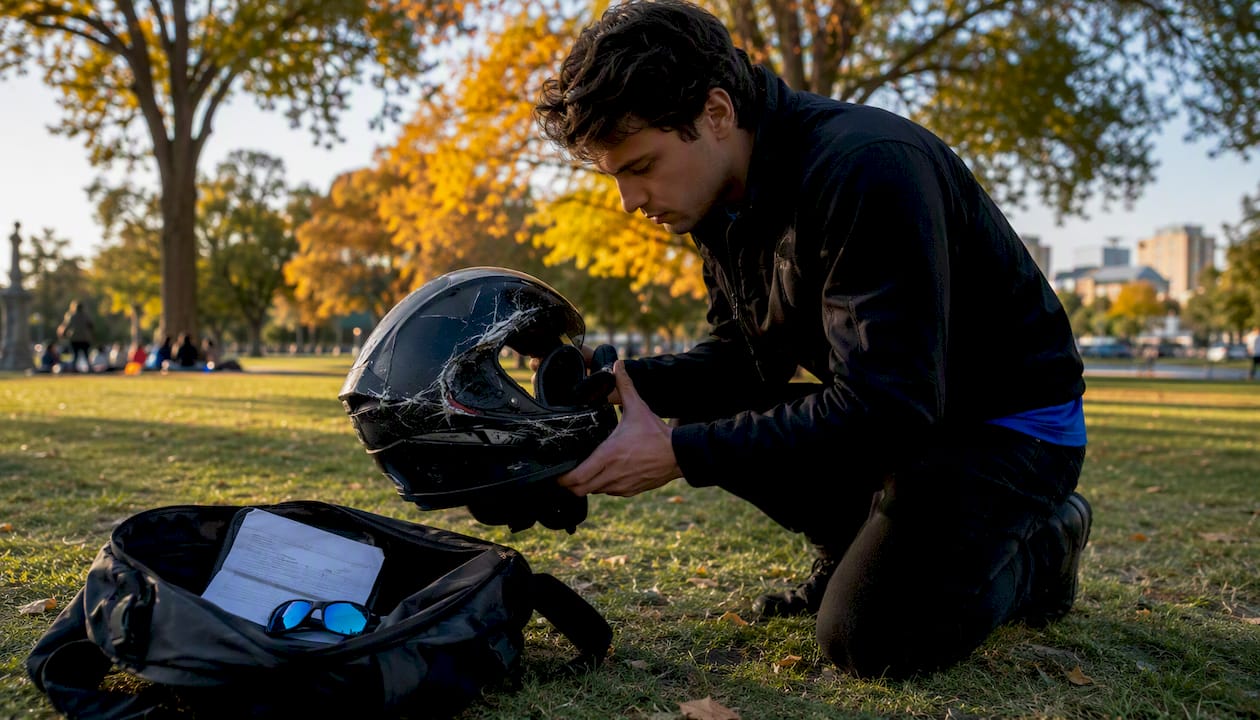
- Your first move: Photograph every piece of gear before anything is cleaned, repaired, or discarded. Then put it in a bag and leave it there.
The rest of this guide walks through the legal mechanics, state-law variables, concrete settlement math, and the evidence steps that separate a strong claim from a weak one.
Table of Contents
- How motorcycle gear shifts the legal mechanics of a claim
- Why the state you rode in determines how much gear matters
- Which pieces of gear matter most in a claim, and why
- How insurers use gear arguments to push down offers, and how to counter them
- Recovering the value of your damaged gear
- What to collect and preserve after a crash
- Settlement examples showing how gear changes the numbers
- Common myths about gear and claims, debunked
- How a motorcycle-accident attorney protects your settlement
- Key Takeaways
- What victims should actually expect when insurers argue about your gear
- Injured in a motorcycle crash? Here is how to get matched with an attorney
- Useful sources and further reading
How motorcycle gear shifts the legal mechanics of a claim
Two legal concepts drive most gear-related disputes: comparative negligence and causation.
Comparative negligence means that if you contributed to your own injuries, your damages award is reduced by your percentage of fault. Causation means the insurer must prove that your specific gear choice (or lack of one) directly produced or worsened the specific injury you are claiming. Both concepts sound simple. In practice, insurers often blur them to create leverage.
The credibility angle most victims miss
Wearing high-quality, certified gear does something beyond physical protection: it builds a responsible-rider narrative in front of adjusters, mediators, and juries. Presenting documented gear evidence counters the default assumption that motorcyclists are reckless, and that assumption is worth real money in non-economic damages. An adjuster who believes a jury will sympathize with a careful rider will settle higher.
How gear enters the damages calculation
Gear evidence touches three parts of a claim:
- Medical causation. If you wore a DOT-certified helmet and still suffered a concussion, the helmet evidence limits the insurer's argument that your head injury was self-inflicted by poor choices.
- Severity mitigation. An insurer may concede the crash caused injury but argue the severity was amplified by missing gear. Proving you wore appropriate protection cuts off that argument.
- Property damage. Destroyed gear is a separate line item in your demand, recoverable from the at-fault party's liability coverage.
What the insurer must actually prove
Insurers use comparative negligence to reduce settlement offers when a rider lacked safety gear, but they must show that missing gear directly worsened the specific injury. Raising a gear argument is not the same as winning it. To justify a percentage reduction, the adjuster must produce:
- A medical opinion connecting the absence of a specific item to the specific injury claimed
- Biomechanical or accident-reconstruction evidence showing the crash mechanics would have produced a different outcome with that item present
- Evidence that the item was legally required in the state where the crash occurred
Without those three elements, the gear argument is a negotiation tactic, not a legal bar to recovery.
Why the state you rode in determines how much gear matters
State law governs two variables that can swing a settlement significantly: helmet requirements and the comparative-fault system your case falls under.
Helmet law categories
- Universal helmet laws (California, New York, Washington, and 18 others) require all riders to wear a helmet regardless of age. In these states, riding without one creates a stronger comparative-fault argument for the insurer, particularly in head-injury cases. New York's Vehicle and Traffic Law § 381 mandates helmet use for all motorcycle operators and passengers.
- Partial helmet laws (Florida, Texas, Michigan, and others) require helmets only for riders under a certain age or without sufficient insurance coverage. Florida Statute § 316.211 exempts riders 21 and older who carry at least $10,000 in medical benefits coverage. In these states, an adult riding without a helmet has not violated the law, which weakens the insurer's comparative-fault argument considerably.
- No helmet requirement states (Illinois, Iowa, New Hampshire) impose no universal helmet mandate. In these states, the insurer's gear argument for head injuries is the weakest it can be.
Comparative-fault systems and what they mean for your recovery
| Fault System | States (examples) | Effect on a gear-fault finding |
|---|---|---|
| Pure comparative negligence | California, New York, Florida | You recover 80% of damages — no bar to recovery |
| Modified (51% bar) | Texas, Georgia, Colorado | You recover 80% — barred only if your fault exceeds 50% |
| Modified (50% bar) | Arkansas, Utah, Maine | You recover 80% — barred if your fault equals or exceeds 50% |
| Contributory negligence | Alabama, Maryland, Virginia, D.C. | Any fault can bar recovery entirely |
Florida's comparative-fault statute § 768.81 moved the state to a modified comparative negligence system in 2023, barring recovery when a plaintiff's fault exceeds 50%. That change matters for gear arguments: a strong insurer case that a rider was 51% responsible for their own injuries now eliminates recovery in Florida, where it previously would not have.
In contributory-negligence states, the stakes are highest. A finding that you contributed even slightly to your injuries through a gear choice can theoretically bar your entire claim. An attorney familiar with local venue tendencies is essential in those states.
Which pieces of gear matter most in a claim, and why
The legal relevance of any gear item depends on whether it plausibly prevents or reduces the specific injury you suffered. Crash-type biomechanics connect impact mechanics to expected injuries, which is exactly the framework an expert witness will use.
| Gear Item | Injuries commonly mitigated | Litigation frequency |
|---|---|---|
| Helmet (DOT/ECE certified) | TBI, skull fracture, facial lacerations | Highest — litigated in nearly every head-injury case |
| Armored jacket | Clavicle/rib fractures, road rash, shoulder injuries | High — especially in highside and collision crashes |
| Riding pants with armor | Hip fractures, knee injuries, thigh abrasions | Moderate |
| Gloves | Hand fractures, metacarpal injuries, road rash | Moderate |
| Riding boots | Ankle fractures, foot crush injuries, lower-leg abrasions | Moderate to high |
| Eye protection | Corneal injuries, vision impairment | Lower, but relevant in open-face helmet cases |
The insurer's causation burden is item-specific. If you suffered a broken ankle and were not wearing riding boots, that is a legitimate gear argument. If you suffered a broken collarbone and were not wearing boots, the boot argument is irrelevant to that injury.
Helmet certification as an evidentiary battleground
The ECE 22.06 standard introduced mandatory rotational-impact testing and has become a new front in 2026 settlement disputes. Adjusters now reference the availability of ECE 22.06-certified helmets to argue that a rider wearing only a DOT-certified helmet chose a less protective option, even when DOT certification satisfies the legal requirement. Plaintiff attorneys counter by showing the helmet met all applicable legal standards at the time of purchase.
Pro Tip: Photograph your helmet's certification label (DOT, ECE, or SNELL sticker) immediately after a crash, before the helmet is moved or handled. That label is evidence.
How insurers use gear arguments to push down offers, and how to counter them
Adjusters use the missing-gear argument primarily as a negotiation lever. The goal is to create doubt early, before you have medical records or expert opinions that close off their arguments. Knowing the playbook in advance takes away most of its power.
Common adjuster tactics
- Early percentage assertions. The first offer arrives with a stated reduction ("we've applied a 25% comparative-fault reduction for failure to wear a helmet") before any medical causation analysis exists.
- Bad-character framing. Language in correspondence that characterizes the rider as reckless or irresponsible, designed to lower non-economic damage expectations.
- IME requests focused on gear. An independent medical examination ordered by the insurer, with questions specifically designed to elicit opinions that missing gear worsened the injury.
- Lowball property-damage offers. Offering actual cash value for destroyed gear when replacement cost is the appropriate measure under the at-fault party's liability coverage.
The attorney's counter-checklist
Experienced attorneys focus on medical causation to rebut insurer claims that gear absence increased injury severity. Here is the sequence:
- Demand the specific medical opinion the insurer is relying on to justify the percentage reduction.
- Obtain an independent biomechanical expert opinion on whether the missing gear would have changed the injury outcome in this specific crash mechanism.
- Commission accident reconstruction to establish the exact impact forces and angles.
- Retain a helmet or gear forensic expert if the insurer is attacking certification.
- Build the responsible-rider narrative through gear receipts, pre-crash photos, and riding-course certifications.
Pro Tip: Before any IME, ask your attorney to prepare you for gear-specific questions. The examiner will ask what you were wearing, why, and whether you knew about safer options. Your answers become part of the insurer's causation argument.
Recovering the value of your damaged gear
Most victims focus entirely on medical damages and leave gear compensation on the table. Damaged motorcycle gear is compensable property, and the difference between a well-documented claim and a poorly documented one can easily reach $2,000–$5,000 for a single set of quality riding gear.
Replacement cost vs. actual cash value
The distinction matters and depends on which coverage is paying:
- Third-party liability (the at-fault driver's insurer): you are generally entitled to replacement cost, meaning what it costs to buy equivalent gear today, not what your five-year-old jacket was worth before the crash.
- First-party coverage (your own policy): the policy language controls. Many policies pay actual cash value (replacement cost minus depreciation), which can be significantly lower for older gear.
What you need to document
- Original purchase receipts or order confirmations
- Pre-crash photos showing the gear's condition
- Post-crash photos of all damage, taken before any cleaning
- The physical items themselves (do not discard anything)
- Repair estimates from a gear retailer if partial repair is possible
- A professional appraisal for high-end gear (a $900 helmet or a $600 jacket warrants one)
Submitting the property-damage demand
- List every damaged item with purchase price, purchase date, and current replacement cost.
- Attach receipts and photos to the demand letter.
- For items without receipts, provide manufacturer suggested retail price from the current product listing.
- If the insurer offers ACV on a third-party claim, push back in writing citing the at-fault party's obligation to make you whole.
Original receipts and pre-crash photos frequently shift insurer offers from ACV to replacement cost when documented properly. That shift is worth pursuing.
What to collect and preserve after a crash
Speed matters here. Evidence degrades, memories fade, and gear that gets washed or repaired loses its evidentiary value. The motorcycle accident legal rights checklist covers the full scope, but the gear-specific priorities are below.
At the scene
- Photograph every piece of gear you were wearing, from multiple angles, before removing it.
- Photograph the motorcycle, the other vehicle, road marks, and the final positions of everything involved.
- Get witness names and contact information.
- Note road conditions, lighting, and any signage.
Gear preservation steps
- Remove gear carefully and place each item in a separate bag without washing or cleaning.
- Label each bag with the date, crash location, and item description.
- Store items in a dry location away from sunlight.
- Do not authorize any repair until your attorney has documented the damage.
- If a severe brain injury is involved, request a forensic helmet inspection before the helmet is handled further.
Pro Tip: Take a short video walking around the crash scene and narrating what you see. Video captures context that still photos miss, including the angle of impact and road surface conditions.
Medical documentation
Timely treatment is the single most important step for linking injuries to the crash. A gap in treatment gives the insurer room to argue your injuries were pre-existing or unrelated. Ask your treating physician to document:
- The mechanism of injury (how the crash produced each specific injury)
- Whether protective gear was present and its apparent condition
- Whether the injury severity would likely have differed with different gear
Administrative items
- Photograph your motorcycle accident scene thoroughly and preserve any dashcam or helmet-cam footage before it overwrites.
- Obtain the police report and flag any errors in the gear description.
- Preserve helmet certification labels (DOT, ECE stickers).
- File insurance notices within the required timeframes.
Settlement examples showing how gear changes the numbers
The following scenarios use settlement ranges from Fair Settlement's motorcycle accident data as benchmarks: minor injuries typically settle in the $25,000–$80,000 range, moderate injuries in the $80,000–$250,000 range, and catastrophic cases at $1 million or more. These are illustrative models, not guarantees.
| Scenario | Base damages | Gear status | Insurer's fault argument | Adjusted recovery |
|---|---|---|---|---|
| Minor road rash, no fractures | — | Full gear, documented | None viable | — |
| Broken collarbone, moderate | — | No jacket, no gloves | 15% comparative fault | — |
| TBI, universal helmet state | — | No helmet | 25% comparative fault | — |
| Catastrophic spinal injury | — | Full gear, documented | Minimal gear argument | — |
Worked calculation: moderate TBI in a partial-helmet state

A rider in Florida (partial helmet law, pure comparative negligence) suffers a moderate TBI. The at-fault driver ran a red light. Base economic damages: $180,000 in medical bills plus $40,000 in lost wages, totaling $220,000. A pain-and-suffering multiplier of 2.5x produces $550,000 in total claimed damages.
The rider was 23 years old and legally exempt from Florida's helmet requirement. The insurer still argues 15% comparative fault for not wearing a helmet.
- Total claimed damages: $550,000
- Insurer's proposed fault reduction (15%): $82,500
- Adjusted offer without attorney pushback: $467,500
- Attorney demands medical causation proof. Insurer cannot produce a biomechanical opinion connecting helmet absence to the specific TBI pattern in this crash. Fault argument drops to 5%.
- Revised reduction (5%): $27,500
- Final negotiated settlement: $522,500
- Plus gear property damage (helmet, jacket, boots): $1,800
- Total recovery: $524,300
The attorney's challenge to the causation argument recovered $55,000 that the initial offer would have left behind.
The ECE 22.06 standard's rotational-impact testing has introduced a new wrinkle in 2026: insurers now argue that a rider wearing only a DOT-certified helmet chose a less protective option when ECE 22.06-certified helmets were available. Plaintiff attorneys counter by showing the helmet met all legal requirements and that no statute mandated ECE certification.
Common myths about gear and claims, debunked
Myth: "No helmet means no recovery"
Fact: Fault for causing the crash remains the central issue. If the other driver ran a stop sign and hit you, their liability does not disappear because you were not wearing a helmet. An insurer cannot simply deny a valid claim solely because a rider lacked protective gear. Courts require causation evidence to assign damages reductions, and denying a valid claim on gear grounds alone risks bad-faith exposure.
Myth: "Wearing gear guarantees a higher settlement"
Fact: Gear helps, but high-value settlements are driven by objective medical damages. An attorney's primary work is linking injuries to the defendant's negligence. Gear evidence supports that narrative; it does not replace it.
Myth: "If I broke the law by not wearing gear, I can't win"
Fact: The better question is causation, not legality. Attorneys force insurers to prove that the missing gear directly worsened the claimed injury. A rider without a helmet who suffered only a broken leg has a strong argument that the helmet was irrelevant to that specific injury.
When gear absence genuinely matters
- TBI in a universal helmet state, with a medical opinion connecting the injury severity to the absence of a helmet
- Lower-extremity crush injuries where riding boots were absent and the treating physician notes the boots would likely have reduced severity
- A documented insurer argument supported by an independent biomechanical expert, not just an adjuster's assertion
When gear is irrelevant: a spinal cord injury from a rear-end collision at a stoplight is not meaningfully affected by whether the rider wore gloves. The insurer's gear argument there is noise.
How a motorcycle-accident attorney protects your settlement
The practical work an attorney does on gear-related claims goes well beyond paperwork. Understanding how motorcycle accident lawyers win cases in 2026 means understanding how they neutralize the specific tactics described above.
What an attorney actually does
- Preserves and subpoenas evidence before it is lost or overwritten (dashcam footage, surveillance video, police body-cam).
- Retains biomechanical and helmet-forensic experts to challenge causation arguments.
- Connects treating physicians to the crash mechanics through structured medical-legal letters.
- Handles all insurer communications to prevent off-the-cuff statements about gear from becoming admissions.
- Builds a trial-ready posture that signals to the insurer that the gear argument will be contested in court if necessary.
A trial-ready posture matters because insurers settle higher when they believe a jury will hear the case. An attorney who has retained experts and completed discovery is not bluffing.
When to call
- Immediately after any crash involving serious injury, before speaking to the insurer about gear.
- When the insurer's first offer includes a stated gear-based reduction.
- Before signing any release or accepting any settlement.
- When the insurer disputes your gear's replacement value.
Most motorcycle accident attorneys work on contingency, meaning no upfront cost. A free case evaluation tells you quickly whether the gear arguments in your case are strong or weak, and what a realistic recovery looks like.
Key Takeaways
Gear presence or absence changes settlement math in two concrete ways: comparative-fault reductions and recoverable property damage, but insurers must prove direct causation to justify any reduction.
| Point | Details |
|---|---|
| Gear affects two claim paths | Comparative-fault arguments and property-damage recovery are both in play; document both from day one. |
| Causation is the insurer's burden | The insurer must prove missing gear directly worsened your specific injury, not just that you lacked protection. |
| State law sets the stakes | Universal helmet states and contributory-negligence states give insurers the strongest gear arguments; know your state's rules. |
| Documentation drives recovery | Receipts, pre-crash photos, and retained gear items shift property-damage offers from ACV to replacement cost. |
| Carcollisionlawyer connects you to counsel | A free case evaluation matches you with an attorney who can challenge gear-based reductions and maximize your recovery. |
What victims should actually expect when insurers argue about your gear
When an insurer first mentions your gear in a settlement letter, the instinct is to panic. That reaction is understandable and also exactly what the adjuster is counting on. The gear argument is designed to arrive early, before you have medical records, expert opinions, or legal counsel, because that is when it is most effective as a pressure tool.
Here is what the process actually looks like. The initial offer comes in low, with a percentage reduction attached to a gear argument stated as fact. Your attorney responds by demanding the medical and biomechanical evidence behind that percentage. In most cases, the insurer cannot produce a credible causation opinion, and the percentage drops or disappears in the next round of negotiation. That exchange takes weeks, sometimes months, and it requires patience.
The timeline for a moderately complex motorcycle claim with gear disputes can extend over several months from crash to settlement. Expert reports take time. Medical treatment needs to reach maximum medical improvement before damages are fully calculable. Insurers use that timeline strategically, making low offers early when victims are financially pressured.
What protects you during that period is documentation you collected in the first 48 hours and an attorney who has signaled a trial-ready posture. The insurer's gear argument loses most of its leverage the moment a biomechanical expert is retained and a causation demand letter goes out. After that, the negotiation is about numbers, not about whether you deserve to recover.
Injured in a motorcycle crash? Here is how to get matched with an attorney
The difference between a gear-related settlement that gets picked apart by an insurer and one that holds up comes down to one thing: having an attorney who has handled these arguments before and knows how to close them off with medical and biomechanical evidence.
Carcollisionlawyer connects injured riders with vetted attorneys who handle exactly this kind of case, including the gear-causation disputes, the ECE 22.06 certification arguments, and the property-damage valuation fights that most victims do not know to pursue. The process starts with a free case evaluation: you describe your crash, your injuries, and your gear situation, and the service matches you with counsel experienced in motorcycle claims in your state.
There is no cost to submit, no obligation after the evaluation, and no guessing about whether your gear situation matters legally. Request your free case evaluation and find out what your claim is actually worth before you accept anything from an insurer.
Have your crash date, state, injury description, and any gear documentation ready when you submit. The evaluation is faster and more useful when those details are on hand.
Useful sources and further reading
The claims and legal frameworks in this article draw from the following sources. Each is linked for direct reference.
- NHTSA: Choose the Right Motorcycle Helmet — Federal guidance on helmet standards, DOT certification requirements, and selection criteria.
- New York Vehicle and Traffic Law § 381 — Universal helmet requirement for New York motorcycle operators and passengers.
- Florida Statute § 316.211 — Florida's partial helmet law, including the age and insurance exemptions.
- Florida Statute § 768.81 — Florida's modified comparative-fault statute, including the 51% bar to recovery.
- PMC: A review of common motorcycle collision mechanisms of injury — Peer-reviewed analysis of crash types (lowside, highside, collision) and their injury patterns; foundational for causation arguments.
- Fair Settlement: Average motorcycle accident settlement amounts — Settlement range benchmarks for minor, moderate, and catastrophic motorcycle injury cases.
- ECE 22.06 Helmet Safety Standard: Settlement impact and liability strategy — Analysis of how ECE 22.06 rotational-impact testing affects comparative-fault arguments in 2026 claims.
- Adley Law Firm: Will insurance pay for damaged riding gear? — Practical explanation of replacement cost vs. ACV for gear claims and documentation requirements.
- Justice Finder: Motorcycle accident insurance claims — Evidence preservation guidance and the responsible-rider narrative strategy.
- Carcollisionlawyer: How motorcycle accident compensation works in 2026 — Overview of compensation categories, policy interactions, and 2026-specific legal developments.
This article provides general legal information, not legal advice. Laws vary by state and change over time. Confirm the rules that apply to your specific situation with a licensed attorney in your jurisdiction.