
Punitive damages in a car accident case are the exception, not the rule. Courts reserve them for conduct that goes far past ordinary carelessness, such as drunk driving, street racing, or intentional collisions. If your crash involved routine negligence, like a driver who ran a light or misjudged a lane change, you're almost certainly looking at compensatory damages only. Punitive damages come from a court, never an insurance adjuster, and they demand a heavier burden of proof.
TL;DR:
- Punitive damages are awarded only in cases involving gross negligence, recklessness, or intentional misconduct, and are very rare in routine car accident claims.
- Most punitive damage cases require clear and convincing evidence, which raises the proof burden compared to standard negligence claims.
- States vary widely in their punitive damages laws, often capping awards or requiring specific conduct predicates, making such damages unlikely in most cases.
- Evidence needed for punitive claims includes BAC results, vehicle data, surveillance footage, and witness statements, which must be preserved quickly to be admissible.
- Winning a punitive damage award does not guarantee collection due to insurance exclusions and potential taxation, so evaluating defendant assets early is crucial.
Table of Contents
- What Are Punitive Damages, and How Do They Differ from Compensatory Damages?
- When Are Punitive Damages Available? State Variation and How Rare They Really Are
- Burden and Standard of Proof for Punitive Damages
- Common Fact Patterns That Support a Punitive Damages Claim
- How Courts Calculate Punitive Damages: Proportionality, Caps, and the State Farm Rule
- How to Pursue Punitive Damages: Pleading, Trial Procedure, and Evidence Preservation
- What Happens After a Punitive Award: Insurance, Collection, and Taxes
- Get a Free Evaluation Before You Decide How to Proceed
- Where to Verify These Rules Yourself
- Sources
What Are Punitive Damages, and How Do They Differ from Compensatory Damages?
Punitive damages exist to punish the wrongdoer and deter similar conduct in the future. They aren't about making you whole again. That job belongs to compensatory damages, which cover the concrete losses you can point to and the harder-to-quantify ones tied to pain and suffering.
Courts generally sort damages into three buckets:
- Economic compensatory damages: medical bills, lost wages, property repair costs, future care expenses.
- Non-economic compensatory damages: pain and suffering, emotional distress, loss of enjoyment of life.
- Punitive damages: additional money awarded on top of compensatory damages, aimed squarely at punishment rather than reimbursement.
Some states call these "exemplary damages" instead, but the legal function stays the same across jurisdictions. Punitive damages are awarded in addition to compensatory damages and are never a substitute for them. No underlying compensatory loss means no punitive damages either.
When Are Punitive Damages Available? State Variation and How Rare They Really Are
Ordinary negligence, even careless negligence, doesn't clear the bar for punitive damages. You need conduct that rises to gross negligence, recklessness, willful and wanton disregard for safety, or outright malice. A driver distracted by a text message is negligent. A driver who's been drinking heavily, gets behind the wheel anyway, and plows through a crosswalk is behaving with the kind of disregard that opens the door to punitive exposure.
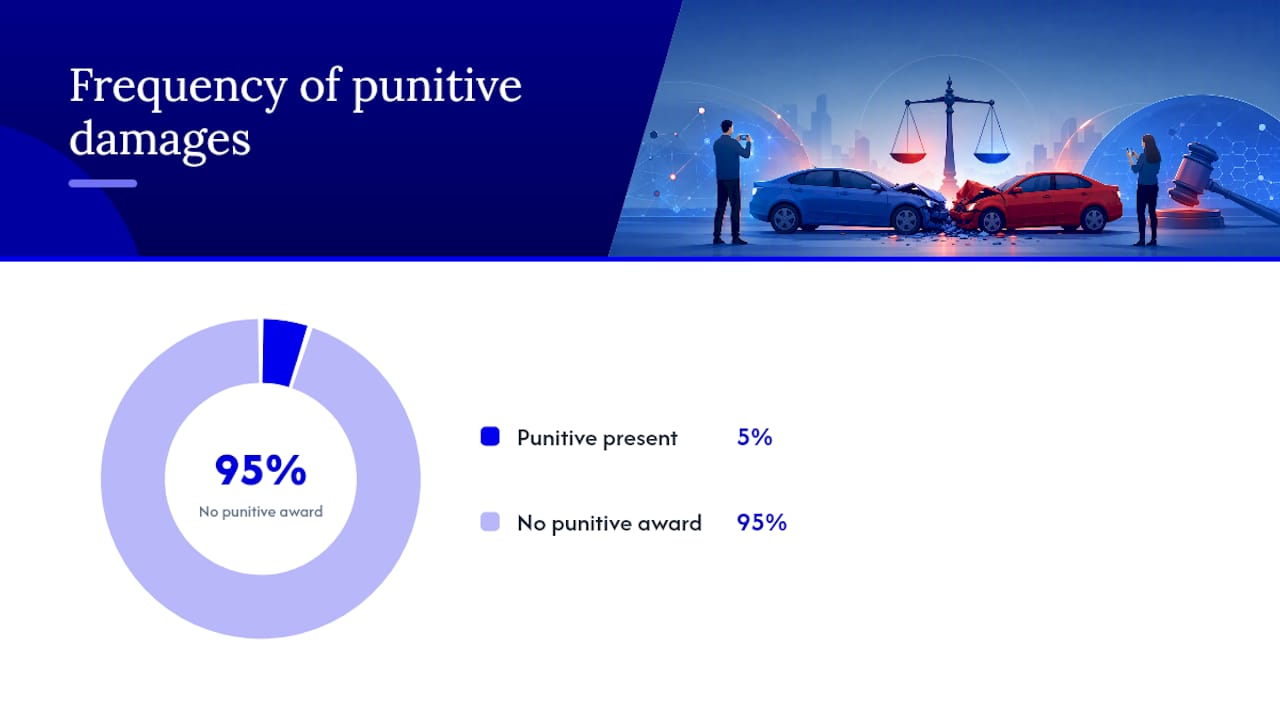
State law shapes that door width considerably. Some states cap punitive awards at a fixed dollar amount or a multiple of compensatory damages. Others require the plaintiff to show a statutory predicate, meaning specific conduct spelled out in a state code, before punitive damages can even be pleaded. A handful of states bar punitive damages in wrongful death cases outright, while others fold punitive exposure into broader tort reform statutes that cap all non-economic and punitive recovery combined.
However your state defines the threshold, the numbers tell the real story:
- Punitive damages show up in roughly 5% of civil verdicts nationwide.
- Punitive damages must be tethered to an underlying compensatory award. No liability finding, no punitive claim.
- Most car accident lawsuits, even ones involving serious injury, resolve on compensatory damages alone.
It's a reason to get an honest read on your facts before you build your case strategy around a punitive claim that may never materialize.
Burden and Standard of Proof for Punitive Damages
Ordinary negligence claims run on the "preponderance of the evidence" standard: more likely than not, roughly a 51% threshold. Punitive damages usually demand something tougher, often "clear and convincing evidence," a standard that sits well above a mere tip of the scales.
That higher bar changes how a case gets built from day one. Your attorney can't rely on inference or a plausible narrative. They need documented, verifiable proof of the defendant's state of mind and conduct, not just proof that the defendant caused the crash. Legal analysts note that this elevated standard significantly raises the evidentiary burden and complicates litigation strategy accordingly.
Several states add procedural friction on top of the evidentiary one. Some require you to file a motion and get a judge's permission before you can even plead punitive damages in your complaint, forcing you to show early on that you have a reasonable likelihood of proving egregious conduct. Skip that step where it's required, and a punitive claim gets struck before a jury ever hears it.
Common Fact Patterns That Support a Punitive Damages Claim
Certain fact patterns show up again and again in cases where punitive damages actually stick. None of these guarantee an award, but they're the scenarios worth flagging to an attorney immediately.
- Drunk or drug-impaired driving. A blood alcohol content reading well above the legal limit, or a toxicology report showing illegal drug use, gives a jury concrete proof of reckless disregard. Criminal charges and BAC records from the responding police agency often become central exhibits.
- Street racing, road rage, and intentional collisions. A driver who deliberately rams another vehicle, engages in a high-speed race on public roads, or weaponizes a car during a road rage incident has moved from careless to intentional.
- Fleeing law enforcement. A driver who causes a crash while attempting to evade police adds a layer of willful disregard that supports punitive exposure.
- Known mechanical defects or repeated violations. A commercial driver or fleet operator who kept a vehicle on the road despite documented brake failures, or a driver with a long history of reckless citations, can show a pattern of disregard rather than a single lapse.
How Courts Calculate Punitive Damages: Proportionality, Caps, and the State Farm Rule
Judges and juries weigh several factors when they set a punitive number: how reprehensible the conduct was, the size of the compensatory award already granted, the defendant's financial resources, and the likelihood that similar harm could happen again. Wealthier defendants sometimes face larger punitive figures precisely because a small dollar amount wouldn't sting enough to deter them.
The U.S. Supreme Court drew the sharpest line on proportionality in State Farm Mutual Automobile Insurance Co. v. Campbell. That decision directs courts to focus on the reprehensibility of the conduct and to keep punitive awards proportionate to the compensatory damages already awarded, and it's why many courts now hesitate to approve punitive-to-compensatory ratios above roughly four to one. A single-digit ratio has become the practical ceiling in most jurisdictions, though egregious conduct paired with a low compensatory award can sometimes push higher.
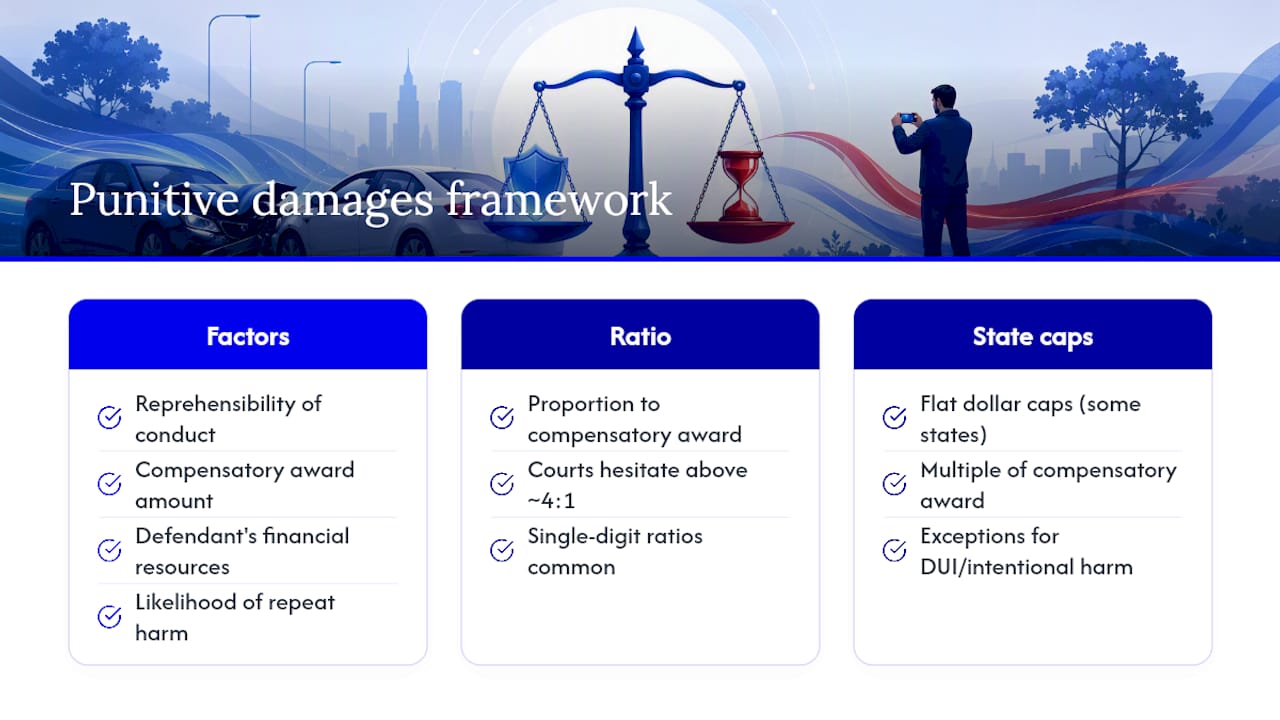
State statutory caps add another layer on top of that. Some states cap punitive damages at a flat dollar figure, others at a multiple of compensatory damages, and a few carve out exceptions for cases involving drunk driving or intentional harm. The variation is wide enough that checking your specific state's statute, or asking an attorney to check it for you, matters more than any general rule of thumb.
How to Pursue Punitive Damages: Pleading, Trial Procedure, and Evidence Preservation
Punitive damages only become available once you file a lawsuit and win a favorable verdict at trial. You cannot request or obtain punitive damages through a standard insurance claim, no matter how egregious the defendant's conduct was. That single fact catches a lot of accident victims off guard, especially when an adjuster's early settlement offer looks tempting.
Once suit is filed, some states require specific pleading language for punitive damages, and a few require court permission before that claim can even appear in your complaint. Many courts also bifurcate the trial, meaning the jury first decides liability and compensatory damages, then hears a separate phase focused only on punitive conduct and amount. That structure keeps evidence of the defendant's wealth or past misconduct from contaminating the jury's compensatory decision.
Evidence preservation is where cases are won or lost, and much of it disappears fast if nobody moves quickly:
- BAC and toxicology results from the scene or hospital.
- Event data recorder (EDR) downloads from the vehicle's black box, which capture speed, braking, and steering inputs in the seconds before impact.
- Dashcam footage, nearby business surveillance, and traffic camera video.
- Phone records and rideshare or navigation app data showing distraction or intoxication.
- Vehicle maintenance and inspection records, especially for commercial defendants.
- The at-fault driver's prior citations or violation history.
- Witness statements taken close to the incident, before memories fade.
Pro Tip: Event data recorders often overwrite themselves within days if the vehicle keeps running. Get a preservation letter to the defendant, insurer, or fleet operator immediately, before that data gets erased.
What Happens After a Punitive Award: Insurance, Collection, and Taxes
Winning a punitive award doesn't guarantee you'll collect it in full. Many auto liability policies specifically exclude punitive damages from coverage, and several states go further by prohibiting insurers from paying punitive awards at all, on the theory that letting insurance absorb the penalty defeats its deterrent purpose. That leaves you pursuing the defendant's personal assets directly, which is exactly why attorneys investigate a defendant's financial position early rather than after a verdict comes down.
Tax treatment adds another wrinkle most people don't see coming. Punitive damages are commonly treated as taxable income under federal tax rules, unlike most compensatory damages tied to physical injury. Talk to a tax professional before you count on a punitive award as untaxed money, and factor that into any settlement negotiation where a defendant's attorney raises the specter of a drawn-out punitive fight to push for a lower, faster compensatory-only resolution.
Get a Free Evaluation Before You Decide How to Proceed
Figuring out whether your crash involves the kind of conduct that supports a punitive damages claim isn't something you should guess at from a search engine. A free case evaluation can help determine whether your accident shows signs of gross negligence, intoxication, or intentional conduct, or fits the ordinary negligence pattern that most crashes follow.
The intake process asks targeted questions about how the crash happened, what evidence exists, and what injuries resulted, then routes serious punitive-facts cases differently than routine claims. If your answers point toward a viable punitive damages angle, Carcollisionlawyer connects you with a vetted local personal injury attorney who can act fast on evidence preservation, particularly the perishable kind like event data recorder downloads and toxicology reports.
Start your free case evaluation today and find out where your case actually stands. For litigation strategy beyond the initial evaluation, resources like Houston civil litigation counsel can also speak to how bifurcated trials and evidentiary hurdles play out in practice.
Where to Verify These Rules Yourself
Cornell's Legal Information Institute maintains a plain-language entry on punitive damages that's worth bookmarking. Nolo's car-accident-specific breakdown walks through the pleading and insurance issues in more detail, and the IRS page on taxable income covers how punitive awards get treated at tax time. Check your own state's statute before assuming any of the general rules above apply to your case without modification.
This article is general information, not a substitute for advice from a qualified lawyer. Consult a qualified legal professional about your own circumstances before acting on anything here.
Sources
- Punitive damages | Wex | US Law | LII / Legal Information Institute
- State Farm v. Campbell discussion (NYU faculty chapter)
- What is taxable and nontaxable income? (IRS)
- What Are Punitive Damages? Purpose, Cap, Calculation, and Example (Investopedia)