
A policy limits settlement happens when an insurer pays out the full available liability coverage called a tender to close a claim. It buys speed and certainty, but if your damages exceed that cap, you could walk away with less than you deserve. When an insurer refuses a reasonable within-limits demand, that refusal can expose it to a bad-faith claim in many states.
TL;DR:
- A policy limits settlement involves an insurer paying the maximum coverage amount to close a claim, which can leave claimants short if damages exceed that cap.
- Insurers tend to tender limits when liability is clear, injuries are severe, or multiple claimants threaten to exhaust the policy, aiming to avoid excess verdicts and bad-faith claims.
- Claimants must verify the actual policy limit, explore other available coverage, and wait until medical treatment stabilizes before submitting a demand letter with full documentation.
- Refusing a reasonable, well-documented demand within limits can expose insurers to liability for damages beyond the policy, including excess judgments and bad-faith claims.
- Claimants should investigate additional recovery sources like uninsured/underinsured coverage, excess policies, or other liable parties before accepting a policy limits tender.
Table of Contents
- What a Policy Limits Settlement Means for Your Case
- When and Why Insurers Tender Policy Limits
- How to Write a Demand That Actually Gets Paid
- What Happens When an Insurer Refuses a Reasonable Demand
- When Damages Exceed the Policy: Where Else to Look
- How Much of a Policy Limits Settlement You Actually Keep
- Court Rulings That Shaped How Insurers Handle Limits
- Does Accepting Policy Limits Affect Your Future Rights?
- Can Mediation Resolve a Policy Limits Dispute?
- Auto, Homeowners, and Commercial Policies Handle Limits Differently
- When We'd Take the Tender and When We'd Push Harder
- Get a Free Evaluation Before You Sign Anything
- Where to Verify State Rules and Deadlines
- Sources
- FAQ
What a Policy Limits Settlement Means for Your Case
Tendering policy limits means the insurer puts its entire coverage amount on the table to end the claim. Once you accept, you typically sign a release that closes the door on suing the insured driver over the same crash, even if your medical bills keep climbing. That's the trade: certainty now, in exchange for giving up the right to chase more from that particular policy or person later.
The adjuster tenders the money on behalf of the insured. The claimant, or their attorney, signs the release once funds are confirmed. According to legal explainers on tendering, accepting a tender usually requires a release that prevents further claims against the insured, which is why timing and sequencing matter so much.
Before signing anything, claimants need to nail down a few things:
- Confirm the policy limit is genuinely the ceiling, not just what the adjuster claims it is.
- Check whether other coverage layers exist (umbrella, excess, employer policies) before releasing the insured.
- Get medical treatment far enough along to know the real cost of your injury, not just the current bill.
- Understand that once you sign, the insured is protected from further exposure on this claim.
Sign too fast, and you might release rights to money that was sitting one phone call away.
When and Why Insurers Tender Policy Limits
Insurers don't hand over full policy limits out of generosity. They do it to protect themselves from a bigger bill down the line. A few patterns show up again and again.
- Liability is clear and injuries are severe. When fault isn't in dispute and the injuries are catastrophic or permanent, insurers know a jury verdict could dwarf the policy limit, so tendering early limits their downside; understanding memory, personality, and emotional changes after a car crash highlights the severe impacts insurers aim to mitigate.
- The policy carries state-minimum coverage. Many states set minimum liability limits that may be relatively low compared to serious injury costs. When damages clearly outstrip those numbers, insurers often tender fast rather than fight over a fraction of the real exposure.
- Multiple claimants are competing for one pool of money. A crash with several injured parties creates aggregate exposure that can exhaust the policy quickly, pushing insurers toward early resolution before costs balloon.
- The insurer wants to avoid an excess verdict. Insurers are primarily motivated to tender limits to avoid an excess verdict and the separate exposure of bad-faith liability, especially when the claimant's damages and documentation are already locked in.
Coverage size matters here too. For a broader look at how settlement amounts move with case specifics, see this breakdown of factors that affect settlement size.
How to Write a Demand That Actually Gets Paid
A policy limits demand letter only works if it reads as reasonable, not as a trap. Insurers and courts both scrutinize whether the demand gave the insurer a fair shot to pay before litigation started.
A solid demand typically includes:
- A clear label stating this is a policy limits or time-limited demand, not a routine settlement offer.
- A firm deadline for response, long enough to allow real investigation.
- A concise summary of the facts and liability evidence, including police reports or witness statements.
- Complete medical records and itemized bills covering the full treatment history.
- Proof of wage loss, if applicable, with documentation rather than estimates.
Timing matters as much as content. Send the demand too early, before medical treatment has stabilized or before records are complete, and it can look like a setup rather than a genuine offer to settle. A policy limits demand must include full documentation of damages and a clear deadline; demands sent too early risk being treated as setup letters, which can undercut a later bad-faith argument instead of strengthening it.
California illustrates how specific these rules can get. CCP § 999 requires at least 30 days, or 33 if mailed, for a time-limited demand, along with substantial supporting evidence. Other states have their own versions of this timing rule, so check the statute that governs your case before setting a deadline.
Pro Tip: Send your demand only after your treating doctor confirms you've reached maximum medical improvement, or at least has a solid prognosis. A demand anchored to a moving medical picture invites a lowball counter or outright rejection.
What Happens When an Insurer Refuses a Reasonable Demand
Insurers carry a legal duty to settle claims in good faith, and refusing a reasonable within-limits demand can expose them to more than just the policy limit. Courts in many states apply doctrines similar to the Stowers duty, requiring insurers to weigh the insured's interests as heavily as their own bottom line.
An insurer that unreasonably rejects a reasonable within-limits demand may be held liable for an excess judgment, meaning the insurer, not just the insured, can end up on the hook for damages beyond the policy cap. Whether a demand counts as "reasonable" is decided case by case, and courts look closely at what evidence was in front of the insurer when it made its decision.
Judges and juries typically weigh:
- Whether the demand included enough documentation to evaluate the claim fairly.
- Whether the deadline gave the insurer adequate time to investigate.
- Whether liability was reasonably clear at the time of the demand.
- Whether the insurer's investigation was thorough or rushed.
In several states, claimants (or the insured, through an assignment) can pursue a separate bad-faith action after an excess verdict. For background on how these claims work and what to preserve, this overview of bad-faith claims is worth a look before you send anything.
When Damages Exceed the Policy: Where Else to Look
A policy limits tender only solves part of the problem if your damages exceed the cap. Before signing a release, it pays to dig for every other source of recovery.
- Your own underinsured/uninsured motorist coverage. If the at-fault driver's limits fall short, your UM/UIM policy may cover the gap, sometimes stacking with other policies depending on your state and insurer.
- Umbrella or excess policies. Commercial vehicles, rideshare drivers, and even some homeowners carry excess coverage layered on top of a standard auto policy, and it often takes formal discovery requests to uncover it.
- A personal lawsuit against the at-fault party. Suing beyond the policy is legally possible, but collectability is the real question. A judgment against someone with no assets is often not worth the cost of litigation.
When damages exceed available coverage, claimants should check UIM/UM, umbrella/excess policies, or other liable parties, since a pre-demand coverage investigation is critical. Finding a second layer of coverage before you send your demand changes your entire negotiation posture, because you're no longer negotiating against a hard ceiling.
How Much of a Policy Limits Settlement You Actually Keep
Gross policy limits and net recovery are two very different numbers. Attorney fees, case costs, and liens all take a bite before you see a check, and the gap between the headline figure and your actual payout can be significant.
| Deduction | Typical basis | Effect on net |
|---|---|---|
| Attorney fee | Around 33% of gross settlement, per fee agreement | Largest single deduction |
| Case costs | Filing fees, expert reports, record retrieval | Varies by case complexity |
| Medicare/Medicaid or hospital liens | Amount owed for treatment already paid | Can be negotiated down in many cases |
| Net to claimant | Remainder after fees, costs, and liens | Often well below the gross figure |
A $50,000 policy limits settlement can shrink substantially once a rough one-third attorney fee, case costs, and Medicare/Medicaid or hospital liens are subtracted, leaving considerably less in hand than the headline number suggests. Before you accept a tender, ask your attorney for a written estimate of net recovery, including projected lien amounts, so the number you're picturing matches the check you'll actually get.
Court Rulings That Shaped How Insurers Handle Limits
Bad-faith law didn't emerge from nowhere. It grew out of decades of court decisions where insurers gambled on litigation instead of paying a reasonable demand, and lost far more than the policy limit as a result.
The foundational idea, often traced to cases establishing what's now called the Stowers duty in various states, is that an insurer controlling the defense of its insured owes that insured the same good-faith consideration it would give its own financial interests. When an insurer rejects a demand within limits and a jury later returns a verdict above the policy cap, the insurer can be on the hook for the entire excess amount, not just what the policy would have paid.
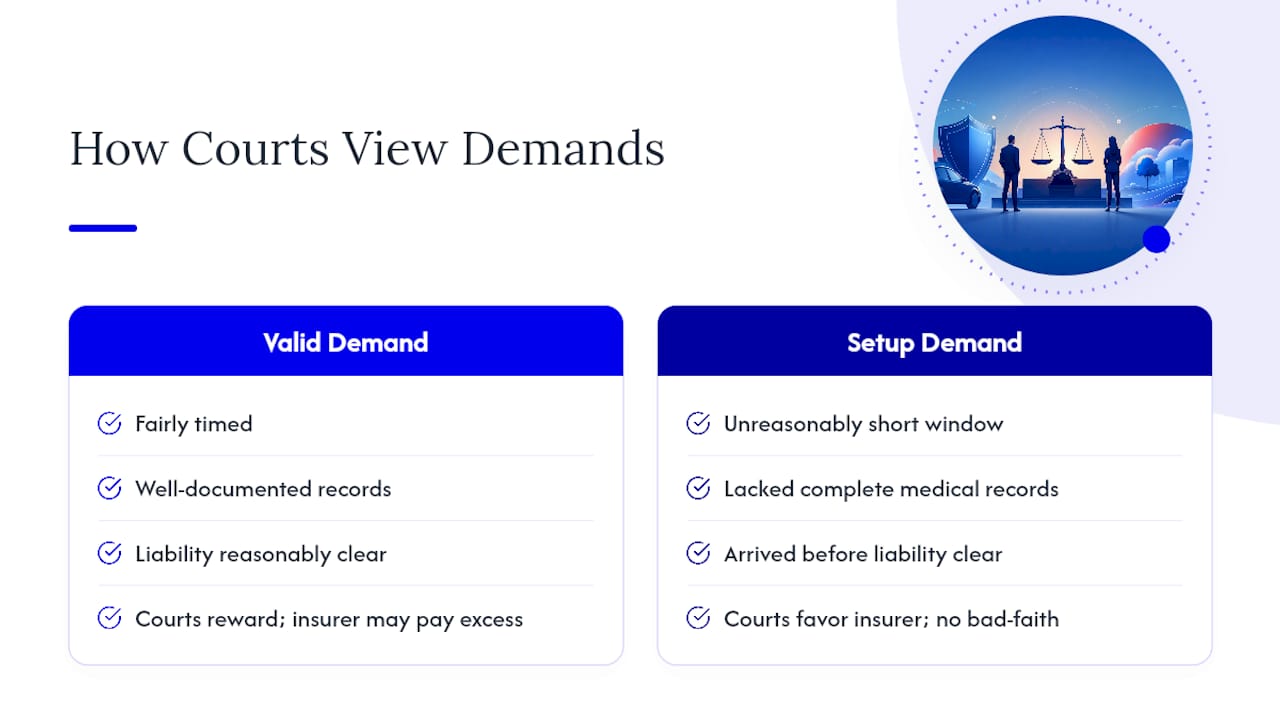
Cases addressing "setup" demands cut the other way. Courts in several jurisdictions have scrutinized demands that lacked complete medical records, gave insurers unreasonably short windows to respond, or arrived before liability was reasonably clear. Judges in these cases sided with insurers, finding the demand wasn't a genuine settlement opportunity so much as an attempt to manufacture a bad-faith claim.
The upshot for claimants: courts consistently reward thorough, well-documented, fairly timed demands and punish rushed or incomplete ones. That pattern holds across the different variations of duty-to-settle doctrine in state courts, even though the exact legal standard differs from one jurisdiction to the next. Reading your state's version of this rule, or having an attorney explain it, matters more than memorizing a single landmark case.
Does Accepting Policy Limits Affect Your Future Rights?
Signing a release after a policy limits tender generally closes your ability to pursue the insured driver again for that same crash, even if new symptoms or complications show up later. That finality is the tradeoff you're accepting in exchange for a guaranteed payout.
It doesn't necessarily close every door, though. If you later discover an umbrella policy, an employer's commercial coverage, or a separate liable party who wasn't part of the original release, you may still have a claim against that other source, depending on how the release is worded. This is why release language matters as much as the settlement number itself. A release drafted to cover "any and all claims arising from the incident" can be far broader than one narrowly tied to the named insured and policy.
Future insurance claims can be affected too. If you accept a policy limits settlement and later develop related medical issues, your own health insurer or Medicare may look at whether those costs should have been part of the original settlement, which can complicate lien negotiations after the fact. Claimants handling pedestrian or multi-vehicle cases often weigh this tradeoff explicitly, since the choice between accepting limits and pursuing further litigation carries different risk depending on how catastrophic the injuries are and how many parties might share liability.
Bottom line: read the release carefully, know exactly whose claims it extinguishes, and confirm nothing valuable is being signed away along with the insured's exposure.
Can Mediation Resolve a Policy Limits Dispute?
Mediation gives both sides a structured way to test a policy limits demand without the cost and delay of trial. A neutral mediator, often a retired judge or experienced attorney, helps the claimant and insurer find common ground when the initial demand and the insurer's response are far apart.
Mediation works especially well in policy limits disputes because the core disagreement is usually about value and risk, not about whether an accident happened. If liability is clear but the insurer disputes the extent of damages, a mediator can push both sides toward a realistic number faster than months of litigation would.
It's not binding unless both sides agree to a resolution during the session, which makes it lower-risk than arbitration. Claimants keep the right to pursue litigation, and potentially a bad-faith claim, if mediation fails and the insurer's final position still looks unreasonable given the documented damages. Many insurers now request mediation specifically to create a record showing they engaged in good faith, which can undercut a later bad-faith argument even if the mediation doesn't settle the case.
Auto, Homeowners, and Commercial Policies Handle Limits Differently
Not every policy limits settlement plays out the same way, and the type of policy involved changes both the numbers and the strategy.
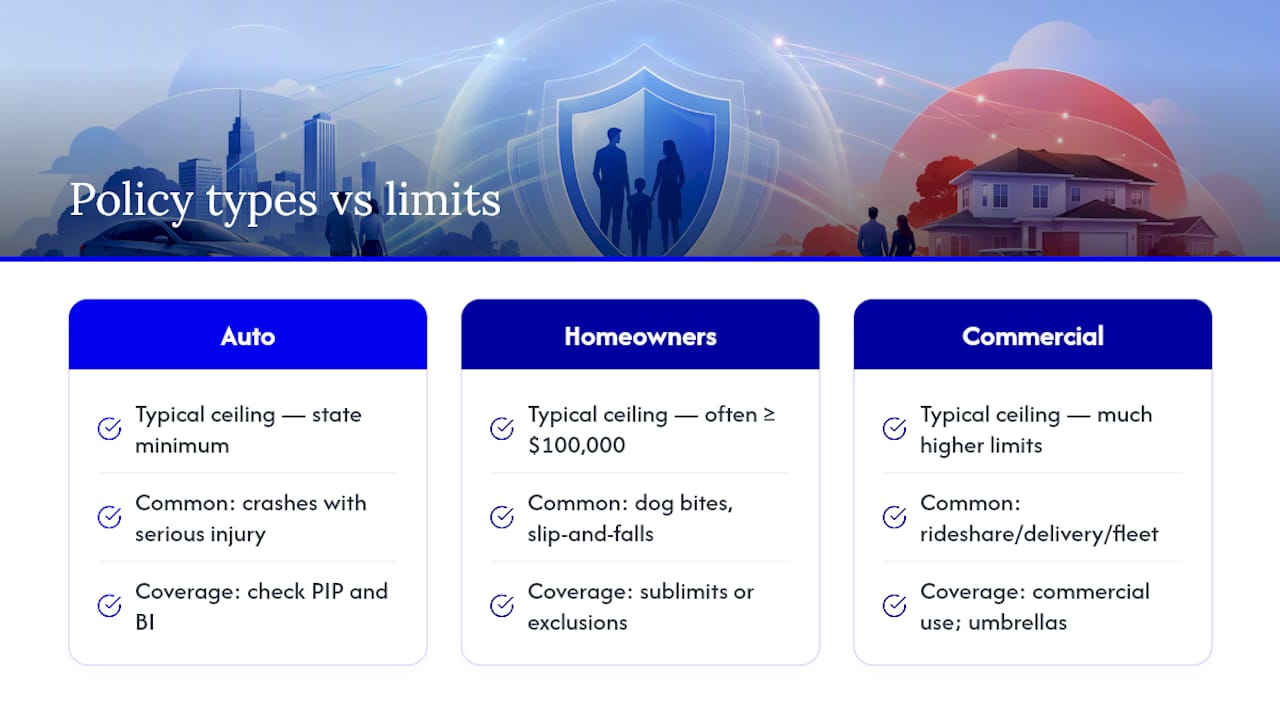
Auto policies are the most common setting for this issue, largely because state-minimum limits are often low relative to the cost of a serious injury. A driver carrying only the state minimum can leave a badly injured claimant with a policy limit that doesn't come close to covering medical bills, which is exactly why checking for PIP and bodily injury coverage interplay matters before assuming the auto policy is the only source of recovery.
Homeowners policies tend to carry higher limits, often starting at $100,000 or more in liability coverage, but claims involving dog bites, slip-and-falls, or other premises liability can trigger sublimits or exclusions that reduce what's actually available. Reading the declarations page closely matters here, since homeowners policies frequently bury sublimits for specific injury categories.
Commercial policies, including those covering rideshare drivers, delivery vehicles, and business fleets, usually carry far higher limits than personal auto policies, sometimes with umbrella coverage layered on top. That higher ceiling is exactly why identifying whether a vehicle was being used commercially at the time of a crash can dramatically change the available recovery.
When We'd Take the Tender and When We'd Push Harder
Accepting a tender makes sense when the gap between the policy limit and your actual damages is small, or when the at-fault party has no meaningful assets to pursue beyond insurance. Pushing further makes sense when multiple coverage layers exist, liability is airtight, or the damages clearly dwarf the tendered amount.
The deciding factor is usually the coverage investigation, not the injury itself. A thin-looking policy can turn into a strong case the moment an umbrella layer or a commercial policy surfaces. Getting a free evaluation can help check coverage gaps, and a referral to an attorney might uncover coverage not yet identified. It doesn't replace legal advice, but it's a reasonable first move before signing anything.
— Gerard
Get a Free Evaluation Before You Sign Anything
A tender might look like the end of the road, but it's worth checking what else is out there before you sign a release that closes it off for good. A free evaluation service exists for exactly this moment: a no-obligation review of your situation before you commit to accepting a policy limit as your final number.
The evaluation looks at the coverage picture around your claim, including whether umbrella or excess policies might apply, and connects you with local attorneys if your case warrants a closer look. There's no cost and no pressure to hire anyone. You share the details of your accident and injury, and the process flags whether a fuller legal review makes sense before you settle for what's on the table.
If you're facing a policy limits tender right now, or you're still gathering records and wondering whether your demand is strong enough, start your free case evaluation before you make a final decision. It takes a few minutes and could change what you end up walking away with.
Where to Verify State Rules and Deadlines
Statutes and deadlines around policy limits demands vary by state, so it's worth confirming the specifics that apply to your case rather than relying on a general rule of thumb.
The American Bar Association's brief on policy-limits and time-limit demands walks through the duty-to-settle standard in plain terms. For state-specific minimums and consumer protections, the NAIC's consumer auto insurance guidance and resources like the New York State Department of Financial Services auto resource center are solid starting points. Always confirm your own state's statute before setting a demand deadline.
This article is general information, not a substitute for advice from a qualified lawyer. Consult a qualified legal professional about your own circumstances before acting on anything here.
Sources
- Policy Limits Demands and Time Limit Demands Duty to Settle — American Bar Association
- PMC article referencing procedural rules including CCP § 999
- What Does Tendering Policy Limits Mean in Insurance? — LegalClarity
- NAIC consumer auto insurance guidance
FAQ
How often do insurance companies settle for policy limits?
It happens most often when liability is clear and injuries are severe or permanent, since insurers want to avoid the risk of an excess verdict. Cases involving low state-minimum coverage and catastrophic injuries are among the most common settings for a full policy limits tender.
What is a policy limits settlement?
It's when an insurer pays out the entire available liability coverage on a policy to resolve a claim, known as tendering the limits. Accepting a tender usually means signing a release that prevents further claims against the insured for that same incident.
Can you settle for more than policy limits?
Not from that specific policy alone, but you can pursue additional recovery through your own UM/UIM coverage, an umbrella or excess policy, or a personal lawsuit against the at-fault party if they have collectible assets. A coverage investigation before you sign anything is the best way to find out whether more money is available.
How much of a $25,000 settlement will I get?
It depends on your fee agreement, case costs, and any liens against the settlement, such as Medicare, Medicaid, or hospital liens. A rough industry pattern shows attorney fees around a third of the gross amount, with liens and costs further reducing the final number, so ask your attorney for a written net-recovery estimate before accepting.
Does Carcollisionlawyer charge for the case evaluation?
No. The free evaluation carries no published cost and no obligation to hire an attorney afterward. It's designed to help you understand what coverage might apply to your situation before you make a final decision on a tender.