
Most emotional distress settlements in the United States typically fall into rough bands for mild, moderate, and severe psychological injury, varying widely based on evidence and severity. Where your case lands depends almost entirely on what you can prove, not on how bad it felt.
That variance isn't random. It comes down to three levers: which state you're in, how much documentation you have, and how deep the defendant's insurance policy runs. A claimant with six months of therapy records and a psychiatric evaluation routinely settles for triple what an identical injury gets with no paper trail behind it.
The single most useful thing you can do right now, before you negotiate anything, is start documenting. See a licensed mental health professional, keep a dated journal of your symptoms, and note how the distress has disrupted work or relationships. Then check your state's statute of limitations, because that clock is often running whether you've started your claim or not.
- Mild emotional distress (anxiety, short-term stress): generally settles for relatively lower amounts
- Moderate emotional distress (diagnosed anxiety or depression, ongoing therapy): generally settles for mid-range amounts
- Severe or extreme emotional distress (PTSD, long-term disability, catastrophic injury): generally settles for higher amounts
Pro Tip: The gap between a $15,000 offer and a $150,000 offer is almost never the severity of what happened to you. It's whether a therapist's records back it up.
Key Takeaways
Emotional distress settlements in the US typically range from $10,000 for mild, undocumented harm to $500,000 or more for severe, well-documented psychological injury, with documentation and state law driving nearly all of the variance.
| Point | Details |
|---|---|
| Settlement bands vary by severity | Mild claims commonly settle for relatively lower amounts; severe or extreme claims can reach substantially higher amounts. |
| Documentation drives value more than anything | A diagnosed condition with consistent therapy records outweighs raw severity in most negotiations. |
| No fixed calculation formula exists | Multiplier (1.5 to 5) and per diem methods are negotiation tools, not legal requirements. |
| Deadlines and caps can override your evidence | Statutes of limitations run 1 to 3 years in most states, and noneconomic damage caps vary widely. |
| Consult an attorney before major deadlines pass | Carcollisionlawyer connects claimants with vetted attorneys through a free, no-obligation case evaluation. |
Table of Contents
- What Counts as an Emotional Distress Settlement Under US Law?
- How Do Different Types of Emotional Distress Claims Affect Value?
- How Do Attorneys and Insurers Calculate a Settlement Amount?
- What Are Typical Emotional Distress Settlement Amounts by Severity?
- What Factors Increase or Decrease Settlement Value the Most?
- How Do You Prove an Emotional Distress Claim?
- Do State Caps or Deadlines Limit Your Emotional Distress Claim?
- How Long Does an Emotional Distress Claim Take to Settle?
- How Do You Calculate Your Own Emotional Distress Settlement?
- When Should You Hire an Attorney for an Emotional Distress Claim?
- Sources
What Counts as an Emotional Distress Settlement Under US Law?
Emotional distress, in legal terms, covers the psychological fallout of an injury or wrongful act: anxiety, depression, PTSD, humiliation, grief, and the general mental suffering that follows trauma. Courts and insurers also call it mental anguish or fold it into the broader category of pain and suffering. These terms overlap heavily, and you'll see all three used interchangeably in demand letters and settlement paperwork.
The legal standard for when this distress becomes compensable traces back to a well-known principle from the Restatement of Torts: the law generally leaves ordinary emotional upset alone and steps in only when the distress is severe enough that a reasonable person shouldn't be expected to endure it. Everyday frustration, embarrassment, or a bad week isn't compensable. A diagnosed anxiety disorder that keeps you from driving for a year is a different matter. Legal commentary on this standard, summarized in Cornell's Legal Information Institute, frames emotional distress as a form of mental suffering that becomes actionable once it crosses that severity line.
Here's the part that surprises a lot of claimants: there's no dollar chart. Jury instructions used in courts explicitly tell jurors there's no fixed formula for translating suffering into money.
There is no fixed standard for deciding the amount of noneconomic damages. Jurors are told to use their judgment and common sense, based on the evidence, to decide what is a reasonable amount.
That language comes directly from standard jury instructions on physical pain, mental suffering, and emotional distress, and it explains why two nearly identical cases can settle $80,000 apart. Common terms you'll encounter along the way:
- Mental anguish: a near-synonym for emotional distress, used heavily in demand letters
- Pain and suffering: the broader category that includes both physical pain and emotional distress
- Noneconomic damages: the formal legal bucket that emotional distress falls into, as opposed to economic damages like medical bills or lost wages
How Do Different Types of Emotional Distress Claims Affect Value?
Not all emotional distress claims are built the same, and the type you're filing changes both how hard you have to work to prove it and how much you're likely to recover.
Intentional infliction of emotional distress (IIED) requires showing the defendant's conduct was extreme and outrageous, not just careless. Think stalking, threats, or deliberate psychological abuse. Because the bar for proving intent is high, successful IIED claims often carry the possibility of punitive damages on top of compensatory ones, which can push settlement value well above the standard bands.

Negligent infliction of emotional distress (NIED) is the more common route for accident victims. Here you're arguing the defendant's carelessness, not malice, caused your psychological harm. Many states restrict standalone NIED claims to plaintiffs who were in the "zone of danger," meaning you were at physical risk yourself, not just a witness to someone else's injury. Some states have relaxed this rule for close family members who witness a loved one's injury, but it varies enough that you need to check your state's specific approach.
Emotional distress tied to a physical injury is generally the strongest and easiest position. When you're already recovering compensation for a broken bone or a concussion, the emotional suffering that comes with it, including fear of future complications, gets folded into your pain-and-suffering award without a separate outrageousness or zone-of-danger hurdle. The Supreme Court addressed this distinction directly in a case involving asbestos exposure, confirming that emotional distress connected to a physical injury is recoverable as part of a standard pain-and-suffering claim, while standalone claims face tighter limits.
A few illustrative patterns show up again and again in practice:
- A rear-end collision victim with whiplash and documented panic attacks about driving: distress tied to physical injury, straightforward to include in the settlement
- A pedestrian who watched a family member get struck but wasn't hit themselves: NIED claim, success depends heavily on the state's zone-of-danger rule
- A worker subjected to months of deliberate harassment by a supervisor: potential IIED claim, with punitive damages in play if the conduct was severe enough
For a deeper look at how one specific doctrine affects standalone claims, this breakdown of the impact rule and emotional claims walks through how state law treats cases with no accompanying physical injury.
How Do Attorneys and Insurers Calculate a Settlement Amount?
Two informal methods dominate real-world negotiations, and neither one is a legal requirement. They're tools for turning a subjective injury into a specific number both sides can argue over.
- The multiplier method. Add up your economic damages (medical bills, therapy costs, lost wages) and multiply that total by a factor, typically between 1.5 and 5, depending on severity and evidence. A claimant with $20,000 in documented medical and therapy costs and a moderate-severity multiplier of 3 would open negotiations around $60,000 for the emotional distress component alone, separate from other damages.
- The per diem method. Assign a daily dollar value to your suffering, often anchored to your daily lost wages, then multiply by the number of days you were significantly affected. Someone earning $200 a day who experienced debilitating anxiety for 90 days might see a per diem calculation land around $18,000, though attorneys frequently adjust the daily rate upward for distress that outlasts the physical recovery period.
Neither approach carries legal weight in a courtroom. A jury can ignore both entirely and award whatever amount it decides fits the evidence, guided only by the "reasonable judgment and common sense" standard from jury instructions. Practitioner guides on emotional distress payouts describe these two methods as the industry's default negotiation shorthand, not a formula insurers are bound to follow.
Strengths and weaknesses worth knowing before you rely on either one:
- The multiplier method works well when you have solid economic damages to anchor it to, but it undervalues distress in cases with few medical bills, like pure emotional harm with no accompanying injury.
- The per diem method feels concrete and easy to explain to a jury, but it can shortchange claimants whose suffering doesn't map neatly onto a "per day" framework, such as ongoing anxiety that flares unpredictably.
- Both methods are starting points for negotiation, not ceilings. A strong expert report or particularly egregious defendant conduct can push a final number well past what either calculation suggests.
What Are Typical Emotional Distress Settlement Amounts by Severity?
Ranges vary this widely because three things move independently: the severity of the diagnosis, the strength of your documentation, and the size of the defendant's insurance policy. A catastrophic injury against a defendant with a $25,000 minimum policy limit settles very differently than the same injury against a commercial trucking company carrying a $1 million policy.
| Severity Level | Typical Settlement Range | Common Evidence Profile |
|---|---|---|
| Mild | Generally lower settlement amounts | Short-term anxiety, no formal diagnosis, brief counseling |
| Moderate | Generally mid-range settlement amounts | Diagnosed anxiety or depression, months of ongoing therapy |
| Severe | Generally higher settlement amounts | PTSD diagnosis, extended treatment, documented work impact |
| Extreme/catastrophic | Generally among the highest settlement amounts | Permanent psychological disability, expert testimony, punitive conduct |
A few anonymized examples show how the same category of injury can land at very different points on that scale:
- A rideshare passenger developed a diagnosed driving phobia after a highway collision, attended weekly therapy for eight months, and had a psychologist's report documenting functional impairment. The case settled near the top of the moderate band.
- A pedestrian struck in a crosswalk suffered a mild concussion and reported anxiety about crossing streets but never sought treatment and had no medical record of the distress. The insurer's initial offer sat near the bottom of the mild band, and negotiations barely moved it without documentation to support a higher figure.
- A commercial truck crash left a survivor with a confirmed PTSD diagnosis, two years of continuing treatment, and an inability to return to a previous job. With expert testimony and a large commercial policy behind the defendant, the settlement reached well into the severe band.
State-specific caps can flatten even a well-documented severe case, and a defendant's minimum policy limit can do the same regardless of how strong your evidence is. For a broader look at how these categories play out in real accident settlements, the examples compiled in real 2026 car accident damage cases show how noneconomic damages interact with the rest of a claim.
What Factors Increase or Decrease Settlement Value the Most?
Some factors move the needle enormously. Others barely register. Knowing the difference tells you where to spend your energy.
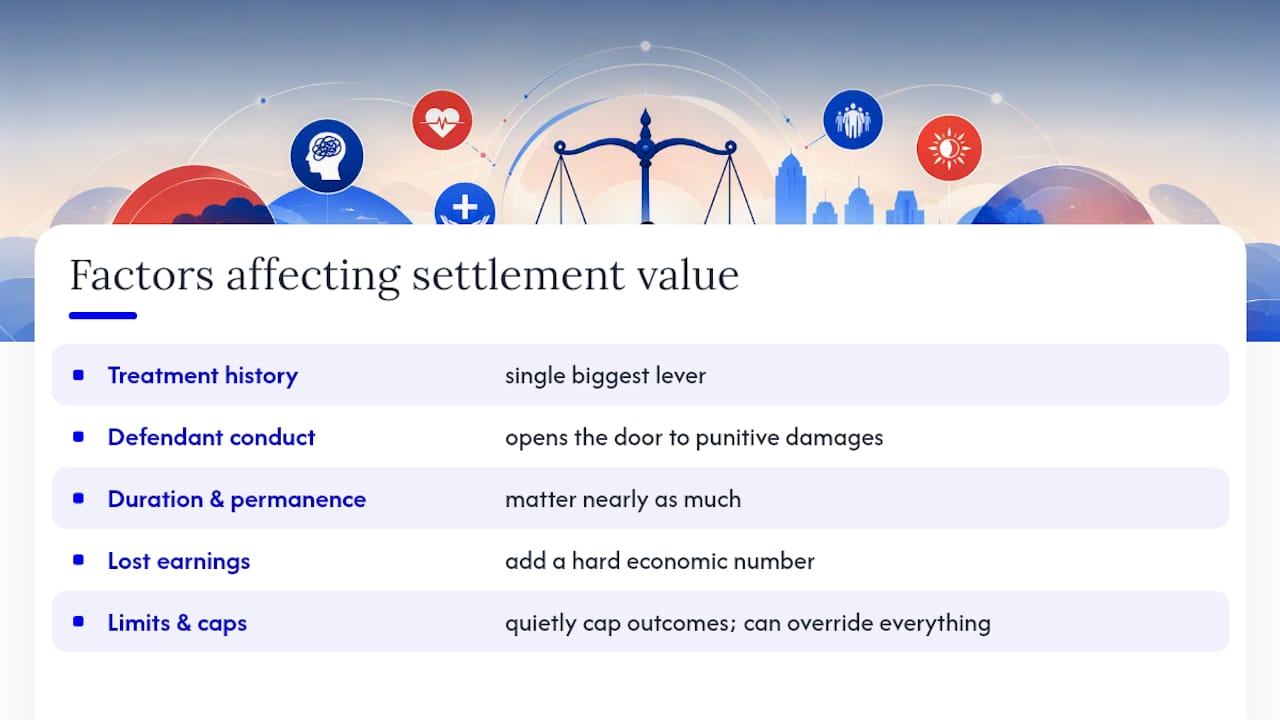
Documented treatment history is the single biggest lever available to most claimants. A diagnosis from a licensed psychiatrist or psychologist, backed by consistent session notes, does more to raise a settlement offer than almost anything else you control. This is also the factor most within your power to build, starting the moment you seek treatment.
Duration and permanence of the harm matter nearly as much. Six weeks of situational anxiety after a fender-bender reads very differently to an adjuster than eighteen months of PTSD symptoms that haven't resolved with treatment.
Lost earnings and work disruption add a hard economic number that anchors the multiplier method and makes the emotional component feel less speculative to a skeptical insurer.
Witness corroboration, meaning testimony from family, coworkers, or friends who observed behavioral changes, fills gaps that medical records alone can't cover, especially around how the distress affected daily life outside a therapist's office.
Defendant conduct shifts everything. Ordinary negligence caps expectations at compensatory damages. Reckless or intentional conduct, like a drunk driver or an employer who ignored repeated harassment complaints, opens the door to punitive damages, which can dwarf the underlying compensatory award.
Insurance policy limits quietly cap outcomes no matter how strong your case is. A textbook-severe PTSD claim against a driver with a $25,000 minimum policy rarely settles above that ceiling unless there's a separate avenue, like an underinsured motorist policy, to pursue.
State damage caps can override everything else on this list, a point worth remembering before you get attached to a number based on national averages. For a fuller rundown of how these variables interact in accident cases specifically, this guide to settlement factors for car accidents breaks down how adjusters weigh them in practice.
How Do You Prove an Emotional Distress Claim?
Insurers and courts don't take your word for suffering. They want a paper trail, and the strength of that trail is often the difference between a settlement offer that insults you and one that reflects the real harm.
Here's the priority order, from most persuasive to least:
- Medical and therapy records from a licensed mental health professional, showing diagnosis, treatment frequency, and progress notes over time
- Psychiatric or psychological evaluations, ideally including a formal diagnosis such as PTSD, generalized anxiety disorder, or major depressive disorder
- Prescription records for anti-anxiety medication, antidepressants, or sleep aids tied to the incident
- Contemporaneous journals or notes written close to the time symptoms occurred, which carry more weight than a recollection written months later for litigation purposes
- Witness statements from people who observed changes in your mood, behavior, or daily functioning
- Employment records documenting missed work, reduced hours, or a formal accommodation request tied to your mental health
Clinical resources on PTSD from the NIMH and on anxiety symptoms from MedlinePlus describe the diagnostic criteria that a treating professional will document, and that documentation is exactly what an adjuster or jury looks for.
Pro Tip: A useful expert report doesn't just confirm a diagnosis. It should connect the diagnosis directly to the incident, describe functional impairment in concrete terms (can't drive, can't sleep, missed X weeks of work), and give a prognosis for recovery or permanence. A report that just says "patient reports anxiety" carries far less weight than one that ties symptoms to specific, dated limitations.
A rough evidence timeline looks like this in most well-handled claims:
- First 30 days: seek treatment immediately, start a symptom journal, tell your doctor the incident is the cause
- 3 to 6 months: continue consistent therapy or psychiatric visits, request a written evaluation, gather witness statements while memories are fresh
- Ongoing: track any work or relationship impact, keep every receipt for treatment and medication, update your attorney if symptoms change
A cautionary note worth sitting with: a federal judge recently rescinded a $100,000 jury award for emotional distress because the plaintiff lacked direct evidence, testimony or medical corroboration, tying the harm to the incident. Juries can hand you a number, and courts can still take it away if the record doesn't back it up. For claims involving specific diagnoses like driving-related phobias or PTSD after a collision, these guides on proving accident-related phobias and PTSD claims after an accident walk through the specific documentation each diagnosis requires.
Do State Caps or Deadlines Limit Your Emotional Distress Claim?
Timing rules and damage caps can bar or shrink a claim regardless of how strong your evidence is, which makes this section as important as anything about proof or valuation.
Most states set a statute of limitations for personal injury and related emotional distress claims somewhere between one and three years from the date of injury, though a handful allow longer. Many states also apply a discovery rule, which starts the clock when you discovered, or reasonably should have discovered, the harm rather than the date of the original incident. This matters a lot for emotional distress, since psychological symptoms sometimes surface weeks or months after a physical injury has already healed.
State caps on noneconomic damages are the other major variable, and they don't follow any consistent national pattern. Some states cap noneconomic damages in specific categories like medical malpractice but leave general personal injury claims uncapped. Others impose broader caps that apply across most personal injury contexts. A handful place no cap at all on noneconomic damages in standard injury cases.
| Timing or Limit Issue | What It Means for Your Claim |
|---|---|
| Statute of limitations | Generally 1 to 3 years from injury or discovery, varies by state |
| Discovery rule | Clock may start when symptoms are discovered, not the incident date |
| Noneconomic damage caps | Some states cap these damages in certain claim types; others don't cap them at all |
| Government defendant claims | Often require a separate, much shorter notice deadline before suing |
Because these rules genuinely vary by state and by claim type, this article can't tell you your exact deadline or cap. Verify your specific state's statute of limitations and any applicable damage cap with a licensed attorney or your state's official court resources before assuming a general range applies to you.
How Long Does an Emotional Distress Claim Take to Settle?
Simple cases with clear liability and strong documentation can resolve in a few months. Complex cases involving disputed liability, catastrophic harm, or a defendant's insurer digging in can stretch past a year, sometimes well past it if the case heads to trial.
- Immediate aftermath (weeks 1 to 4): seek treatment, document symptoms, report the incident, avoid giving a recorded statement to the opposing insurer without guidance.
- Investigation and demand preparation (months 1 to 6): gather medical records, therapy notes, and witness statements; your attorney assembles a demand packet.
- Initial demand and negotiation (months 3 to 9): your attorney sends a formal demand letter with supporting documentation; the insurer typically counters low.
- Mediation or continued negotiation (months 6 to 12): many cases settle here once both sides have exchanged enough evidence to assess trial risk realistically.
- Trial preparation and trial (12+ months): reserved for cases where the insurer refuses a reasonable offer or liability is genuinely disputed.
A few negotiation habits separate claimants who get fair offers from those who get lowballed:
- Never speculate about your symptoms getting better or worse in early conversations with an insurance adjuster; stick to documented facts.
- Don't accept a quick first offer before your treatment has stabilized. Settling early often means settling before the true scope of the harm is known.
- Structure your demand packet with medical records first, a clear narrative of how the distress affects daily life second, and any expert report last as the capstone.
- Bring in a mental health expert report specifically when the insurer disputes causation or severity, not as a default step in every case.
For a practical walkthrough of what happens in the weeks immediately following an accident, this overview of the claim process covers the early evidence-gathering steps that shape everything that follows.
How Do You Calculate Your Own Emotional Distress Settlement?
Here's a worked example using both methods so you can see how the math actually behaves, and how much a single piece of added evidence can shift the outcome.
The scenario: A claimant develops diagnosed anxiety and driving-related avoidance after a car crash. They accumulate $8,000 in therapy and psychiatric costs over four months and miss three weeks of work, losing $2,400 in wages. Total economic damages: $10,400.
- Multiplier method: with a moderate-severity diagnosis and consistent treatment records, an attorney might apply a multiplier of 3. That's $10,400 x 3 = $31,200 for the emotional distress and pain-and-suffering component.
- Per diem method: the claimant's effective daily wage is $114 (based on $2,400 over 21 workdays). Applying that rate across 120 days of documented significant impact, $114 x 120 = $13,680. Attorneys often round this figure up when the distress clearly outlasted the physical recovery period, since the per diem rate is anchored to lost wages rather than the severity of suffering.
- Reconciling the two: most negotiators use the multiplier figure as the anchor and the per diem number as a sanity check or fallback argument, landing an opening demand somewhere in the $25,000 to $35,000 range for this specific component of the claim.
Now the sensitivity test. Add six more months of documented therapy and a formal psychiatric evaluation confirming a PTSD diagnosis, and two things change: the severity classification shifts from moderate toward severe, and the applicable multiplier commonly moves from 3 up toward 4 or 5. Economic damages also grow with the added treatment costs, say another $6,000, bringing the base to $16,400. At a multiplier of 4, that's $65,600, more than double the original estimate, driven almost entirely by six extra months of paperwork.
That gap illustrates the core lesson of this entire process: the injury didn't get worse in that hypothetical. The documentation did. For claims involving specific conditions like anxiety disorders, the evidence categories in this anxiety disorder claim guide map closely onto the same multiplier logic used here.
When Should You Hire an Attorney for an Emotional Distress Claim?
Some emotional distress claims are simple enough to handle through an insurer's standard claims process. Most aren't, and a few specific triggers should push you toward hiring counsel without much hesitation.
Hire an attorney when:
- The defendant's insurance policy limits are unclear or you suspect they're substantial (commercial vehicles, corporate defendants, government entities)
- Your emotional distress is severe, long-term, or accompanied by a formal psychiatric diagnosis
- The defendant is a business, employer, or government agency, since these claims often involve separate notice deadlines and more aggressive legal defense
- The insurer has already disputed causation or offered a settlement that doesn't reflect your documented treatment costs
- Your claim combines emotional distress with a physical injury, since valuing the two together requires more nuanced negotiation than either alone
How to vet an attorney before you sign anything:
- Ask directly how many emotional-distress or psychological injury cases they've handled in the past few years, not just personal injury cases generally.
- Ask what kind of expert witnesses they typically bring in for psychological injury claims and how they've used expert reports in past settlements.
- Ask how their contingency fee works. Most personal injury attorneys work on contingency, meaning they take a percentage of the settlement and charge nothing upfront, but the percentage and what counts as a "cost" can vary between firms.
- Ask what a realistic timeline looks like for a case like yours specifically, not a generic estimate.
Red flags worth walking away from include an attorney who guarantees a specific settlement number before reviewing your medical records, pressure to settle quickly without documenting the full scope of treatment, or a consultation that feels more like a sales pitch than a case assessment. A legitimate free case evaluation should focus on the facts of your situation, not on rushing you toward a signature. For a closer look at what separates strong representation from a weak one in these specific cases, how emotional injury attorneys build winning cases and this attorney evaluation guide both walk through practical vetting questions.
A Realistic Note on What Claimants Underestimate
The gap that trips up most people isn't the law. It's the gap between how bad something felt and how well that feeling got documented in real time. Claimants routinely assume that because their distress was obvious to everyone around them, it will be obvious to an insurance adjuster too. It won't be, not without a paper trail built while the symptoms were happening, not months later when a lawyer asks for records that don't exist.
The other underestimated piece is how much state law quietly shapes the ceiling on a case before evidence even enters the picture. Two people with nearly identical psychological injuries, one in a state with a damage cap and one without, can walk away with wildly different outcomes that have nothing to do with how well either of them documented their suffering.
Treat every number in this article as a realistic band, not a promise. Get treatment first, document consistently, and let the evidence set your expectations rather than the other way around. If you're trying to figure out where your specific situation fits, a free case evaluation is a low-friction way to get a read on your claim before you commit to anything.
How Does the Free Case Evaluation and Attorney Matching Process Work?
Figuring out what your claim is actually worth shouldn't require guesswork or a $300 initial consultation fee just to get a straight answer. Carcollisionlawyer built its evaluation process specifically so you can understand your situation, and what it might be worth, before you commit to anything.
The process itself is short by design:
- Free intake: answer a focused set of questions about your accident, injuries, and any emotional or psychological impact you've experienced
- Case review: your answers get matched against the specific criteria attorneys in your state use to evaluate emotional distress and personal injury claims
- Attorney match: you get connected with a vetted local attorney who handles cases like yours, with no obligation to move forward
Your information is handled according to Carcollisionlawyer's privacy policy, and you're never charged for the evaluation itself. If you've been documenting your treatment and you're wondering whether your case has real value, get a free case evaluation and find out where you actually stand before an insurance adjuster tells you what they think it's worth.
Sources
The legal and clinical concepts covered in this article draw on primary sources worth bookmarking if you want to dig deeper into your specific situation.
- mental suffering | Wex | US Law | LII / Legal Information Institute
- CACI No. 3905A. Physical Pain, Mental Suffering, and Emotional Distress (Noneconomic Damage)
- Post-Traumatic Stress Disorder (PTSD) | NIMH
- Emotional Distress Lawsuit 2026: Payouts & How to Sue
Because statutes of limitations and damage caps differ by state and change over time, search for your specific state's current rules or speak with a licensed attorney before relying on any general range in this article as your final answer. This article provides general information only and isn't a substitute for advice from a licensed attorney about your specific situation.
This article is general information, not a substitute for advice from a qualified lawyer. Consult a qualified legal professional about your own circumstances before acting on anything here.