
How depression raises the value of your accident claim
Depression increases accident claim value through two distinct damage categories: non-economic and economic. Get both documented correctly, and your total compensation can rise considerably compared to a claim covering only physical injuries.
Non-economic damages affected by depression include:
- Loss of enjoyment of life. If depression has stripped away hobbies, social activities, or daily pleasures you once valued, that loss carries real dollar weight in most US jurisdictions.
- Strained relationships. Depression affects marriages, parenting, friendships, and work relationships. Courts recognize this relational damage as part of pain and suffering.
- Emotional pain and suffering. Persistent sadness, hopelessness, and inability to function are compensable conditions, not just background noise.
Economic damages tied to depression include:
- Lost wages. If depression delays your return to work or forces reduced hours, those lost earnings are recoverable.
- Diminished earning capacity. A claimant whose depression permanently limits career performance can claim the long-term income gap.
- Ongoing treatment costs. Therapy, psychiatric medication, and future mental health care are future medical expenses added to your damages.
One critical requirement: depression must be linked to a physical injury sustained in the accident to qualify as compensable in most US states. Depression alone, without that physical nexus, rarely clears the legal threshold. Carcollisionlawyer connects accident victims with attorneys who understand exactly how to build that connection.
Table of Contents
- Why clinical depression and general stress are not the same thing in a claim
- The claims process itself can make your depression worse
- Your legal rights when pursuing psychological injury compensation
- What 2026 accident settlements actually look like with depression included
- How to negotiate a settlement that includes psychological damages
- How insurance companies assess and dispute depression claims
- Timeframes for documenting depression's impact on your claim
- Carcollisionlawyer connects you with attorneys who handle psychological injury claims
- Key Takeaways
Why clinical depression and general stress are not the same thing in a claim
Mislabeling ordinary post-accident stress as clinical depression is one of the fastest ways to weaken your claim. Insurers and defense attorneys know the difference, and they will use it against you.
Mental health exists on a continuum, and depression is frequently used as a catch-all diagnosis for any kind of psychological distress. Without confirming the actual diagnostic criteria, a claim for depression often lacks the medical evidence needed to survive scrutiny. The DSM-5 criteria for a major depressive episode require at least five specific symptoms persisting for two or more weeks, with measurable functional impairment. Acute stress after a crash does not meet that bar.
What strengthens a depression claim:
- A formal diagnosis from a licensed psychologist, psychiatrist, or clinical social worker
- Documented DSM-5 criteria met at evaluation
- Treatment records showing symptom frequency, severity, and functional impact over time
- Standardized assessment tools such as the Beck Depression Inventory or PHQ-9 used during evaluation
- Personal journals noting daily limitations to supplement clinical records
Expert clinical evaluation is the single factor that separates a compensable depression claim from a dismissed one.
Pro Tip: Engage a licensed mental health professional as early as possible after your accident, ideally before your first meeting with an insurance adjuster. Early treatment records establish a clear timeline connecting your depression to the accident, making causation far harder to dispute.
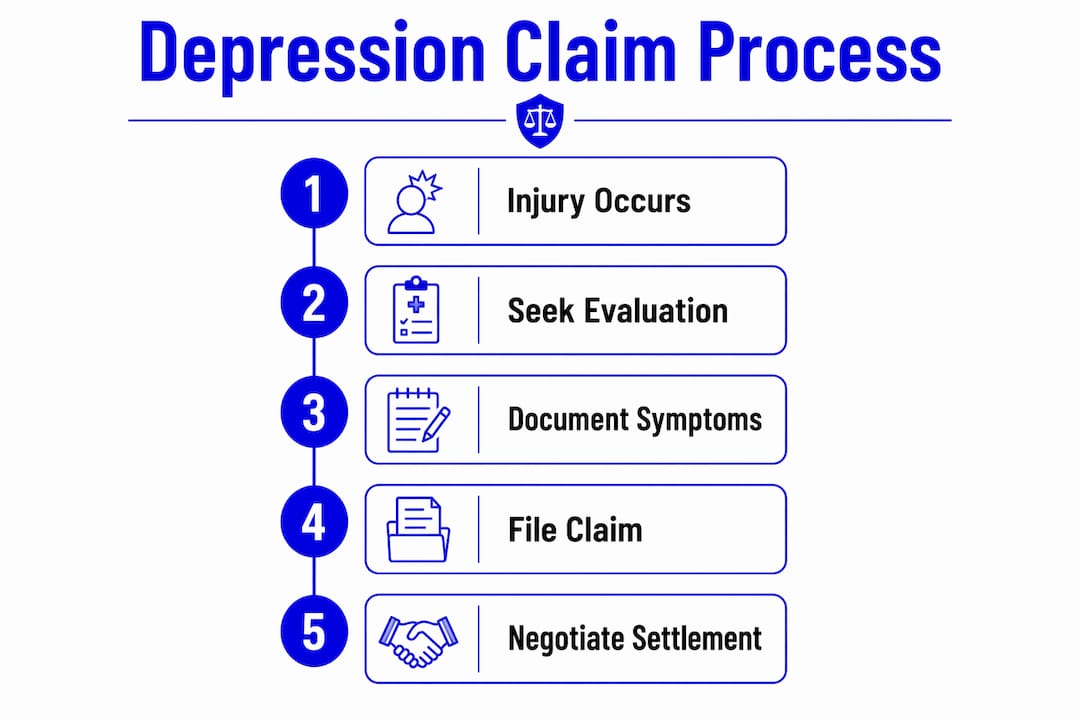
The claims process itself can make your depression worse
The adjudication phase of a compensation claim is not a neutral waiting period. Research published in the Journal of Occupational Rehabilitation found that patients with claims under assessment reported significantly worse DASS-21 depression and stress scores than claimants with accepted claims, rejected claims, or no claim at all.
Key finding: On the DASS-21 scale, claimants whose applications were being assessed showed depression scores approximately 5.88 points higher than those with rejected claims, and stress scores 5.73 points higher than those with accepted claims, with moderate to strong effect sizes.
The pattern is telling. Uncertainty, procedural delays, and the feeling that nobody believes you appear to drive mental health deterioration more than the outcome itself. Once a claim resolves, whether accepted or denied, mental health scores improve. The liminal phase is the problem.
For claimants, this has a practical implication: document your mental health throughout the entire process, not just at the start. Worsening symptoms during adjudication are part of your injury story and can support your claim for ongoing treatment costs.

Your legal rights when pursuing psychological injury compensation
Depression claims in US accident cases sit within a specific legal framework, and understanding it protects you from common pitfalls.
In states including North Carolina and Oregon, depression must arise as a consequence of a compensable physical injury to be recoverable in negligence. Oregon case law, including the Workers' Compensation Board's analysis in Perez-Reynoso (WCB Case No. 19-05223), confirms that mental disorders arising as sequelae to accepted physical conditions are analyzed as consequential conditions, requiring the claimant to show the physical injury is the major contributing cause.
Common challenges you will face:
- Pre-existing conditions. Insurers argue your depression predated the accident. Counter this with the eggshell plaintiff doctrine: if the accident worsened a pre-existing condition, you are entitled to compensation for that worsening.
- Causation disputes. Proving the accident caused your depression, rather than life circumstances, requires a clear clinical narrative from your treating provider.
- Lack of treatment records. Gaps in treatment signal to adjusters that your condition is not serious. Consistent care is both medically and legally protective.
Key documentation to gather:
- Clinical diagnosis with DSM-5 criteria noted
- All treatment records from mental health providers
- Personal testimony and daily symptom journals
- Expert evaluations addressing causation
- Employer records showing missed work or reduced performance
Understanding why mental injuries deserve compensation under US law gives you a stronger foundation before you ever sit across from an adjuster.
What 2026 accident settlements actually look like with depression included
Documented depression, when properly supported by clinical evidence and legal representation, adds real value to accident settlements. Real 2026 examples show how economic and non-economic damages combine when psychological injuries are part of the claim.
| Damage category | Type | What depression contributes |
|---|---|---|
| Pain and suffering | Non-economic | Loss of enjoyment, emotional distress, relationship harm |
| Lost wages | Economic | Missed work during depressive episodes |
| Reduced earning capacity | Economic | Long-term career limitation from persistent symptoms |
| Future medical expenses | Economic | Ongoing therapy and psychiatric medication costs |
| Physical injury damages | Non-economic/economic | Amplified by documented psychological impact |
The interaction between physical severity and psychological damages matters. A claimant with moderate physical injuries who develops well-documented major depressive disorder typically recovers more than one with identical physical injuries and no psychological claim. The depression is not a separate lawsuit. It is a multiplier on the existing claim when the physical nexus is established and the clinical record is solid.
How to negotiate a settlement that includes psychological damages
Negotiating with depression in the picture requires a different posture than a purely physical claim. Your attorney needs to quantify what is inherently hard to measure.
Start with a demand that separates economic and non-economic components clearly. Itemize lost wages with pay stubs and employer letters. Attach a life care plan or psychiatric evaluation projecting future treatment costs. For non-economic damages, personal testimony and a treating clinician's narrative about functional limitations carry more weight than a generic pain and suffering multiplier.
Resist early settlement offers. Insurers often push for quick resolution before the full psychological picture is documented. Settling before you have a stable diagnosis, a treatment history, and a clear prognosis locks in a number that does not reflect your actual losses. Patience, backed by a growing clinical record, shifts the negotiating leverage.
How insurance companies assess and dispute depression claims
Insurers approach depression claims with a specific playbook. Knowing it in advance lets you counter it.
The first move is almost always a pre-existing condition argument. Adjusters will pull any prior mental health history and argue your depression existed before the accident. The second is a severity challenge: without objective clinical evidence, they treat depression as subjective and unprovable. Insurers dispute claims by pointing to gaps in treatment, inconsistencies between reported symptoms and observed activity levels, and the absence of a formal DSM-5 diagnosis.
Your behavior during the claim period is scrutinized. Social media posts showing you at events, surveillance footage, or even a lack of ongoing therapy appointments all feed the insurer's narrative that your condition is not as severe as claimed. Consistent treatment, limited social media activity, and a treating provider who documents functional limitations at every visit are your best defenses.
Timeframes for documenting depression's impact on your claim
Timing shapes everything in a psychological injury claim. The window for building a credible record is shorter than most claimants realize.
Seek a mental health evaluation within the first few weeks after your accident, ideally before your first recorded statement to the insurer. Courts and adjusters both look at when treatment began relative to the accident date. A six-month gap between the crash and your first therapy appointment invites the argument that something else caused your depression.
Maintain continuous treatment throughout the claims process. The research on adjudication-phase mental health deterioration underscores why: your symptoms may genuinely worsen during the claim, and those worsening records are part of your documented injury. Most depressive episodes last four to eight months on average, but claims involving chronic or recurrent depression extend that timeline considerably. Document every phase.
Also track the PTSD and psychological injury dimensions of your claim separately if they apply. PTSD and depression often co-occur after accidents, and each carries its own compensable weight.
Carcollisionlawyer connects you with attorneys who handle psychological injury claims
Accident victims with depression face a claim that is more complex than a broken bone, and most general adjusters are counting on you not knowing that.
Carcollisionlawyer gives you direct access to attorneys who specialize in exactly this type of claim: physical injuries with documented psychological consequences. The free evaluation process means you can find out what your claim is actually worth, including the depression component, before committing to anything. No upfront cost, no guesswork about whether your mental health damages qualify. You describe your injury and situation; Carcollisionlawyer matches you with a specialist who knows how to document, value, and fight for the full picture. Start your free evaluation and find out what your claim is really worth.
Key Takeaways
Depression raises accident claim value through both non-economic damages like loss of enjoyment and strained relationships, and economic damages including lost wages and future treatment costs, but only when linked to a physical injury and supported by clinical documentation.
| Point | Details |
|---|---|
| Physical injury nexus is required | Depression must arise from a compensable physical injury to qualify in most US states, including North Carolina and Oregon. |
| Clinical diagnosis is non-negotiable | A formal DSM-5 diagnosis from a licensed mental health provider is the foundation of any compensable depression claim. |
| Adjudication worsens mental health | Research shows DASS-21 depression scores are significantly higher during claim assessment than after acceptance, rejection, or no claim. |
| Early documentation protects your claim | Seeking mental health evaluation within weeks of the accident closes the causation gap insurers exploit. |
| Carcollisionlawyer offers free evaluations | Carcollisionlawyer connects accident victims with attorneys who specialize in psychological injury claims at no upfront cost. |