
A spinal cord injury claim is a legal action filed to obtain financial compensation for injuries to the spinal cord caused by another party's negligence or wrongdoing. These claims are distinct from workers' compensation or disability benefits because they require proving that a specific person or entity acted negligently and that negligence directly caused your injury. The financial stakes are enormous. Lifetime costs for a 25-year-old with high tetraplegia can exceed $6.2 million, with first-year expenses alone often reaching $1.2 million. Understanding what is a spinal cord injury claim, and how to pursue one correctly, is the difference between full recovery and financial ruin.
What is a spinal cord injury claim and what does it cover?
A spinal cord injury claim is a personal injury lawsuit or pre-litigation demand seeking compensation for all losses tied to a spinal cord injury caused by someone else's negligence. The legal standard requires proving four elements: duty of care, breach of that duty, causation, and damages. These four elements form the foundation of every successful tort claim. Without all four, the claim fails regardless of how severe the injury is.
Spinal cord injury claims are also fundamentally different from disability or workers' compensation claims. Workers' comp does not require proving fault. A personal injury claim does, and that distinction matters because it opens the door to a much larger category of damages.
The claim covers two broad categories of losses: economic and non-economic damages. Economic damages are measurable financial losses. Non-economic damages cover the human cost of the injury, which is harder to quantify but equally real.

What economic and non-economic damages can you recover?
Economic damages represent every dollar you have lost or will lose because of the injury. They include:
- Current and future medical expenses: surgeries, hospitalization, rehabilitation, medications, and ongoing specialist care
- Lost wages and lost earning capacity: income you cannot earn now and career earnings you will never reach
- Home modifications: wheelchair ramps, widened doorways, accessible bathrooms, and elevator installations
- Attendant care: the cost of hiring caregivers for daily living assistance, which can run tens of thousands of dollars per year
- Adaptive equipment: power wheelchairs, ventilators, communication devices, and vehicle modifications
Non-economic damages cover pain and suffering, emotional distress, loss of enjoyment of life, and loss of consortium for a spouse or partner. These losses are real but do not come with receipts. Courts and juries assign dollar values based on the severity and permanence of the injury.
Punitive damages are rare but possible. They apply when the defendant's conduct was especially reckless or intentional, such as a drunk driver who caused the crash. Punitive damages punish the defendant rather than compensate you.
Pro Tip: A Certified Life Care Planner, a credentialed specialist who projects decades of future medical and care costs, is the single most important expert you can hire. Life care plans often run 200 to 500 pages and project 40 to 60 years of inflation-adjusted expenses. Without one, insurers will lowball every future cost.
How is the value of a spinal cord injury claim calculated?
Spinal cord injury compensation does not come from a simple formula. The value depends on the severity of the injury, the jurisdiction, insurance policy limits, and the quality of your documentation.
The role of a life care plan
A Certified Life Care Planner builds a detailed projection of every cost you will face for the rest of your life. This includes attendant care hours, medical appointments, equipment replacement schedules, and housing modifications. Life care plans consider inflation-adjusted healthcare costs for up to 60 years. That projection becomes the foundation of your economic damages number.
The multiplier method for non-economic damages
Once economic damages are totaled, attorneys and insurers apply the multiplier method to estimate non-economic damages. The multiplier method multiplies total economic damages by 1.5 to 5 to produce a non-economic damages figure. Spinal cord injuries typically warrant multipliers at the higher end of that range because of their catastrophic and permanent nature.
A complete spinal cord injury at the cervical level, causing quadriplegia, will command a far higher multiplier than an incomplete lumbar injury with partial function retained. The multiplier reflects the permanent, life-altering quality of the harm, not just the medical bills. Injury level and completeness are the two factors that drive value more than any other.
Factors that cap or limit your recovery
Jurisdictional caps on non-economic damages exist in many states and can limit your recovery regardless of how strong your case is. Insurance policy limits also create a ceiling unless you pursue the defendant's personal assets. Spinal cord injury settlements typically range from $250,000 to over $10 million, with catastrophic cases exceeding $20 million. Generic online settlement calculators cannot account for these variables. They produce numbers that are often wildly inaccurate.
What is the legal process for filing a spinal cord injury claim?
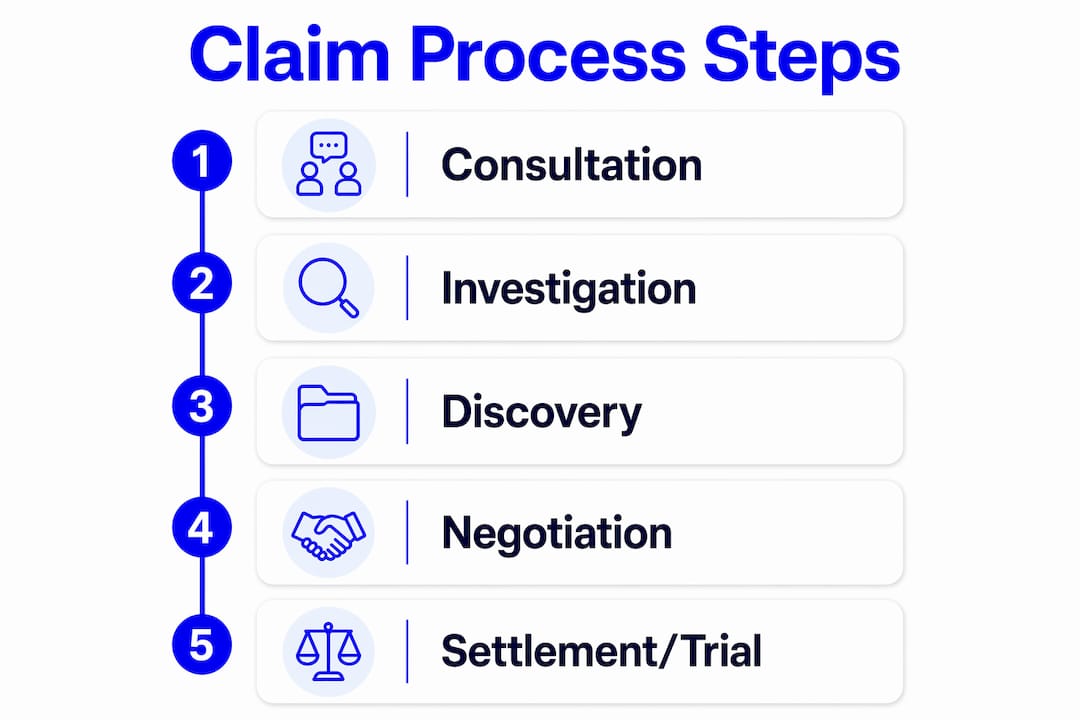
The spinal injury legal process follows a defined sequence of steps. Each phase has its own timeline and requirements.
- Attorney consultation: You meet with a personal injury attorney who evaluates liability, damages, and the strength of your case. Most work on contingency, meaning no upfront fees.
- Medical record collection and investigation: Your attorney gathers hospital records, imaging, physician reports, and accident documentation to build the factual record.
- Filing the claim or lawsuit: A demand letter goes to the insurer, or a formal complaint is filed in court. Filing a lawsuit triggers the discovery process.
- Discovery: Both sides exchange evidence, take depositions, and retain expert witnesses. The discovery phase legally compels defendants to disclose evidence they might otherwise withhold, which significantly increases negotiation leverage.
- Settlement negotiations: Most cases resolve here. Negotiations can last 12 to 24 months as both sides assess liability and damages.
- Trial: If no agreement is reached, the case goes before a judge or jury. Trials add time and cost but sometimes produce larger verdicts.
The full legal process spans 18 to 36 months when taken to trial. The discovery phase alone can last 3 to 18 months depending on case complexity.
Pro Tip: Never settle before reaching maximum medical improvement (MMI). MMI is the point at which your condition has stabilized and your doctors can project your long-term prognosis. Settling before MMI means you may accept far less than your future costs actually require.
The statute of limitations is a hard deadline. Ohio, for example, enforces a 2-year filing deadline under Ohio Revised Code Section 2305.10. Most states set limits between 1 and 3 years from the accident date. Missing that deadline ends your claim permanently.
| Phase | Typical duration |
|---|---|
| Attorney consultation and investigation | 1–3 months |
| Discovery | 3–18 months |
| Settlement negotiations | 12–24 months |
| Trial (if required) | Adds 6–12 months |
| Total process | 18–36 months |
Comparative fault rules also affect your recovery. If you are found partially responsible for the accident, your compensation reduces by your percentage of fault. In some states, being more than 50% at fault bars recovery entirely.
Common challenges and practical tips for your claim
Insurance companies treat spinal cord injury claims as major financial exposures. Their adjusters are trained to minimize payouts from the first contact. Knowing their tactics protects you.
- Early lowball offers: Insurers often make quick settlement offers before you know the full extent of your injuries. These offers rarely reflect lifetime costs. Reject them and wait for a complete medical picture.
- Recorded statements: Adjusters may ask for recorded statements and use your words to reduce liability. Decline until you have legal representation.
- Surveillance: Insurers sometimes conduct physical surveillance or review your social media to find evidence that contradicts your injury claims. Limit public posts during your claim.
- Disputing causation: Defendants often argue that your spinal condition was pre-existing. Strong medical documentation linking the accident directly to your injury defeats this argument.
Expert witnesses are not optional in serious spinal cord injury cases. You need a Certified Life Care Planner, a medical expert to explain the injury, a vocational expert to quantify lost earning capacity, and sometimes an accident reconstruction specialist.
Structured settlements are common for catastrophic injuries. They combine a lump sum with periodic payments over time. Under IRC §104(a)(2), structured settlement payments are tax-free, which makes them financially superior to a single large payment for many claimants.
Pro Tip: When selecting an attorney, look specifically for experience with catastrophic injury cases, not just general personal injury work. Ask how many spinal cord injury cases they have handled and whether they work with Certified Life Care Planners. The settlement factors in spinal cord cases are far more complex than in standard car accident claims.
Key Takeaways
A spinal cord injury claim requires proving negligence, documenting all economic and non-economic losses, and following a legal process that typically spans 18 to 36 months from filing to resolution.
| Point | Details |
|---|---|
| Claim definition | A spinal cord injury claim is a personal injury action requiring proof of duty, breach, causation, and damages. |
| Damages scope | Claims cover medical costs, lost wages, home modifications, attendant care, pain and suffering, and emotional distress. |
| Valuation method | Life care plans and the multiplier method (1.5 to 5x economic damages) determine total compensation. |
| Legal timeline | The full process spans 18 to 36 months, with strict statute of limitations deadlines that vary by state. |
| Settlement strategy | Never settle before reaching maximum medical improvement, and reject early lowball offers from insurers. |
What I've learned after watching too many claimants settle too soon
The single most damaging mistake I see in spinal cord injury cases is settling before the full picture is clear. Claimants are exhausted, financially stressed, and desperate for relief. Insurers know this and time their offers accordingly. A settlement that looks generous in month three can be catastrophically inadequate by year two when the true cost of lifetime care becomes apparent.
The second mistake is underestimating the power of documentation. A 400-page life care plan from a credentialed Certified Life Care Planner does not just add numbers to a claim. It changes the entire negotiation dynamic. Insurers settle faster and higher when they face a detailed, expert-backed projection they cannot easily dispute.
The emotional weight of these cases is real. You are not just fighting for money. You are fighting for your ability to live with dignity, access care, and maintain some version of the life you had planned. That fight deserves patience, the right legal team, and a refusal to accept less than what your future actually costs. If you feel pressure to settle quickly, treat that pressure as a signal to slow down, not speed up. The claim timeline is long for a reason. Use every phase of it.
— Gerard
How Carcollisionlawyer connects you with the right legal support
Spinal cord injury cases require attorneys who specialize in catastrophic injuries, not general practitioners handling fender-benders between other cases.

Carcollisionlawyer connects people injured in serious accidents with attorneys who handle high-stakes injury claims every day. The free evaluation process lets you understand your potential spinal cord injury compensation without any upfront commitment. You answer questions about your injury and circumstances, and Carcollisionlawyer matches you with legal professionals who have the specific experience your case demands. If you were injured in a car, motorcycle, or truck accident, start with a free case evaluation to understand what your claim may be worth.
FAQ
What is a spinal cord injury claim?
A spinal cord injury claim is a personal injury lawsuit or demand for compensation filed against a negligent party whose actions caused damage to your spinal cord. It requires proving duty of care, breach, causation, and damages to succeed.
How much is a spinal cord injury claim worth?
Settlements typically range from $250,000 to over $10 million, with catastrophic cases exceeding $20 million. The value depends on injury severity, lifetime care costs, lost earnings, and jurisdictional rules.
How long does a spinal cord injury claim take?
The full legal process spans 18 to 36 months when taken to trial. Settlement negotiations alone can last 12 to 24 months, and the discovery phase may run 3 to 18 months.
What is the statute of limitations for a spinal cord injury claim?
Most states require filing within 1 to 3 years from the accident date. Ohio, for example, enforces a strict 2-year deadline. Missing this deadline permanently bars your claim.
Do I need an expert witness for a spinal cord injury claim?
Yes. Serious spinal cord injury cases require a Certified Life Care Planner, a medical expert, and often a vocational expert to accurately document and prove the full scope of your damages.