
A letter of protection (LOP) is an attorney's written promise to a medical provider, agreeing to pay for a patient's treatment out of a future settlement or court judgment. It lets an injured person get care now instead of waiting on insurance or their own bank account. The catch: the patient stays personally on the hook for that bill if the case settles for too little or falls apart entirely.
TL;DR:
- Providers are more likely to accept LOPs when they trust the attorney’s track record and believe the case has a strong liability or injury record.
- The timeline from treatment to payment can stretch over a year, with attorneys disbursing funds only after settlement checks clear under strict trust account rules.
- Patients remain personally liable for medical bills regardless of case outcome, even if the settlement falls short or the case is dismissed.
- Not all providers accept LOPs, and refusals are common among smaller practices or practices with limited cash flow, which may affect access to care.
- LOPs are enforceable and create a legal interest in settlement proceeds, but do not guarantee payment, and attorneys must disclose ongoing personal liability to clients.
Table of Contents
- What Is a Letter of Protection, Exactly?
- How an LOP Plays Out from First Visit to Final Check
- Who Actually Owes What: Patient, Attorney, and Provider Roles
- When Does an LOP Actually Make Sense?
- Is an LOP Legally Binding?
- How Medical Bills Actually Get Paid Once You Settle
- The Real Risks and What You Can Do Instead
- Getting an LOP: What to Prepare and Ask
- A Straight Answer About Where LOPs Actually Fit
- Get Matched With an Attorney Who Handles LOPs Regularly
- Where to Read the Original Guidance
- Sources
- FAQ
What Is a Letter of Protection, Exactly?
A letter of protection is a signed document, usually on the attorney's letterhead, sent directly to a hospital, surgeon, physical therapist, or specialist. It tells the provider: treat this patient now, and we will pay you from the proceeds of the case once it resolves. The provider isn't billing the patient's insurance or demanding payment at the time of service. It's waiting on the outcome of the lawsuit or claim, often because the patient has run through PIP benefits, doesn't have health insurance, or is worried a provider won't touch a case tied to litigation.
That's different from a medical lien, which is a legal claim a provider files against settlement funds, usually after treatment has already happened and often under a specific state lien statute. An LOP is proactive, opening the door to care before it starts. A lien is reactive; it secures payment for care that already occurred. Some providers use both, an LOP to begin treatment and then a lien to formalize their claim against the eventual recovery.
Health insurance and personal injury protection (PIP) work on a completely different logic. Those pay claims according to policy terms, regardless of who's at fault or how the legal case turns out. An LOP has no such guarantee behind it. It is a bet the provider makes on the strength of the case and the attorney's reputation.
Providers accept LOPs for a few practical reasons:
- They trust the attorney has a track record of paying out claims fairly.
- Medical documentation of the injury actually strengthens the legal case, so providers know their records matter to the outcome.
- The provider believes there's a real chance of recovery based on the facts (a clear liability case, adequate insurance coverage on the other side, or significant injuries).
Not every provider says yes. Orthopedic surgeons and specialists often accept LOPs more readily than smaller practices, which may lack the cash flow to wait months or years for payment.
How an LOP Plays Out from First Visit to Final Check
The mechanics are more linear than people expect, though the timeline can stretch far longer than anyone wants.
- The attorney drafts the letter. After taking the case, the lawyer identifies providers willing to treat under an LOP and sends a formal letter stating the promise to pay from settlement proceeds.
- The patient begins treatment. Care proceeds as normal. No copays, no upfront billing, no insurance paperwork slowing things down.
- The provider bills against the case file, not the patient. Instead of monthly statements to the patient, the provider tracks the balance and sends records and bills to the attorney's office as treatment continues.
- The attorney negotiates the case. This can take months. Serious injury claims routinely run past a year, especially if the injury requires ongoing treatment before reaching maximum medical improvement.
- Settlement or judgment happens. Once funds arrive, they land in the attorney's client trust account, not the client's personal bank account and not the provider's.
- The attorney pays providers from trust funds. This happens after the money has fully cleared, a process bound by "good funds" rules that prevent lawyers from disbursing against a check that hasn't settled.
- The client receives the remaining balance. After medical bills, liens, and attorney fees are paid out, whatever is left goes to the client.
Pro Tip: Ask your attorney for a written itemized settlement statement before any money moves. It should show exactly what each provider is owed, what's being negotiated down, and what you'll actually receive. A verbal promise isn't enough when real money is on the line.
The "good funds" step trips people up the most. Settlement checks, even certified ones, typically need to clear the bank before an attorney can ethically distribute a cent. That's often a delay of days, sometimes longer with larger checks or insurer-issued drafts, and it's not something your attorney can rush no matter how badly you want your check.
Who Actually Owes What: Patient, Attorney, and Provider Roles
An LOP creates a three-way relationship, and each party carries distinct obligations that don't disappear once the ink dries.
The patient signs the LOP (or authorizes it) and remains personally liable for the medical debt the entire time. If the case settles for less than expected, gets dismissed, or the defendant turns out to be judgment-proof, the patient still owes the provider. The LOP shifts the timing of payment, not the underlying responsibility.
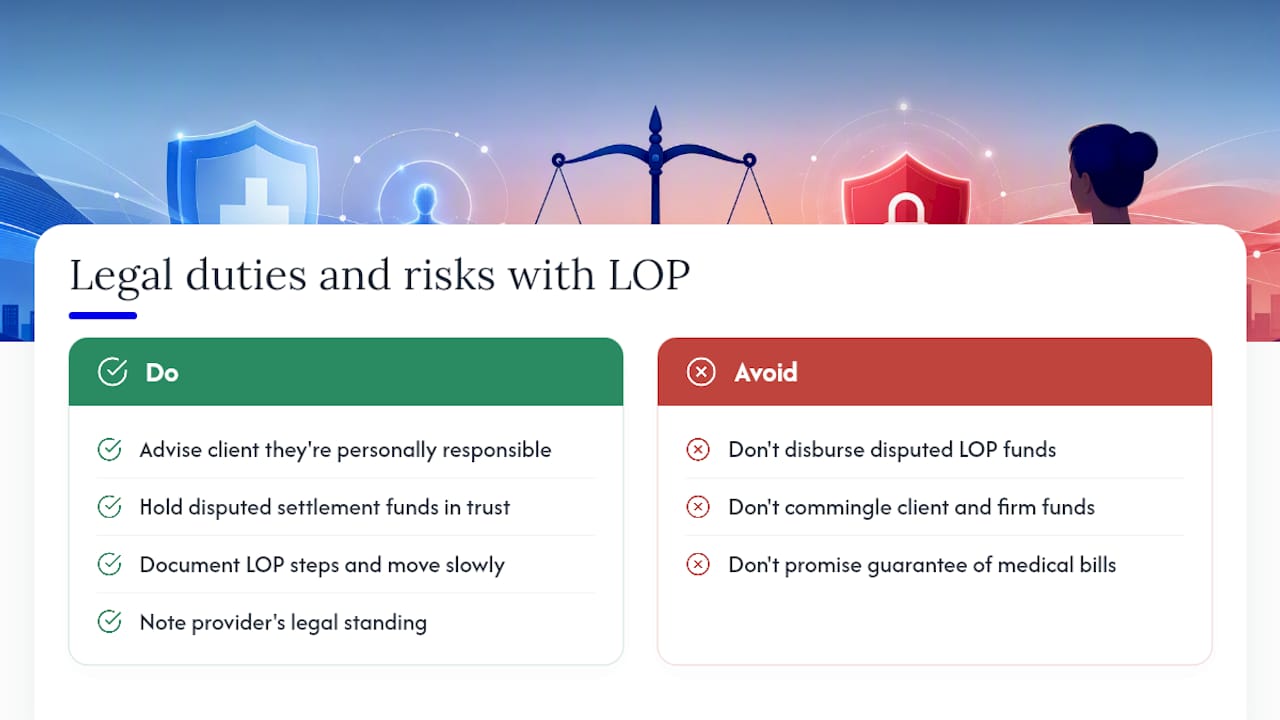
The attorney takes on real ethical duties once an LOP is issued. State ethics opinions are clear that lawyers must:
- Disclose to the client, in plain terms, that they remain personally liable even with an LOP in place.
- Negotiate lien or bill reductions where possible, but never promise a specific payoff amount they can't guarantee.
- Hold any disputed funds in the client trust account until the dispute is resolved, rather than paying out unilaterally.
- Avoid commingling client and provider funds with the firm's own operating money.
The provider has three real options once approached with an LOP request: accept it and treat on the promise of future payment, insist on a formal lien arrangement instead (which gives them stronger legal footing to collect), or decline treatment altogether and refer the patient elsewhere. None of these choices are unusual, and a provider's refusal isn't a sign anything went wrong with the request. It's often just a matter of that practice's cash flow tolerance.
When Does an LOP Actually Make Sense?
Not every injury claim needs one. LOPs solve a specific problem: the gap between needing care and having a way to pay for it right now.
- Insurance is stalling or denying the claim. Auto insurers sometimes drag out liability disputes for weeks while a patient needs an MRI or a surgical consult immediately.
- PIP or health insurance benefits ran out. Many state PIP policies cap out at a modest dollar amount, which barely covers an ER visit, let alone months of physical therapy.
- The patient has no health insurance at all. This is one of the most common situations where LOPs come into play, since there's no other coverage bridging the gap.
- Out-of-pocket costs would force the patient to skip necessary treatment. Delaying an orthopedic surgery for financial reasons can also hurt the legal case, since gaps in treatment give insurance adjusters an argument that the injury wasn't serious.
- A specialist wants assurance before scheduling a procedure. Surgeons in particular often want the LOP formalized before booking an operating room, since surgical costs run high and collection after the fact is harder.
If you already have solid health insurance and a modest treatment plan, an LOP may not add much value and could complicate the eventual settlement math. It tends to matter most for people facing real financial pressure who would otherwise delay care they need.
Is an LOP Legally Binding?
Courts and state bar associations generally treat a letter of protection as creating an enforceable financial interest in the proceeds of a claim, even though it isn't a contract in the traditional two-sided sense. The provider is relying on the promise; the attorney and client are making one. That reliance is exactly what gives providers legal standing to pursue payment later, sometimes through direct suit against the patient if the attorney's office doesn't pay.
Ohio's state bar addressed this directly in a widely cited advisory opinion, laying out what lawyers must do once an LOP is on the table.
A letter of protection can create a lawful interest in the proceeds of a settlement or judgment. Attorneys who issue LOPs must advise clients that they remain personally responsible for the underlying debt, and must hold any disputed portion of settlement funds in trust until the dispute is resolved rather than disbursing unilaterally.
That guidance from the Ohio Ethics Opinion 2023-10 reflects a pattern seen across other states as well: LOPs are enforceable enough to expose clients to real risk, but they're not a substitute for a guaranteed payout. Attorneys who mismanage trust accounts around disputed LOP funds, whether by paying a provider before a dispute is settled or by commingling client money with firm operating funds, face bar discipline separate from any malpractice exposure. That's a serious professional risk, and it's part of why careful attorneys move slowly and document everything once an LOP is in play.
Clients need to hear this plainly, not buried in fine print: an LOP does not mean the lawyer is personally guaranteeing your medical bills. It means the lawyer is promising to pay from a specific, uncertain future source. If that source comes up short, the provider can still come after the patient directly.
How Medical Bills Actually Get Paid Once You Settle
Settlement day isn't the finish line for medical bills. It's the start of a negotiation and disbursement process that can take a few extra weeks.
- Providers formally assert their claims. Anyone treating under an LOP, plus any provider holding a formal lien, submits a final bill and often documentation supporting the charges.
- Attorneys negotiate reductions where possible. It's common practice for lawyers to push back on inflated bills, especially from providers who bill at rates far above what insurance would have paid, and many providers agree to accept a percentage reduction to get paid faster and avoid litigation over the balance.
- A settlement statement lays out the math. This document itemizes the total settlement, attorney fees, case costs, each provider's claim, and the client's net recovery, and it should be shared with the client before any checks go out.
- Funds must clear before disbursement. Even after the settlement statement is agreed, money sits in the trust account until the check is confirmed as good funds.
- Undisputed amounts get paid promptly. Once cleared, attorneys are expected to disburse the parts everyone agrees on without unnecessary delay.
- Disputed amounts stay put. If a provider disagrees with a proposed reduction, that portion stays in trust. In extreme cases, an attorney may file an interpleader action, asking a court to decide who's owed what, rather than risk paying the wrong party.
Reducing what's owed to providers directly affects how much money the client actually walks away with. Understanding how medical liens interact with a settlement and how billed versus paid amounts factor into the final number helps set realistic expectations well before the check arrives.
The Real Risks and What You Can Do Instead
The single biggest misunderstanding about LOPs is thinking they eliminate the medical debt if the case doesn't pan out. It doesn't work that way.
- Personal liability survives a bad outcome. A low settlement, a lost trial, or an uninsured defendant with no assets can leave the patient owing the full balance directly to the provider.
- Providers can and do sue for unpaid balances. An LOP doesn't waive a provider's right to collect through normal means if the case falls through.
- Some providers will refuse an LOP outright. Smaller practices often can't absorb the wait, and refusal is common enough that it shouldn't derail your plan for care.
- Warning sign: a provider demanding you sign broader authorization than the treatment requires, or pushing for an LOP that doesn't specify a payment cap, deserves a second look before you sign anything.
Alternatives worth exploring before committing to an LOP include using any remaining PIP or health insurance benefits first, since those don't carry personal liability the same way. Some claimants use pre-settlement funding companies, though those often come with steep fees and should be read carefully before signing. Negotiating a self-pay rate directly with a provider, which is sometimes lower than the billed insurance rate, is another underused option.
Pro Tip: Before signing an LOP, ask the provider for their self-pay or cash rate. Some practices discount significantly for patients paying out of pocket or under an LOP compared to what they'd bill an insurance company, and that difference can matter a great deal at settlement.
Getting an LOP: What to Prepare and Ask
Getting a letter of protection issued moves faster when you walk into the conversation prepared.
- Gather your records first. Pull together prior medical history relevant to the injury, current provider contact information, and any bills already received.
- Ask your attorney direct questions about scope. Confirm exactly which providers and treatments the LOP covers, whether there's a dollar cap, and what happens if treatment costs exceed initial estimates.
- Ask who holds liability if the case underperforms. Get a straight answer, in writing if possible, about your personal exposure.
- Ask how settlement funds will be handled. Confirm the attorney will provide a written settlement statement before any disbursement.
- Limit your medical record releases. Under HIPAA, you can restrict a release to relevant providers and date ranges rather than signing a blanket authorization that hands over your entire medical history.
- Document every agreement in writing. Verbal promises about payment or coverage aren't worth much once a dispute starts.
A Straight Answer About Where LOPs Actually Fit
Most articles on this topic treat LOPs like a clean solution: sign here, get treated, get paid at the end. That framing undersells the risk. The gap between "the attorney will handle it" and "you are still legally on the hook" is where a lot of injured people get burned, not because attorneys are acting in bad faith, but because nobody sat down and explained the downside clearly before the signature happened.
What doesn't get said enough: the strength of your case matters more than the paperwork. An LOP is only as good as the settlement behind it. A weak liability case with a low policy limit on the other side means an LOP just delays a bill you'll eventually have to pay yourself. That's why matching with the right attorney for your specific facts, someone who's negotiated LOPs before and knows which providers in your area will work with injury claimants, matters more than the LOP document itself.
A free evaluation process exists for this gap. Submitting a case for review connects claimants with attorneys who routinely work through LOP arrangements and lien negotiations, rather than leaving someone to figure it out through a general search. After submission, you can expect a case reviewer to assess the basic facts and route you toward local counsel suited to your injury type, with no obligation attached. Details submitted are handled according to the site's privacy policy, and nothing about the evaluation commits you to hiring anyone.
— Gerard
Get Matched With an Attorney Who Handles LOPs Regularly
Finding a provider willing to accept a letter of protection is only half the battle. The harder part is finding an attorney who negotiates them well and won't leave you exposed at settlement. A free evaluation connects injury claimants with local attorneys experienced in exactly this kind of arrangement, car accidents, truck collisions, motorcycle wrecks, and more, without any upfront cost or obligation to hire.
The process takes a few minutes: describe your injury and how the accident happened, and the evaluation routes your case toward attorneys suited to that specific situation rather than a generic referral list. If you're weighing whether an LOP makes sense for your treatment plan, getting matched with counsel who already knows the local providers willing to work under one saves real time. Start your free case evaluation today and find out where you stand before your next medical appointment.
Where to Read the Original Guidance
- HHS guidance on medical records access covers your right to inspect and copy your own records under HIPAA.
- HHS Right to Access FAQs explains the limits providers face when patients request or restrict record releases.
- Ohio Ethics Opinion 2023-10 lays out attorney obligations when issuing letters of protection.
- The ABA's Litigation Journal details proper settlement fund distribution and trust account practice.
- The CFPB's research on medical debt provides broader context on why access-to-care tools matter for injury claimants.
Sources
- HHS — Medical records: patients' right to access
- Ohio Ethics Opinion 2023-10 — Lawyer’s Obligation When Letter of Protection Issued
- CFPB — Medical debt burden in the United States
FAQ
What Is a Letter of Protection?
A letter of protection is an attorney's written promise to a medical provider to pay for a patient's treatment from a future settlement or judgment, rather than collecting payment upfront. It lets injured people access care immediately, but the patient remains personally responsible for the bill if the case doesn't produce enough recovery.
Is a Letter of Protection the Same as a Lien?
No. An LOP is issued before or during treatment to arrange payment later, while a medical lien is typically filed after treatment to formally secure a provider's claim against settlement proceeds. Providers sometimes use both together, starting with an LOP and later formalizing a lien.
Can You Give an Example of a Letter of Protection?
A typical LOP is a short letter on law firm letterhead stating that the firm represents a named patient in a pending injury claim, that the provider is authorized to treat the patient, and that the firm agrees to pay the provider's bill from settlement or judgment proceeds once the case resolves. It usually includes the case details, provider contact information, and sometimes a cap on the amount covered.
Is a Letter of Protection Legally Binding?
Yes, in the sense that it creates an enforceable interest in settlement proceeds, and providers can pursue payment if that promise isn't honored. It does not guarantee payment in a fixed amount, and state ethics guidance requires attorneys to disclose that the client remains personally liable regardless of the LOP.
How Long Does It Take to Get Paid Under an LOP?
Timing depends entirely on how long the underlying case takes to settle, which can range from a few months to well over a year for complex injury claims. Once settlement funds clear the attorney's trust account under good funds rules, undisputed provider payments are typically issued promptly.