
Treating physicians generally testify as fact witnesses about their own observations, diagnoses, and care decisions. That's the baseline. The moment a physician steps beyond what they personally observed and documented during treatment — offering opinions on causation, permanency, or future costs — they risk being reclassified as an expert or "hybrid" witness, triggering a different set of discovery rules entirely.
Three things follow from that distinction:
- Disclosure format shifts. A treating physician limited to fact testimony typically needs only a summary disclosure under Federal Rule of Civil Procedure 26(a)(2)(C), not a full written report. Offer one causation opinion formed after reviewing litigation materials, and courts often demand the full Rule 26(a)(2)(B) report.
- Credibility is real and earned. A doctor who treated a patient for months carries a different kind of authority than a retained expert who examined the plaintiff once. Jurors notice that difference.
- The reclassification risk is the most dangerous trap. Attorneys who fail to decide early whether their treating physician will offer post-treatment opinions routinely face preclusion motions, sanctions under Rule 37, and last-minute scrambles to find a retained expert. That mistake is avoidable.
The sections below cover the full scope: what treating physicians can and cannot say, the triggers that convert a treater into a hybrid witness, how Rule 26 governs disclosure, what subpoenas can compel, how treater testimony plays at trial, and a practical checklist for attorneys and physicians preparing for deposition or the stand.
Key Takeaways
The role of treating physician testimony in U.S. personal-injury cases is powerful within its lane, but crossing into expert-opinion territory without proper disclosure is the single most avoidable way to lose that testimony entirely.
| Point | Details |
|---|---|
| Fact-witness baseline | Treating physicians testify to observations, diagnoses, and care decisions documented during treatment. |
| Reclassification trigger | Causation, prognosis, or permanency opinions formed outside treatment convert a treater to a hybrid or retained expert under Rule 26. |
| Disclosure risk | Inadequate Rule 26(a)(2)(C) summary disclosures can result in preclusion under Rule 37(c)(1); plan disclosures conservatively. |
| Subpoena scope | Fact witnesses can be compelled to testify about treatment; HIPAA requires patient authorization or a court order before records are produced. |
| Carcollisionlawyer | Free attorney matching connects accident victims to counsel experienced in medical-testimony strategy and disclosure planning. |
Table of Contents
- What does treating physician testimony normally cover?
- When does a treating physician become a hybrid or expert witness?
- What are the limits on treating physician testimony?
- How do Rule 26 disclosure obligations work for treating physicians?
- What can a subpoena compel a treating physician to provide?
- How is treating-physician testimony used at trial?
- How should attorneys and physicians prepare for depositions and trial?
- What ethics and professional obligations govern physician testimony?
- A practitioner's perspective on treating-physician testimony strategy
- How Carcollisionlawyer connects you with attorneys who handle medical testimony
- Sources
What does treating physician testimony normally cover?
The Reference Manual on Scientific Evidence draws a clean line: treating physicians are percipient witnesses. They testify to what they personally observed, recorded, and decided during the course of care. That scope is broader than people assume, but it has a ceiling.
Admissible fact-witness testimony from a treating physician typically includes:
- Dates and findings from clinical examinations
- Diagnoses made during treatment and the reasoning behind them
- Procedures performed and the patient's documented response
- Contemporaneous diagnostic test results (imaging, labs, specialist referrals)
- Why specific treatments were chosen, based on the medical record at the time
A treating physician can also testify to the patient's reported complaints, as long as those complaints were recorded in the normal course of care rather than assembled for litigation. Courts generally allow this because it falls within the physician's direct, firsthand knowledge.
What typically exceeds the fact-witness baseline: opinions on causation that required a specialized differential diagnosis, prognosis and permanency assessments that were never part of the treatment plan, projected future medical costs, and any opinion formed after reviewing records or materials that were created specifically for the lawsuit. Those subjects push the testimony into expert territory, and the procedural consequences are significant.

When does a treating physician become a hybrid or expert witness?
The reclassification from fact witness to expert or hybrid witness is not a formality. Courts apply a functional test: did the physician form this opinion during treatment, or did they form it because litigation required it? The answer drives everything from disclosure format to Daubert challenges.
-
Causation or prognosis opinions formed outside treatment. If a physician was never asked during care whether the accident caused the injury, and they form that opinion only after being retained or subpoenaed, courts treat that opinion as expert testimony. The Tillman v. opinion from Florida's Fifth District Court of Appeal is instructive: treating physicians designated in expert disclosures who intend to testify about permanency, prognosis, or causation beyond their contemporaneous treatment are hybrid witnesses subject to broader discovery, including inquiries into financial bias.
-
Reviewing records created for litigation. A physician who reviews a stack of records assembled by plaintiff's counsel, or who reads an accident reconstruction report to form a causation opinion, has crossed into retained-expert territory in many courts. The N.D. New Mexico court guidance states this plainly: whether a treater must produce a written report turns on whether opinions were formed during treatment or after reviewing litigation materials.
-
Relying on outside specialists' records not reviewed in real time. If a physician pulls in another provider's records post-treatment to support a litigation opinion, that reliance can trigger expert-report obligations.
-
Permanency and future-cost opinions beyond contemporaneous decisions. A physician who never documented a permanency assessment during treatment but offers one at deposition is offering a new expert opinion, not recalling a treatment decision.
The procedural consequence of reclassification is serious. Once a court finds hybrid or retained-expert status, Rule 26(a)(2)(B) report requirements apply, and the physician's opinions become subject to Daubert challenges under Federal Rule of Evidence 702. Courts have excluded treater testimony entirely when counsel failed to anticipate this. Early planning is not optional.
What are the limits on treating physician testimony?
The subject-matter limits on treating-physician testimony are doctrinal, not just tactical. Understanding them helps both sides predict what will survive a motion in limine.
Typical subject-matter limits:
- Causation opinions that required a specialized differential diagnosis the physician never performed during care
- Prognosis and permanency assessments not documented in the contemporaneous medical record
- Complex future-care cost projections that go beyond what the treating team actually planned
- Any opinion formed by reviewing materials assembled for litigation rather than for clinical purposes
Common defense strategies to narrow or exclude treater testimony:
- Daubert or Frye-style reliability challenges arguing the physician's methodology was clinical intuition rather than a reproducible expert analysis
- Arguing the physician relied on hearsay from other providers' records not reviewed during treatment
- Pointing to inconsistencies between the physician's deposition testimony and their contemporaneous notes
- Moving to preclude testimony for inadequate Rule 26 disclosure, particularly when the plaintiff failed to disclose the scope of opinions the treater would offer
The StatPearls summary of expert witness functions draws a useful contrast: retained medical experts in malpractice cases are expected to establish the standard of care, opine on deviation, and assess causation. Treating physicians are not retained for those tasks, and courts are skeptical when treaters try to perform them without proper disclosure.
Pro Tip: Preserve the admissible parts of a treater's testimony by narrowly tailoring the Rule 26(a)(2)(C) summary disclosure to opinions actually formed during care. If the physician will also offer post-treatment opinions, disclose that separately and decide early whether a full report is needed. Mixing the two without a plan invites a motion to exclude both.
How do Rule 26 disclosure obligations work for treating physicians?
Federal Rule of Civil Procedure 26 creates two tracks for expert disclosure, and which track applies to a treating physician depends entirely on what they will say at trial.
The two tracks:
- Rule 26(a)(2)(B) applies to retained or specially employed experts. It requires a full written report: a complete statement of all opinions, the basis and reasons for each, the data or information considered, any exhibits, the witness's qualifications, a list of prior testimony, and compensation. This is the full package.
- Rule 26(a)(2)(C) applies to non-retained experts, including most treating physicians testifying within the scope of their care. It requires only a summary disclosure: the subject matter of the expected testimony and a summary of the facts and opinions to be offered.
A compliant Rule 26(a)(2)(C) summary disclosure for a treating physician should identify: the physician's name and specialty, the time period of treatment, the subject matter of testimony (e.g., diagnosis, treatment course, response to care), and a plain-language summary of the opinions the physician will offer. Courts vary on how detailed that summary must be, but vague disclosures like "will testify consistent with medical records" routinely get challenged.
Rule 26(a)(2)(C) requires a party to disclose the subject matter on which the witness is expected to present evidence and a summary of the facts and opinions to which the witness is expected to testify. Courts have interpreted this to require more than a bare reference to medical records — a meaningful summary of the anticipated opinions is expected.
Sanctions for noncompliance are real. Rule 37(c)(1) authorizes preclusion of testimony when a party fails to make required disclosures, unless the failure was substantially justified or harmless. Courts have excluded treating-physician testimony entirely when the summary disclosure was too vague or when the physician offered opinions at deposition that were never disclosed. Opposing counsel routinely moves to preclude on this basis, and judges grant those motions more often than plaintiffs expect.
There is also meaningful circuit-level variation. Some courts allow post-treatment opinions under a summary disclosure; others require a full report when opinions go beyond the scope of care. Practitioner analysis documents this split across circuits, and the Sixth Circuit has been notably divided on where to draw the line. Treat the question as jurisdiction-specific and plan disclosures conservatively.
What can a subpoena compel a treating physician to provide?
Treating physicians can be compelled to testify as fact witnesses through a standard deposition or trial subpoena. The scope of that compulsion, however, is not unlimited, and HIPAA adds a layer that both physicians and attorneys need to manage carefully.
Checklist for responding to a subpoena as a treating physician:
- Identify the subpoena type: is it a records subpoena, a deposition subpoena, or a trial subpoena? Each carries different obligations.
- Confirm the scope: does it seek records only, testimony only, or both?
- Contact the patient's attorney (if the patient is your patient) or your own counsel before producing anything.
- Preserve privilege issues: attorney-client and work-product protections may apply to communications between the physician and counsel.
- Review the records requested before producing them to confirm no protected third-party information is included.
As a fact witness, a treating physician can generally be compelled to testify about their observations, treatment decisions, and documented findings. University of Wisconsin Office of Legal Affairs guidance confirms that fact witnesses must testify to their observations and acts but may be shielded from forced expert-style reports unless reclassified. A physician who has not been retained as an expert and who limits testimony to treatment facts cannot typically be forced to generate a written expert report.
HIPAA permits disclosure of protected health information in response to a court order or a subpoena accompanied by satisfactory assurance that the patient has been notified or that a qualified protective order is in place. Physicians should not produce records based on a subpoena alone without confirming these conditions are met.
When a court orders disclosure over a patient's objection, the physician should involve counsel, produce only what the order requires, and document the basis for disclosure. Voluntary production beyond the order's scope is both legally risky and ethically problematic under AMA guidance.
How is treating-physician testimony used at trial?
Treating physicians typically appear at trial for four purposes: establishing the foundation for the injury, building the timeline of care, supporting damages, and corroborating the plaintiff's subjective complaints with objective clinical findings. That last function is often the most valuable. A jury that hears a plaintiff describe pain is more persuaded when a physician who treated that patient for months confirms the clinical picture matches.
Common cross-examination themes opposing counsel uses:
- Inconsistencies between the physician's trial testimony and their contemporaneous notes (the notes are usually the more reliable record)
- Absence of objective testing to support the diagnosis or severity claimed
- Financial relationship between the physician and plaintiff's counsel, particularly in cases involving letters of protection or medical liens
- Limits of the physician's training for specialized causation questions outside their specialty
- The fact that the physician never documented certain complaints until after the lawsuit was filed
Juror perception matters here. A physician who treated a patient over months or years carries a different kind of credibility than a retained expert who examined the plaintiff once for two hours. The longitudinal relationship signals that the physician's opinions were formed for clinical reasons, not litigation reasons. That distinction affects weight, not admissibility, but weight is often what decides a case.
Pro Tip: Prepare the treating physician to explain, in plain language, why they made each clinical decision. Jurors respond well to physicians who can connect their notes to their testimony without hesitation. A physician who sounds uncertain about their own records loses credibility fast.
For cases involving psychological injury claims, treating psychiatrists and mental-health providers face the same fact-versus-expert distinction, with additional complexity around diagnostic methodology and causation.
How should attorneys and physicians prepare for depositions and trial?
The most common and costly mistake in personal-injury practice is failing to decide early whether the treating physician will offer opinions beyond direct treatment. That single decision drives disclosure strategy, whether a written report is required, and whether a retained expert needs to supplement the treater's testimony.
Attorney checklist:
- Decide at the outset whether the treater will offer causation, prognosis, or permanency opinions. If yes, plan for either a full Rule 26(a)(2)(B) report or a detailed Rule 26(a)(2)(C) summary, depending on your jurisdiction.
- Prepare clear, specific disclosures. Vague disclosures invite preclusion motions.
- Coordinate with any retained experts to avoid contradictions in the medical narrative.
- Identify which records the physician reviewed during treatment versus which they reviewed after the lawsuit was filed. Keep those categories separate in your disclosure.
- Confirm local rules and standing orders. Some districts require earlier expert disclosures than the federal default.
Physician checklist:
- Keep contemporaneous, specific notes. Vague entries like "patient reports pain" are harder to defend than detailed clinical observations.
- Avoid offering litigation-driven opinions without counsel's involvement and a clear plan for disclosure.
- When served with a subpoena, contact counsel before producing records or agreeing to a deposition date.
- Review the scope of any subpoena carefully. You are not obligated to offer expert opinions as a fact witness.
- Preserve all records related to the patient's care, including communications with other providers.
Dos and don'ts for the witness stand:
- Do answer only the question asked. Volunteering information outside the question creates openings for cross-examination.
- Do say "I don't know" or "I don't recall" when that is accurate. Guessing is worse than admitting uncertainty.
- Do use plain language. Medical jargon that jurors cannot follow reduces your effectiveness.
- Don't argue with opposing counsel. Answer the question and let your attorney handle the rest.
- Don't offer opinions outside your documented treatment unless you have been properly disclosed as an expert and prepared for that role.
The AMA's guidance on giving medical testimony emphasizes that family physicians and long-term treating providers bring a unique longitudinal perspective to the stand, but that perspective requires courtroom training to be effective. Familiarity with legal processes, cross-examination tactics, and the difference between clinical and legal standards of certainty all need to be covered before the deposition.
For cases where settlement factors are being evaluated, the treating physician's documented findings often anchor the damages calculation and directly affect what insurers are willing to offer.
What ethics and professional obligations govern physician testimony?
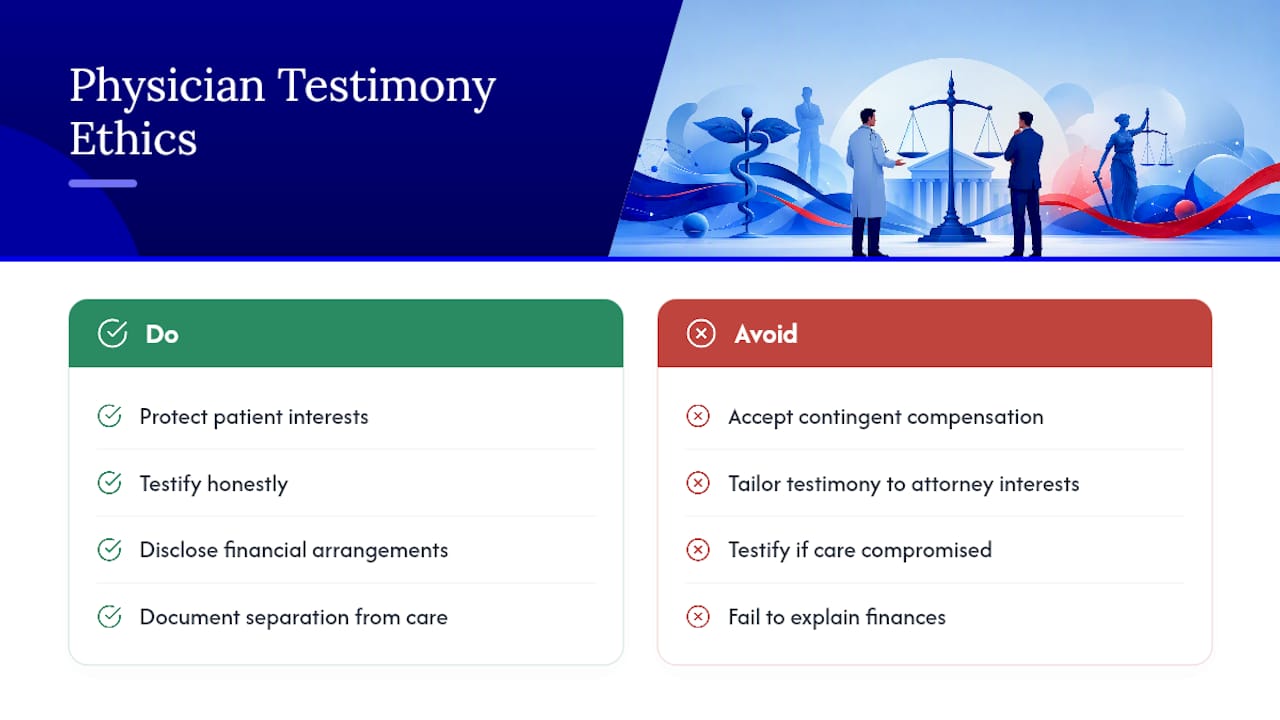
The AMA Code of Medical Ethics sets clear expectations for physicians who testify in legal proceedings. Physicians should assist the administration of justice, but that obligation runs alongside a duty to protect patient interests, testify honestly, and limit testimony to areas where they have appropriate, recent experience.
The AMA's ethics guidance states that physicians must not accept compensation that is contingent on the outcome of litigation. Testimony must be objective and based on medical knowledge, not shaped by the interests of the retaining party. Physicians should also consider whether an adversarial litigation relationship has compromised their ability to continue providing care.
The prohibition on contingency-based compensation for testimony is not just an ethical rule. It is a cross-examination target. Defense counsel routinely asks treating physicians about their financial relationship with plaintiff's counsel, particularly in cases involving letters of protection. A physician who cannot clearly explain the financial arrangement between their practice and the attorney risks having their credibility undermined in front of the jury.
The Reference Manual on Scientific Evidence notes that medical and mental-health professionals make up a large share of testifying experts in U.S. civil cases, and treating physicians are frequently called because they can testify to diagnosis, treatment, and the patient's response to care. That frequency makes the ethical framework more important, not less. A physician who testifies regularly in litigation cases faces heightened scrutiny about objectivity, and the AMA guidance is explicit that testimony must reflect the physician's honest clinical judgment, not advocacy.
Practically, ethical constraints affect two things: whether a treating physician should testify at all (if the litigation relationship has become adversarial enough to compromise care), and how counsel frames that testimony for the jury. A physician who transferred care before testifying, or who clearly documented the separation between clinical decisions and litigation opinions, is a more credible witness than one whose notes appear to have been shaped by the lawsuit.
A practitioner's perspective on treating-physician testimony strategy
The decision of whether to use a treating physician as your primary medical witness, supplement them with a retained expert, or rely entirely on a retained expert is one of the most consequential strategic choices in a personal-injury case. It is also one that gets made too late, too often.
The credibility argument for the treating physician is real. Jurors respond to a doctor who actually cared for the plaintiff, who can speak to the patient's progress over time, and whose opinions were formed in a clinical context rather than a litigation one. That relationship is hard to replicate with a retained expert who reviewed records and examined the plaintiff once.
But credibility alone does not win cases where causation is contested. A treating physician who cannot reliably testify to causation, because they never performed the differential diagnosis required to support that opinion, leaves a gap that opposing counsel will exploit. The retained expert fills that gap, but only if the two witnesses are coordinated. Contradictions between a treater and a retained expert are a gift to the defense.
Practical next steps for attorneys and clients:
- Identify early which opinions the treating physician can offer within the fact-witness lane and which require expert disclosure.
- Coordinate disclosures so the treater's summary and the retained expert's report tell a consistent story.
- Use the treating physician's longitudinal relationship to anchor damages and corroborate subjective complaints; use the retained expert for causation and specialized opinions.
- In settlement negotiations, the treating physician's documented findings often carry more weight with adjusters than a retained expert's report, because they reflect real clinical decisions rather than litigation-driven analysis.
Jurisdictional variance is the final caveat. Local counsel should confirm how their district treats post-treatment opinions, what level of detail a Rule 26(a)(2)(C) summary requires, and whether the circuit has taken a position on the split described in practitioner commentary on the Sixth Circuit's divided approach. Planning disclosures conservatively, as if a full report may be required, is almost always the safer choice.
How Carcollisionlawyer connects you with attorneys who handle medical testimony
When a personal-injury case turns on what a treating physician documented, who they can testify about, and how that testimony is disclosed, you need an attorney who has handled that discovery process before, not one learning it on your case.
Carcollisionlawyer offers a free case evaluation that matches accident victims with attorneys experienced in medical-evidence cases, including cases where treating-physician testimony is central to proving damages and causation. The matching process is built around the specifics of your injury and situation, so you are connected to counsel who understands the medical expert witness landscape in Florida and other key jurisdictions, not a generalist who will figure it out as they go. If your case involves a car, truck, motorcycle, or bicycle accident and medical testimony is part of the picture, start your free evaluation to get matched with an attorney who can assess your disclosure obligations and build a coordinated medical-testimony strategy from day one.
Sources
The rules and cases below are the primary references for anyone researching treating-physician testimony in U.S. civil litigation. Jurisdictional differences are real, and local rules often modify the federal defaults, so checking district-specific standing orders and recent circuit decisions is always worth the time.
- Reference Guide on Medical Testimony - Reference Manual on Scientific Evidence - NCBI Bookshelf
- Tillman v. Opinion (Florida 5th DCA) — treating physicians as hybrid witnesses
- Experts and Discovery Issues (N.D. of New Mexico court guidance)
Jurisdictional variation is not a footnote. Some circuits and districts have developed their own standards for what a Rule 26(a)(2)(C) summary must contain, how courts treat post-treatment causation opinions, and when preclusion is the appropriate sanction for disclosure failures. Always confirm the local rules and any standing orders in the specific district before finalizing your disclosure strategy.
This article is general information, not a substitute for advice from a qualified lawyer. Consult a qualified legal professional about your own circumstances before acting on anything here.