
A medical lien on settlement proceeds is a legal claim that lets hospitals, insurers, Medicare, or Medicaid collect what they paid for your treatment before you see a dime of your injury payout. Some of these claims are fixed by federal law and cannot be ignored. Others are negotiable, sometimes down to a fraction of the original bill, but only if you catch them early and get them in writing. The single best move is to start identifying every lien the day your case opens, not the week it settles.
TL;DR:
- Most liens from hospitals, insurers, Medicare, and Medicaid must be identified early and verified to prevent overpayment or legal liabilities.
- Negotiating hospital and provider liens is often possible by challenging filing procedures, billing reasonableness, or settlement allocation language; Medicare liens require formal procedural requests.
- Medicare's recovery rights are mandatory and enforceable, with potential double recovery penalties if neglected, while Medicaid recovery is limited to medical expenses only.
- Proper documentation, including written payoff agreements and detailed proof of payments, is crucial to avoid personal liability and maintain attorney protection.
- Starting lien identification and negotiations immediately after treatment ends significantly improves net settlement recovery and reduces last-minute surprises.
Table of Contents
- What Is a Medical Lien and How Does It Show Up in a Personal Injury Case?
- Who Can File a Lien and What Are the Common Types?
- How Do Liens Actually Reduce Your Settlement Check?
- How Do Medicare and Medicaid Change the Lien Rules?
- Can You Negotiate a Medical Lien Down, and by How Much?
- What Happens If You Don't Pay a Lien Correctly?
- How Do You Identify and Resolve Liens Before Your Case Settles?
- Why Lien Resolution Deserves More Attention Than It Gets
- Get a Free Case Evaluation Before Liens Eat Into Your Settlement
- Sources
- FAQ
What Is a Medical Lien and How Does It Show Up in a Personal Injury Case?
A medical lien is a legal claim against your settlement money held by whoever paid for or provided your medical treatment. That includes hospitals, doctors, health insurers, Medicare, Medicaid, and workers' compensation carriers. Each of these parties has a right to be paid back out of your recovery, and in most cases, they get paid before you do.
Liens do not all come from the same source. Four separate legal mechanisms can create one:
- State statutory hospital liens. Many states let hospitals file a lien directly against your claim simply by treating you and filing the right paperwork within a set deadline.
- Signed provider lien agreements. Some doctors or clinics will treat you without upfront payment in exchange for a written promise that they get paid from the settlement.
- Insurer subrogation clauses. Your own health insurer, or an ERISA-governed employer plan, often has contract language entitling it to reimbursement for claims it already paid.
- Federal conditional payments. Medicare pays your bills "conditionally" on the assumption it will be reimbursed once the case resolves, under the Medicare Secondary Payer statute.
The practical effect is the same across all four: the lien attaches to your settlement funds, and it typically has to be resolved before your attorney can cut you a check. Skip that step, and you are not just delaying payment. You are creating legal exposure for yourself and your lawyer.
Who Can File a Lien and What Are the Common Types?
Knowing who might have a claim on your settlement helps you spot problems before they surprise you at the closing table. Lienholders generally fall into a handful of predictable categories, each governed by different rules.
- Hospitals and treating providers. These come in two flavors: statutory liens created automatically by state law, and contractual liens created when you sign a lien agreement to get treatment without paying up front.
- Private health insurers and ERISA plans. If your insurer paid your medical bills, its subrogation clause usually entitles it to reimbursement. Employer-sponsored ERISA plans operate under federal preemption, which can limit the state-law defenses that work against ordinary insurers.
- Medicare. The Medicare Secondary Payer Act gives the federal government mandatory recovery rights over conditional payments it made for your accident-related care.
- Medicaid and state agencies. State Medicaid programs can recover what they paid, but the Ahlborn Supreme Court ruling limits that recovery to the medical-expense portion of your settlement.
- Workers' compensation carriers. If comp paid your medical bills after a work-related crash, the carrier typically claims an offset against any third-party settlement.
Reality check: state law usually requires hospitals and providers to follow specific filing and notice steps to make a statutory lien enforceable, according to Nolo's overview of settlement liens. A lien that missed its filing deadline in your state may be invalid outright, which is exactly the kind of detail an attorney checks before ever discussing a reduction.
How Do Liens Actually Reduce Your Settlement Check?
Settlement money does not go straight from the insurance company to your bank account. It moves through a specific sequence, and liens sit ahead of you in line.
Funds land in your attorney's trust account first. From there, the standard order runs like this:
- Case costs are deducted (filing fees, expert witness costs, records requests).
- Attorney fees come out, typically a contingency percentage agreed to at intake.
- Liens get paid to hospitals, insurers, Medicare, Medicaid, or comp carriers, based on verified amounts.
- What remains is your net recovery.
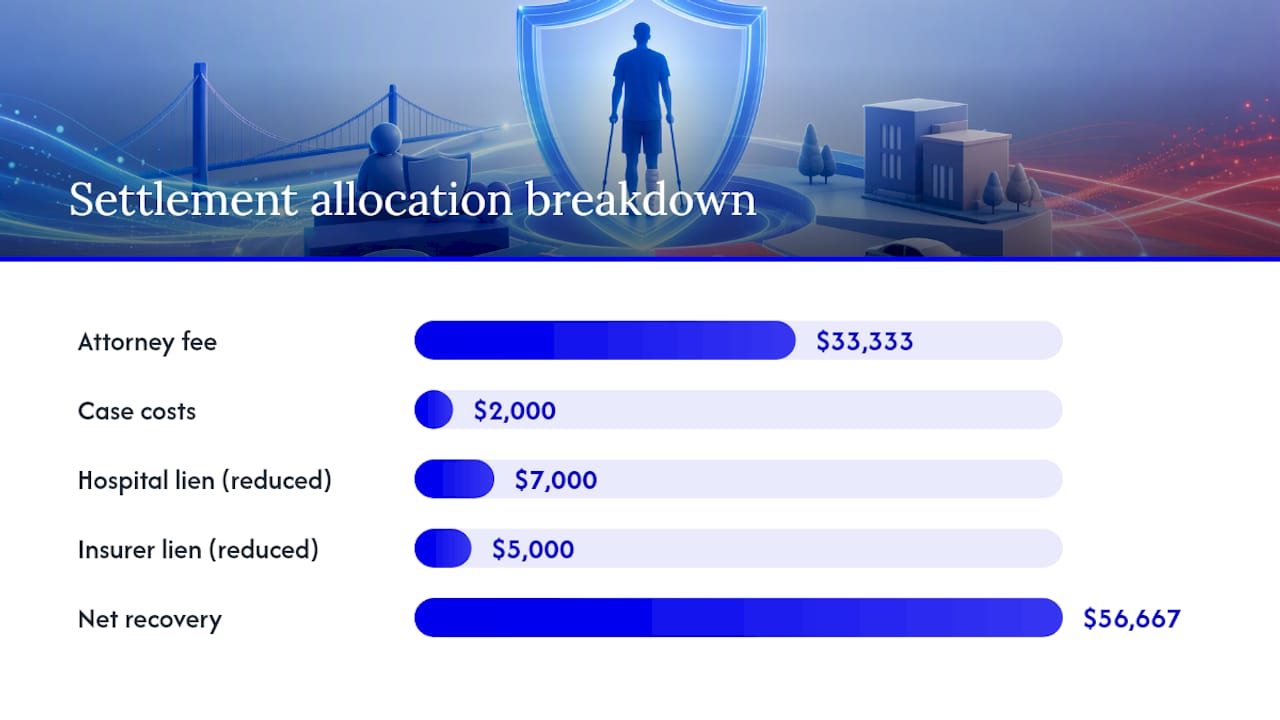
Here is how that plays out with round numbers. Say you settle a car accident claim for $100,000. Your attorney's fee is one-third, or $33,333, leaving $66,667. Case costs of $2,000 come out next, leaving $64,667. Now suppose you have $20,000 in outstanding medical bills subject to liens: a hospital lien for $12,000 and a health insurer subrogation claim for $8,000. If both are paid in full, you are left with $44,667, less than half of the headline settlement number.
That is where negotiation earns its keep. If your attorney gets the hospital to accept $7,000 instead of $12,000, and the insurer to accept $5,000 instead of $8,000, your net recovery jumps to $56,667. A comprehensive guide to lien reductions in personal injury settlements notes that attorneys who verify bills and negotiate early routinely produce swings like this. Every lienholder generally has to accept a proportional share of the fees and costs it took to generate the recovery, an argument rooted in common-fund principles the Supreme Court applied in US Airways v. McCutchen. That single argument, applied correctly, can shrink even a stubborn lien by thousands.
How Do Medicare and Medicaid Change the Lien Rules?
Federal and state health programs do not play by the same rulebook as a hospital billing office, and mixing them up is one of the costliest mistakes a claimant can make.
Medicare's recovery rights are not optional. Under the Medicare Secondary Payer Act, Medicare pays your accident-related bills conditionally, on the assumption it gets reimbursed once you settle. There is no negotiating around this obligation without going through the proper channels; skip it, and Medicare can pursue the settling parties directly for double the amount owed.
- Medicare sends a conditional payment letter listing what it paid, which your attorney disputes or corrects for unrelated charges.
- Once the case resolves, Medicare issues a final demand with the exact reimbursement figure.
- Medicare confirms this recovery is mandatory and carries real penalty exposure if ignored.
- Medicare will typically factor in your attorney's procurement costs and reduce its final number accordingly, but that request has to be made formally, and CMS's own recovery process guidance notes it can take weeks or months to resolve.
Medicaid works differently. The Supreme Court's Ahlborn decision limits state Medicaid recovery to the portion of your settlement attributable to medical expenses, not the full award. That makes how your settlement is allocated between medical damages and everything else (pain and suffering, lost wages, property damage) one of the most important negotiating levers available. State agencies vary in how strictly they apply this rule, which is why allocation language in the settlement agreement matters as much as the total number.
Pro Tip: Ask your attorney to request the Medicare conditional payment letter the moment treatment stabilizes, not after you accept a settlement offer. Final demands can take months to process, and rushing this step at the finish line is how people end up overpaying.
Can You Negotiate a Medical Lien Down, and by How Much?
Negotiating a lien is not something to try without legal training, and here is why: the arguments that work on a hospital bill do not work at all on a Medicare conditional payment, and using the wrong strategy on the wrong lienholder wastes time you often do not have.
Attorneys who handle this regularly lean on a specific set of arguments, matched to the type of lien:
- Procedural defects. Many state statutory liens require exact filing and notice steps within a deadline. Miss it, and the lien may be unenforceable.
- Reasonableness challenges. Billed charges are frequently inflated compared to what insurers actually pay for the same procedure; attorneys push for reductions to a reasonable rate.
- Proportional fee-sharing. Lienholders are generally expected to absorb their share of the attorney fees and costs that produced the recovery, following the common-fund logic from US Airways v. McCutchen.
- Ahlborn allocation. For Medicaid, showing that most of the settlement compensates non-medical damages can shrink the recoverable share substantially.
- Procurement-cost reduction. For Medicare, formally requesting a reduction for legal costs incurred to obtain the settlement.
Real-world outcomes vary widely, but hospitals and providers filing on a lien basis will often accept meaningful reductions when the settlement is small relative to the billed charges, according to MadeForLaw's practical guide to medical liens. Negotiation tends to fail, or barely move the needle, when the lienholder is Medicare acting outside a formal procurement-cost request, or when a provider's lien was filed correctly under state law and the billed amount is already reasonable.
Pro Tip: Get every reduction in writing before you sign a settlement release. A verbal "we'll take less" from a billing department means nothing if that same office sends your account to collections three months later.
What Happens If You Don't Pay a Lien Correctly?
Ignoring a lien, or paying the wrong amount without verifying it first, creates risk for everyone who touched the settlement check, not just you.
- Personal liability. If you receive settlement funds and a valid lien goes unpaid, the lienholder can often pursue you directly for the amount owed, sometimes years later.
- Attorney exposure. Lawyers who disburse funds without properly resolving known liens can face malpractice claims, bar complaints, or professional sanctions, which is exactly why experienced attorneys treat lien resolution as a mandatory step before any check gets cut.
- Federal collection tools. Failing to satisfy a Medicare conditional payment is especially dangerous. Under the Medicare Secondary Payer framework, the government can pursue collection action against the beneficiary, the attorney, or even the liability insurer, and in some situations recover double the amount owed.
- State Medicaid recovery actions. State agencies have their own administrative and civil tools to recover unpaid Medicaid liens, independent of federal Medicare enforcement.
- Civil suits from private lienholders. Hospitals and insurers whose liens go unpaid can sue directly for breach of the lien agreement or subrogation right.
The fix is almost entirely a paperwork problem. A written payoff letter that names the case, states the final reduced amount, and specifies the payment deadline is the only real protection against a lienholder resurfacing later. Verbal agreements, email assurances, and "we'll sort it out" phone calls do not hold up if a collections department reopens the file. Keep every payoff letter, every proof of payment, and every signed reduction agreement in the case file permanently, not just until the check clears.
How Do You Identify and Resolve Liens Before Your Case Settles?
Waiting until settlement day to figure out who has a claim on your money is how people get rushed into overpaying. The fix is starting the paperwork trail early and treating it as a running project throughout the case.
- Request itemized bills from every provider as soon as treatment wraps up, not summary statements.
- Get a written subrogation statement from your health insurer identifying exactly what it paid and claims to be owed.
- Run a Medicare conditional payment search early if you are a Medicare beneficiary; this process alone can take weeks.
- Request a Medicaid payoff statement in writing if Medicaid covered any treatment.
- Insist on signed reduction agreements, not verbal promises, for any negotiated lien.
- Confirm settlement allocation language that separates medical damages from other damages, which matters most for Medicaid cases.
- Keep proof of every payment made to a lienholder, filed permanently with the case records.
A practical checklist for tracking medical expenses through an injury claim covers the record-keeping side of this in more detail. Starting this process before settlement talks even begin, rather than after an offer lands, is the single biggest factor in avoiding a rushed, overpaid lien resolution.
Why Lien Resolution Deserves More Attention Than It Gets
Most people fixate on the settlement number in the demand letter and treat lien resolution as paperwork to handle later. That gets the priorities backward. The number that actually matters is what lands in your account after fees, costs, and liens, and that number is shaped far more by how well liens get negotiated than by how hard anyone pushed during settlement talks.
The conventional wisdom treats Medicare, Medicaid, and hospital liens as roughly interchangeable problems solved with a phone call and a lower offer. They are not. The Medicare Secondary Payer Act leaves almost no room for informal negotiation outside its own procedural channels, while a state hospital lien filed a week past the statutory deadline might be worthless. Knowing which fight is winnable, and which one requires following federal procedure to the letter, is the actual skill here. It's not charm or persistence. It's knowing which rulebook applies to which lienholder.
I have seen the settlement-factors math change dramatically once allocation language gets rewritten to reflect Ahlborn's medical-versus-nonmedical split. That single drafting choice can be worth thousands more in a Medicaid case than any amount of haggling over the bill itself. Gerard has covered how settlement factors and legal fee structures interact in earlier guides, and the pattern holds here too: the people who protect their net recovery are the ones who start the lien paperwork the same week treatment ends, not the week the settlement check arrives.
— Gerard
Get a Free Case Evaluation Before Liens Eat Into Your Settlement
The single biggest advantage of sorting out liens early is simple: it protects the settlement number you actually take home, not just the one printed in the demand letter. You can get connected with attorneys who help identify liens on your case, from hospital filings to Medicare conditional payments, before an offer gets accepted. That means fewer surprises at closing and stronger footing at the negotiating table. Learn more about why hiring an attorney early changes the outcome of a lien-heavy case.

Before requesting your free evaluation, gather what you have: itemized medical bills, any insurer subrogation letters, Medicare or Medicaid correspondence, and a copy of any settlement offer already on the table. The evaluation reviews your case, flags likely liens, and matches you with an attorney suited to your situation, all at no cost and with no obligation. Start your free case evaluation today and find out what your net recovery could actually look like once the liens are handled correctly.
Sources
Sharing these directly with your lawyer speeds up lien verification and keeps everyone working from the same rules.
- 42 U.S.C. § 1395y — Exclusions from coverage; Medicare as secondary payer
- Arkansas Department of Health and Human Services v. Ahlborn — U.S. Supreme Court (Cornell Law School)
- How do car accident settlement liens work? — Nolo
This article is general information, not a substitute for advice from a qualified lawyer. Consult a qualified legal professional about your own circumstances before acting on anything here.
FAQ
Can Medicare Put a Lien on a Settlement?
Yes. Under the Medicare Secondary Payer Act, Medicare has a mandatory right to be reimbursed for conditional payments it made for your accident-related treatment, and this obligation applies regardless of how your settlement is worded.
What Happens if You Don't Pay a Hospital Lien?
An unpaid, validly filed hospital lien can lead to direct collection action against you, and in some states the hospital can sue to enforce the lien years after your case closes; a written payoff letter is the only reliable way to close that risk permanently.
Do You Have to Pay Medicaid Back if You Get a Settlement?
Generally yes, but only from the portion of your settlement that represents medical expenses. The Ahlborn ruling prevents states from recovering against the full settlement, including damages for pain, suffering, or lost wages.
Why Is There a Lien on My Settlement?
A lien appears because someone, a hospital, insurer, Medicare, or Medicaid, paid for or is owed money for your accident-related medical care and has a legal right to reimbursement from your recovery before you get your share.
Can a Medical Lien Be Negotiated Down?
Often yes for hospital and provider liens, especially when billed charges are high relative to the settlement, using arguments like procedural defects, fee-sharing, or reasonableness challenges; Medicare liens require a formal procurement cost request rather than open negotiation, according to CMS guidance.