
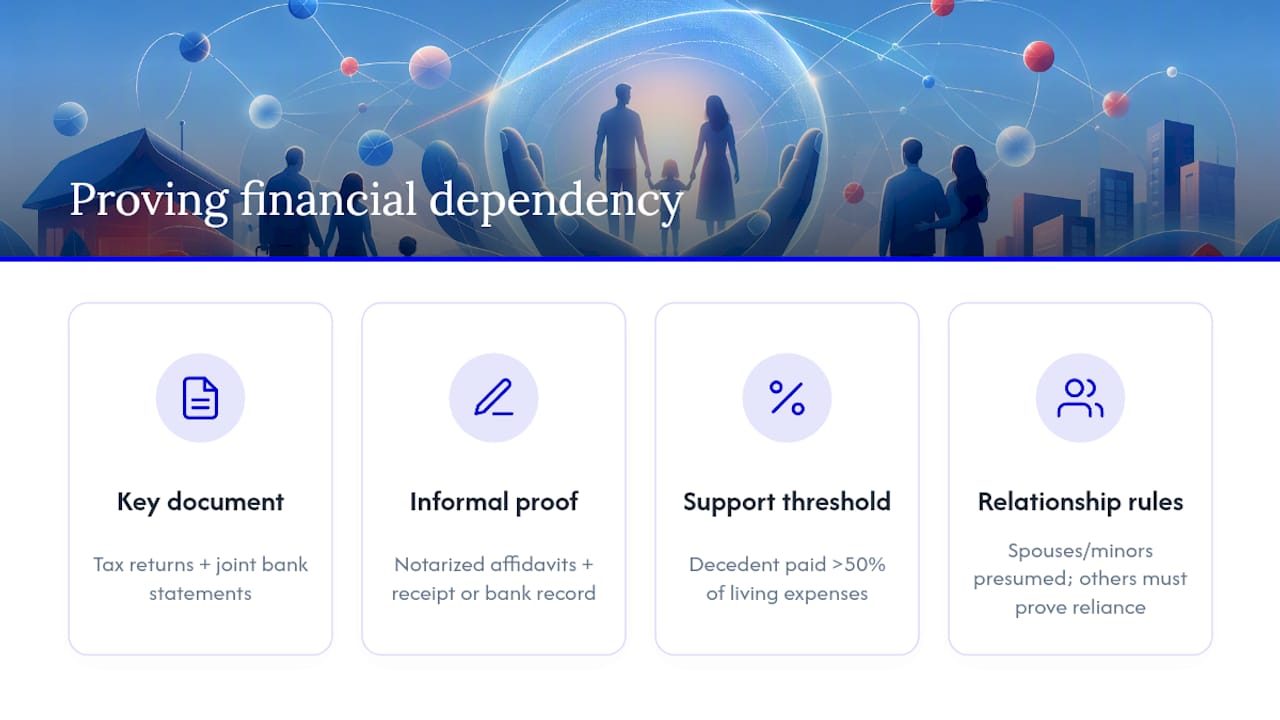
The strongest proof of financial dependency on a deceased victim is a combination of the decedent's tax returns, joint bank statements, and a Social Security survivor award letter. If you have those three, you already have the core of a claim. Everything else on this page fills the gaps around them.
Collect these first, in order:
- Decedent's last two years of federal tax returns
- Joint or shared bank account statements showing regular deposits or transfers
- Social Security survivor award or denial letter
- Recent pay stubs and W-2s
- Marriage, birth, or guardianship documents establishing the relationship
- Child support or custody orders, if applicable
- Rent, mortgage, or utility bills showing shared household expenses
- Notarized affidavits from people who can confirm the support pattern
Request IRS wage and income transcripts and SSA benefit letters immediately since both can take weeks to arrive. Send copies (never irreplaceable originals) to your state victim compensation office, the VCF, or SSA, depending on which program applies to your case.
Pro Tip: File a request for the police or crash report on day one. Almost every program requires it, and it's often the slowest document to obtain.
Key Takeaways
Proving financial dependency on a deceased victim comes down to combining tax and bank records with relationship documents and, when needed, sworn affidavits that fill the gaps.
| Point | Details |
|---|---|
| Lead with financial records | Tax returns, joint bank statements, and SSA survivor letters carry the most weight with any program. |
| Know your category | Spouses, minor children, and IRS-qualified dependents face a lower proof burden than parents or other relatives. |
| Meet the IRS support test | Compare total living expenses against what the decedent paid to confirm you cleared the threshold. |
| Fill gaps with affidavits | Notarized statements from employers, clergy, or neighbors work best when paired with a receipt or bank record. |
| File with the right agency | State victim compensation, the VCF, SSA, and private insurers each have separate forms and timelines. |
| Get evidence reviewed early | Carcollisionlawyer offers a free evaluation to check your documents before you submit them to an agency. |
Where to Request Records and Forms
- State victim compensation offices, for state-specific forms and caps
- The Victim Compensation Fund, for federal claim procedures
- The Social Security Administration, for survivor award letters
- The IRS, for wage and income transcripts
Table of Contents
- Who Qualifies as a Financial Dependent?
- What Documents Prove Financial Dependency?
- How Do You Prove You Provided More Than Half of Someone's Support?
- What If You're Missing Formal Documents?
- Where Do You File a Dependency Claim?
- When Does a Claim Need an Attorney?
- Get Your Evidence Reviewed Before You File
- Frequently Asked Questions
- Sources
Who Qualifies as a Financial Dependent?
Programs generally recognize four categories of dependent: a spouse (including some informal or common-law relationships depending on the state), minor children, other dependents who meet IRS support rules, and individuals under a formal guardianship arrangement. Parents, siblings, or other relatives can qualify too, but they typically carry a heavier burden. Courts treat them as secondary claimants who must show actual, ongoing reliance rather than an assumption they'd eventually inherit something.
Eligibility rules aren't uniform across programs:
- State victim compensation offices often define "dependent" through their own statute, and the definition can shift from state to state.
- The Victim Compensation Fund uses its own presumptive loss calculations for deceased victims.
- Social Security survivor benefits follow federal rules tied to marriage length, age, and disability status.
- Wrongful-death statutes vary by state regarding which relatives have automatic standing versus those who must prove dependency.
Pro Tip: Get the relationship document (birth certificate, marriage license, or guardianship order) notarized and copied early. It's the single piece of paper nearly every program asks for first, and having it ready speeds up everything downstream. If you're unsure which relatives have standing in your state, this surviving family member rights checklist walks through the common categories.
What Documents Prove Financial Dependency?
Think of your evidence in three tiers. The first tier carries the most weight with any agency reviewing your claim; the other two exist to plug holes.
Group A: Primary proof. Tax returns showing the decedent claimed you as a dependent, joint bank statements showing recurring transfers, Social Security survivor award or denial letters, recent pay stubs, and W-2s. Together, these show income existed and that it moved toward supporting you, not just that the decedent earned money.

Group B: Secondary proof. Child support orders, court guardianship papers, marriage or birth certificates, mortgage or rent receipts, utility bills in both names, and insurance or pension beneficiary statements. These establish the relationship and the shared household, which agencies use to contextualize the financial records.
Group C: Gap-fillers. Employer letters confirming the decedent's income, school or medical billing showing who paid, canceled checks, and government benefit statements. Each one answers a narrow question: who paid this bill, and how much did it cost?
If you're missing a full income history, a step-by-step lost wages guide explains how to reconstruct pay records when pay stubs aren't available.
Submit in this order: tax returns and joint bank statements first, SSA letters second, and everything else as supporting context. According to Texas's crime victim compensation guidance, relationship documents plus financial support records plus benefit letters form the backbone of nearly every loss-of-support claim reviewed by state programs.
How Do You Prove You Provided More Than Half of Someone's Support?
The IRS support test asks a simple question: did the decedent pay for more than half of your total living costs during the year? Add up everything you spent on lodging, food, clothing, medical care, education, and transportation, then compare it to what the decedent contributed.
Say your total annual living expenses came to $24,000.
Countable expenses and how to document them:
- Lodging: fair rental value of shared housing, mortgage or rent statements
- Food: grocery receipts, joint account withdrawals
- Medical: paid bills, insurance statements, canceled checks
- Education: tuition statements, loan payments made by the decedent
- Transportation: car payments, insurance, fuel costs tied to shared use
- Child care: provider invoices, payment records
Bank transfers, canceled checks, and comparable rental listings for fair-rental-value estimates are exactly what IRS guidance recommends keeping on hand for this calculation.
What If You're Missing Formal Documents?
Sworn statements can carry real weight when paper records are thin, especially for informal support arrangements that never generated a bank trail.
- Ask an employer to confirm the decedent's income and employment dates.
- Ask a social worker, clergy member, or school official who observed the household to describe what they witnessed.
- Ask a neighbor or family friend to confirm shared living arrangements or regular financial support.
- Draft each affidavit with the relationship, the time period and amount of support, specific examples of expenses paid, a signature, a date, and notarization.
- Attach any corroborating receipt or bank record to back up what the affidavit claims.
Pro Tip: A notarized affidavit with no supporting documents attached carries far less weight than one paired with even a single bank statement or receipt. Pair every sworn statement with something tangible.
Where Do You File a Dependency Claim?
Four types of programs handle these claims, and picking the right one matters as much as the paperwork itself.
- State victim compensation programs cover crime-related deaths and each state sets its own forms, caps, and documentation rules.
- The Victim Compensation Fund applies to specific covered incidents and uses its own presumptive calculation method for deceased victims.
- Social Security Administration survivor benefits apply to spouses and dependent children regardless of how the death occurred.
- Private insurers and estate administrators may owe benefits under a policy or through a wrongful-death settlement.
Before submitting anything, assemble:
- A cover letter listing every document enclosed
- Certified copies where a program requires them (photocopies won't always suffice)
- The law-enforcement or crash report
- Signed, notarized affidavits
Request IRS transcripts and SSA letters as soon as possible since both agencies move slowly. Missing law-enforcement reports and unsigned affidavits are the two most common reasons claims stall in review.
When Does a Claim Need an Attorney?
Legal help earns its cost fastest in a few specific situations: contested dependency claims, missing financial records, complicated benefit offsets between programs, or cases needing a forensic economist to project future lost support.
Attorneys can subpoena records you can't access on your own, prepare affidavits correctly, hire forensic economists to calculate lifetime support value, and negotiate directly with agencies or insurers. Understanding what a wrongful-death attorney actually does helps you gauge whether your case needs that level of support.
Pro Tip: Bring every document you've gathered, even incomplete ones, to a free case evaluation. Attorneys often spot which gaps matter and which don't.
A practical note on the hardest part
The hardest cases usually involve sporadic cash support, informal living arrangements, or tax records that no longer exist; this inheritance dispute documentation checklist: NSW guide provides a practical example of gathering essential evidence in such complex scenarios. There's no clean fix for that. What helps most is building one folder with a one-page index listing every document inside it, dated and labeled. Agencies move faster when they don't have to hunt for what they're reviewing.
Get Your Evidence Reviewed Before You File
Gathering tax returns, SSA letters, and affidavits is only half the job. Knowing whether your documentation actually meets a program's threshold before you submit it is the part most people get wrong, and a rejected claim can cost you months. Carcollisionlawyer connects you with a vetted attorney for a free case evaluation, so you find out where your evidence stands before an agency tells you it's insufficient.
A typical evaluation covers a quick review of what you've collected, a rundown of what's missing, and a referral to an attorney experienced in wrongful-death and dependency claims if your case warrants it. There's no cost and no obligation, and what you share stays confidential. Bring whatever you have, even if the folder feels incomplete. Start your free case evaluation and find out where you actually stand.
Frequently Asked Questions
What's the single most important document for proving financial dependency? Tax returns showing you as a dependent, paired with joint bank statements, carry the most weight across nearly every program reviewed.
Can I prove dependency without formal paperwork? Yes, through notarized affidavits from employers, clergy, or neighbors, though they work best attached to at least one supporting receipt or bank record.
How much support do I need to have received to qualify? Most tests, including the IRS standard, require showing the decedent provided more than half of your total living expenses for the relevant period.
Do parents and siblings have to prove dependency differently than spouses? Yes. Courts and programs generally treat spouses and minor children as presumed dependents, while parents and other relatives must show actual, ongoing reliance.
When should I bring in an attorney? Contact one when dependency is contested, records are missing, benefit offsets get complicated, or your case needs a forensic economist's income projection.
This article is general information, not a substitute for advice from a qualified lawyer. Consult a qualified legal professional about your own circumstances before acting on anything here.
Sources
- Loss of Support for Claimants
- Victim Services — Loss of support
- Filing Requirements & Proof of Support (IRS guidance)
- Section 6: Deceased Victims | VCF