
Your first priority after a fatal accident is safety and legal protection. Secure dependents, preserve evidence, and contact an attorney before you do anything else. Legal and estate experts confirm that delays complicate evidence collection and can close statutory filing windows permanently.
Act now:
- Arrange care for children, elderly relatives, or anyone who depended on the deceased
- Call 911 if the scene is unsecured or if anyone still needs emergency help
- Photograph the accident scene, vehicle damage, and any visible injuries
- Request the official police or crash report number
- Order multiple certified copies of the death certificate
- Contact a wrongful-death attorney for a free case evaluation
Carcollisionlawyer connects surviving families with vetted local attorneys at no cost and with no upfront commitment.
Key Takeaways
Surviving family members who act within the first 72 hours, preserve evidence, and consult an attorney before accepting any settlement offer protect their legal rights most effectively.
| Point | Details |
|---|---|
| Act within 72 hours | Secure dependents, preserve evidence, and order certified death certificates before anything else. |
| Two parallel claims exist | Wrongful-death claims belong to statutory beneficiaries; survival actions belong to the estate. |
| Deadlines are state-specific | Some states allow as little as three months before the personal representative may take over the claim. |
| Document every loss | Medical bills, funeral receipts, and lost-income records are the foundation of any damages calculation. |
| Carcollisionlawyer | Offers a free case evaluation and attorney matching for surviving families, with no upfront cost. |
Table of Contents
- What should you do in the first 48–72 hours?
- Key documents you need to gather right away
- What legal rights do surviving family members actually have?
- Deadlines and statutes of limitations you cannot miss
- How do you pursue compensation after a fatal accident?
- When should you hire an attorney, and what should you ask?
- Banks, benefits, taxes, and estate financial administration
- Probate 101: what does the executor actually do?
- Managing grief while keeping legal tasks on track
- What families often get wrong about this process
- Free case evaluation and attorney matching through Carcollisionlawyer
- Authoritative resources for surviving family members
- Sources
What should you do in the first 48–72 hours?
The first three days set the legal foundation for everything that follows. Work through this list in order.
- Confirm dependent care is stable (childcare, elder care, pet care)
- Notify immediate family and close friends personally before posting anything on social media
- Contact the deceased's employer to report the death and ask about life insurance and survivor benefits
- Obtain the incident or police report from the responding agency
- Request medical records from the treating hospital or emergency room
- Contact the funeral home and begin the death certificate process
- Notify Social Security Administration at 1-800-772-1213 to report the death and ask about survivor benefits
- Preserve physical evidence: do not repair or move the vehicle, and save all clothing and personal items
Pro Tip: Call an attorney before you post anything publicly about the accident. Social media posts can be used by insurers to dispute liability or reduce damages.
Collect names and contact information for every witness at the scene. A written statement taken within 72 hours is far more reliable than one taken weeks later.
Key documents you need to gather right away
County surrogate offices and probate courts consistently ask for the same core set of documents. Gather these as soon as possible.
- Death certificate (certified copies, at least 10)
- Original will and any codicils
- Life insurance policies and beneficiary designation forms
- Auto, homeowner, and umbrella insurance policies
- Police report and crash reconstruction report
- Medical records and emergency room reports
- Bank and brokerage account statements
- Deeds, vehicle titles, and mortgage documents
- Social Security card and birth certificate of the deceased
- Marriage certificate (if applicable)
- Military discharge papers (DD-214) if the deceased was a veteran
- Employer benefits summary and pension documents
| Document | Where to find it | Why it matters |
|---|---|---|
| Certified death certificate | Vital records office or funeral home | Required for every claim, benefit, and account change |
| Original will | Home safe, attorney's office, or bank safe-deposit box | Identifies executor and directs asset distribution |
| Life insurance policy | Home files, employer HR, or insurer directly | Triggers death benefit payout to named beneficiaries |
| Police/crash report | Responding law enforcement agency | Establishes fault and supports wrongful-death claim |
| Military DD-214 | National Personnel Records Center | Required for VA survivor benefits including DIC |
Order more certified death certificates than you think you need. Banks, insurers, the SSA, the VA, and probate courts each typically require their own original certified copy.
What legal rights do surviving family members actually have?
Two separate legal claims exist after a fatal accident, and most families qualify for both.
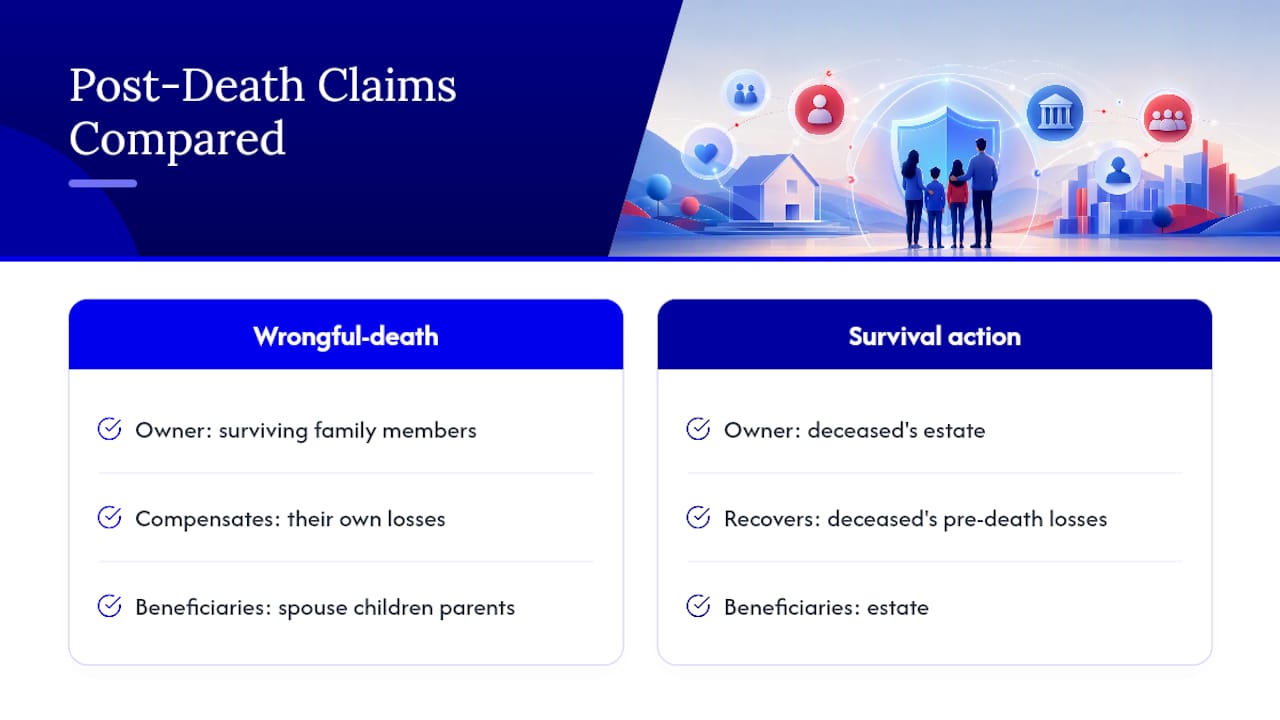
A wrongful-death claim belongs to the surviving family members. It compensates them for their own losses: lost financial support, loss of companionship, funeral expenses, and mental anguish. A survival action belongs to the deceased's estate and recovers losses the deceased suffered before death, such as pre-death medical bills and pain and suffering.
Under Ohio law, wrongful-death beneficiaries are typically limited to the surviving spouse, children, and parents. Texas follows the same beneficiary structure under Tex. Civ. Prac. & Rem. Code §71.004, which also creates a separate survival cause of action for the estate under §71.011. Every state has its own statutory list, so confirm your state's rules with an attorney early.
Pro Tip: Appoint a personal representative or executor as quickly as possible. In Texas, if no statutory beneficiary files a wrongful-death claim within three months, the personal representative may file instead — and that shift changes who controls settlement authority.
For a deeper look at wrongful-death lawsuit basics, including how these claims differ from standard injury suits, that resource covers the full picture.
Deadlines and statutes of limitations you cannot miss
State civil statutes of limitations for wrongful-death claims typically run two years from the date of death, but shorter procedural windows exist and can cut off rights faster. Texas practice resources highlight that if statutory beneficiaries do not act within three months, the personal representative may step in — changing who controls the case and who sits at the settlement table.
Evidence preservation checklist:
- Photograph the accident scene and vehicle immediately
- Preserve the vehicle in its post-accident condition (do not repair)
- Save all medical bills, receipts, and funeral expense invoices
- Collect written witness statements within days, not weeks
- Download and save any dashcam, surveillance, or cell phone footage
- Keep a daily log of grief-related symptoms and financial hardship
Pro Tip: If you miss a filing deadline, the right to sue may shift entirely to the estate's personal representative. That person may have different priorities than you do. An attorney can file a protective action to preserve your standing while the estate is sorted out.
How do you pursue compensation after a fatal accident?
Most wrongful-death cases resolve through insurer negotiation, not a courtroom. That said, accepting an early settlement offer before you have documented all losses is one of the most common and costly mistakes families make.
Damages to document:
- All medical bills incurred before death
- Funeral and burial expenses
- Lost future earnings and financial support
- Loss of household services the deceased provided
- Loss of companionship, guidance, and care
- Mental anguish of surviving family members
Typical process flow:
- Notify the at-fault party's insurer of the death and your intent to claim
- Collect and organize all supporting documents
- Submit a formal demand letter with a damages calculation
- Negotiate with the insurer (expect a low first offer)
- Pursue mediation if negotiations stall
- File suit if a fair settlement cannot be reached
Pro Tip: Keep every receipt, bill, and invoice related to the accident and death. Courts and insurers calculate damages from documented losses. An undocumented expense is an uncompensated one.
Understanding how wrongful-death damages are calculated can help you build a stronger demand before you ever sit across from an adjuster.
When should you hire an attorney, and what should you ask?
Hire an attorney immediately if liability is disputed, damages are significant, multiple beneficiaries are involved, or the estate is contested. Waiting costs you evidence and leverage.
Signs you need an attorney now:
- The insurer has already contacted you with a settlement offer
- Fault is disputed or shared between multiple parties
- The deceased had dependents who relied on their income
- Other family members disagree about the estate or the claim
- The deceased was a commercial vehicle accident victim
Questions to ask during a free evaluation:
- How many wrongful-death cases have you handled in this state?
- What is your contingency fee percentage, and what costs are deducted separately?
- Who in your office will handle day-to-day communications?
- What is a realistic timeline from filing to resolution?
- Have you handled cases involving truck accidents or commercial carriers?
Most wrongful-death attorneys work on contingency, meaning no fee unless you recover. How wrongful-death attorneys charge families explains the fee structure in plain terms.
Banks, benefits, taxes, and estate financial administration
Stop automatic deposits and direct payments first. A paycheck deposited into a deceased person's account after death can create complications with the estate and creditors.
| Who to contact | Documents needed | Typical outcome |
|---|---|---|
| Social Security Administration | Death certificate, SSN | Stop payments; apply for survivor benefits |
| U.S. Department of Veterans Affairs | DD-214, death certificate | Apply for DIC and other VA survivor benefits |
| Employer HR department | Death certificate, beneficiary form | Trigger life insurance, pension, and accrued pay |
| Banks and financial institutions | Death certificate, letters testamentary | Freeze or transfer accounts; open estate account |
| Life insurance companies | Death certificate, policy number | Initiate death benefit claim |
Survivors of service members or veterans who died from service-related causes may qualify for tax-free Dependency and Indemnity Compensation. Eligibility rules vary, so check veteran status early and apply as soon as possible.
AARP's survivor checklist recommends calling SSA directly to confirm the death has been reported, even when a funeral director says they will handle it.
Pro Tip: Order at least 10 certified death certificates on the first order. Each institution typically requires its own original. Reordering later costs time and money you do not have.
Probate 101: what does the executor actually do?
Probate is the court-supervised process that validates the will, pays the deceased's debts, and distributes remaining assets to beneficiaries. The executor (named in the will) or an administrator (appointed by the court when there is no will) carries out these duties.
Core executor responsibilities:
- File the will with the probate court
- Inventory all assets and debts
- Notify creditors and publish required legal notices
- Pay valid debts and taxes from estate funds
- Distribute remaining assets to beneficiaries per the will or state law
State small-estate procedures can shorten or bypass formal probate for smaller estates; check with your local probate court or an estate attorney for the rules in your jurisdiction.
Pro Tip: If the estate is complex or exceeds a practical value threshold, hiring a probate attorney typically pays for itself by avoiding creditor disputes, tax errors, and distribution delays.
Managing grief while keeping legal tasks on track
Death brings both an emotional crisis and a procedural one simultaneously. You cannot do everything yourself, and you should not try.
Delegation checklist:
- Assign one trusted person to coordinate funeral logistics
- Assign another to gather and organize documents
- Designate a single family contact for attorneys and institutions to call
- Use a shared task list (a simple spreadsheet works) so nothing falls through the cracks
- Identify grief counseling resources early: the SAMHSA National Helpline (1-800-662-4357) and local hospice organizations offer referrals
Pro Tip: Tell every attorney, bank, and insurer to communicate through one designated family contact. Multiple people calling the same institution with conflicting instructions slows everything down and can create disputes about authority.
If family members disagree about the will, beneficiary designations, or the estate, do not try to resolve it informally. A probate attorney can mediate or petition the court before positions harden into litigation.
What families often get wrong about this process
The conventional wisdom is that grief gives you time. It does not. The legal system runs on calendars, not emotions. The families who protect their rights most effectively are the ones who delegate the emotional tasks and keep control of the legal decision points themselves.
Most people assume the insurer will be fair. Insurers are businesses. Their first offer is almost never their best offer, and accepting it before you have documented every loss is permanent. You cannot reopen a settled claim.
The other underestimated risk is family conflict. When money and grief intersect, even close families fracture. A contested will or a disputed beneficiary designation can freeze an estate for years. Getting an attorney involved early, before positions harden, is cheaper and faster than litigation.
Free case evaluation and attorney matching through Carcollisionlawyer
When you are managing grief, paperwork, and legal deadlines at the same time, the last thing you need is to spend hours researching attorneys. Carcollisionlawyer offers a free case evaluation that screens your situation and matches you with a vetted local wrongful-death attorney, at no cost and with no obligation.
The free evaluation includes:
- A review of your accident and loss details
- A referral to a local attorney experienced in wrongful-death and survivor claims
- A plain-language explanation of your likely next steps
Most wrongful-death attorneys take cases on contingency, meaning no upfront fees and no payment unless you recover. Start your free case evaluation now and get matched with an attorney who handles cases like yours.
Authoritative resources for surviving family members
- Social Security Administration: call 1-800-772-1213 to report a death and inquire about survivor benefits
- Your local probate court: search "[your county] probate court" for state-specific filing requirements and small-estate thresholds
Consult a licensed attorney in your state for advice specific to your situation. This article is general information, not legal advice.
This article is general information, not a substitute for advice from a qualified lawyer. Consult a qualified legal professional about your own circumstances before acting on anything here.
Sources
- After a Death Occurs checklist — Legal Voice
- Dependency and Indemnity Compensation (DIC) — U.S. Department of Veterans Affairs
- Here’s everything you need to do when a loved one dies — AARP
- Survivor Checklist | Mercer County, NJ
- Section 2125.02 - Ohio Revised Code | Ohio Laws
- 2024 Texas Statutes Civil Practice and Remedies Code Title 4 - Liability in Tort Chapter 71 - Wrongful Death; Survival; Injuries Occurring Out of State Subchapter A. Wrongful Death Section 71.004. Benefitting From and Bringing Action
- Tex. Civ. Prac. & Rem. Code §71.004 limits wrongful-death plaintiffs to the surviving spouse, children, and parents. §71.011 creates a separate survival cause of action for the decedent's estate. Two parallel claims, two parallel beneficiary rules, two parallel damage frameworks.