
Families have a recognized civil right to sue after accidents when another party's negligence or wrongful conduct causes injury or death. This right exists separately from any criminal prosecution and does not depend on a police arrest or conviction. Civil law gives families a direct path to financial compensation for medical bills, lost income, and the loss of a loved one. Understanding why families can sue after accidents, and how that process works, is the first step toward protecting what your family is owed.
Why families can sue after accidents: the legal foundation
Civil litigation is the mechanism that allows families to seek compensation outside of the criminal justice system. A personal injury lawsuit or wrongful death claim does not require the government to press charges. Your family files the case directly against the party responsible, whether that is a driver, a company, or a product manufacturer.
The legal standard in civil cases is lower than in criminal court. Civil wrongful death claims require a preponderance of the evidence, meaning the evidence shows it is more likely than not that the defendant caused the harm. That threshold sits at roughly 51%, compared to the "beyond a reasonable doubt" standard in criminal trials. This distinction matters enormously because a family can win a civil case even when prosecutors never charge anyone, or when a criminal jury returns a not-guilty verdict.
Wrongful death and personal injury lawsuits also serve a different purpose than criminal cases. Criminal law punishes offenders. Civil law restores, as much as money can, what the family lost. That includes economic losses like future earnings and non-economic losses like grief and loss of companionship.
What legal grounds allow families to sue after accidents?
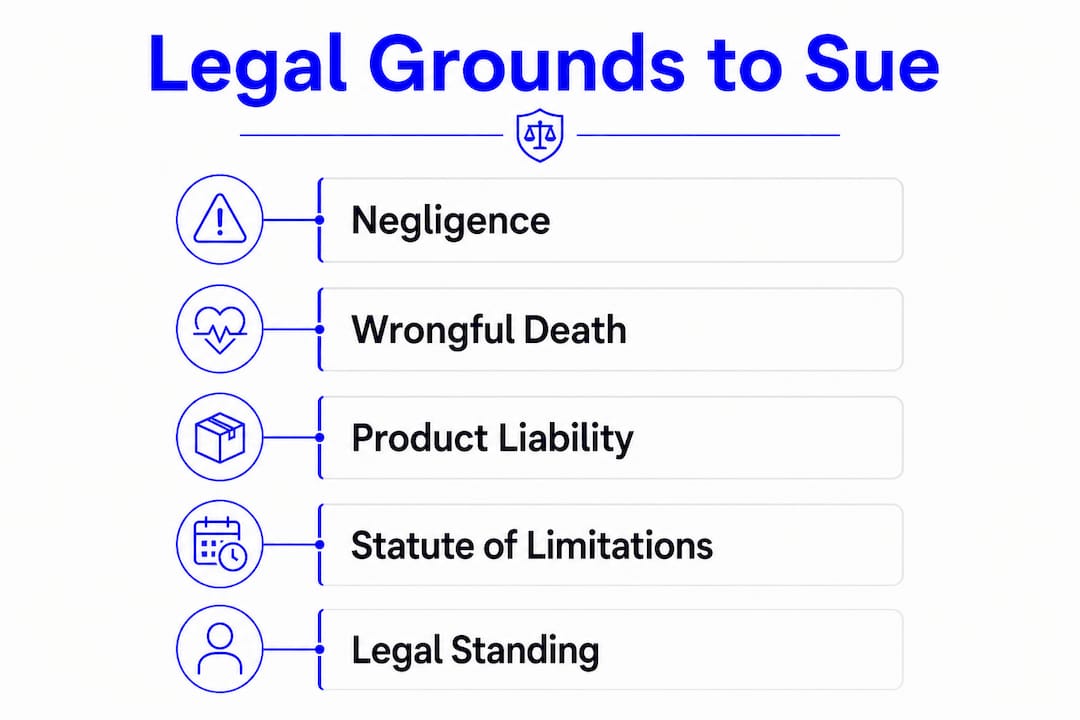
Three main legal theories support most accident claims filed by families: negligence, wrongful death, and product liability.
Negligence is the most common ground. It requires proving four elements: duty, breach, causation, and damages. The defendant owed your family member a duty of care, such as a driver's duty to follow traffic laws. The defendant breached that duty through careless or reckless behavior. That breach directly caused the injury or death. And your family suffered real, measurable damages as a result.

Wrongful death is a specific civil cause of action that applies when negligence or intentional misconduct causes a fatality. Most wrongful death cases combine two claims. The first compensates surviving family members for their own losses. The second, called a survival action, compensates the estate for the pain and suffering the deceased experienced before death. Combining both claims maximizes the total recovery available to the family.
Product liability works differently. Families have the right to sue manufacturers under strict liability when a defective product causes death, without needing to prove the manufacturer was careless. The family must show the product was defective, the defect caused the death, and the product was being used as intended. This theory applies to defective car parts, faulty safety equipment, and dangerous vehicle designs.
Pro Tip: If a defective product contributed to the accident, do not discard any physical evidence. Preserving the item is often the difference between winning and losing a product liability claim.
Who in the family has the right to file a lawsuit?
Legal standing to sue follows a strict hierarchy set by state law, and emotional closeness to the victim does not determine who qualifies. State statutes typically prioritize the surviving spouse and children first, then parents, then siblings. A devoted aunt or longtime domestic partner may have no standing at all in certain states, regardless of how central they were to the victim's life.
The rules vary significantly by jurisdiction. Some states require that all wrongful death claims be filed through the estate's personal representative, even when the actual beneficiaries are the surviving spouse and children. Other states allow eligible family members to file directly. Getting this wrong procedurally can delay or derail a valid claim.
Common misconceptions about standing include:
- Assuming emotional closeness equals legal standing. Courts follow the statute, not the family's internal relationships.
- Believing any family member can file. Only those listed in the state's wrongful death statute have standing.
- Thinking the estate automatically handles everything. In many states, the personal representative files the claim, but the damages flow to the beneficiaries, not the estate itself.
- Overlooking minor children's rights. Children have strong standing in virtually every state, but a guardian or representative typically must act on their behalf.
- Assuming parents cannot sue for an adult child's death. Many states allow parents to file if no spouse or children survive the victim.
Pro Tip: Check your state's specific wrongful death statute before assuming who can file. An attorney familiar with wrongful death claims can identify the correct claimants and representative within the first consultation.
How do civil claims differ from criminal cases in accident lawsuits?
The differences between civil and criminal cases shape what families can realistically expect from the legal process.
| Factor | Civil case | Criminal case |
|---|---|---|
| Who files | The family or estate | The government (prosecutor) |
| Burden of proof | Preponderance of evidence (51%) | Beyond a reasonable doubt |
| Goal | Financial compensation | Punishment (fines, prison) |
| Outcome if defendant acquitted | Civil case can still proceed | Prosecution ends |
| Who controls the case | The family's attorney | The prosecutor |
A civil case can proceed simultaneously with a criminal prosecution, or independently if no charges are filed. The family controls the civil case through their own attorney, which means they decide whether to settle or go to trial. In a criminal case, the prosecutor makes those decisions, and the family is a witness, not a party. This distinction gives families far more direct power in the civil system than many realize.
Why timing is critical: statute of limitations deadlines
Missing a filing deadline permanently bars a family from suing, regardless of how strong the case is. Most U.S. states impose a 2-year deadline for wrongful death and personal injury claims. That clock typically starts on the date of the accident or the date of death.
Several factors affect how the deadline applies:
- The discovery rule applies when the cause of injury was not immediately apparent. In those situations, the clock starts when the family knew or reasonably should have known that negligence caused the harm.
- Minor children often receive extended deadlines. Many states toll, meaning pause, the statute of limitations until the child turns 18.
- Government defendants require much shorter notice periods, sometimes as brief as 60 to 180 days, before a formal lawsuit can be filed.
- Multiple defendants may trigger different deadlines if they are subject to different legal frameworks.
- Evidence decay accelerates regardless of legal deadlines. Surveillance footage gets deleted, witnesses forget details, and accident scenes change within days.
The safest approach is to consult an attorney as soon as possible after an accident. Waiting even a few months can cost the family critical evidence and legal options. A claim timeline guide can help families understand what to expect at each stage.
Practical challenges families face when pursuing accident lawsuits
Causation is the most heavily contested element in wrongful death and personal injury lawsuits. Defense attorneys routinely argue that the defendant's conduct did not directly cause the injury or death. Families should prepare for this challenge by building a strong evidentiary foundation from day one.
The most common obstacles families encounter include:
- Proving causation requires expert witnesses. Accident reconstructionists and medical experts establish the direct link between the defendant's actions and the harm. Without them, causation arguments often fail.
- Evidence loss cripples many claims. Discarding or altering physical evidence such as a defective vehicle part or damaged safety gear removes the foundation of a product liability case.
- Early insurance settlements carry serious risk. Accepting a settlement from an insurer typically waives all future claims, even if long-term injuries or damages emerge months later. Families often do not realize they have signed away their rights until it is too late.
- Insurance adjuster tactics are designed to minimize payouts. Adjusters may contact grieving families within days of an accident, offering fast money before the full extent of damages is known.
Families who document everything from the moment of the accident, including photos, medical records, witness contact information, and any defective products involved, give their attorneys the strongest possible foundation. Reviewing settlement factors before signing anything is equally critical.
Pro Tip: Never sign any document from an insurance company without having an attorney review it first. A settlement that looks fair on day one may cover only a fraction of your actual long-term losses.
Key Takeaways
Families can sue after accidents because civil law grants them the right to seek compensation for negligence or wrongful conduct, independent of any criminal case.
| Point | Details |
|---|---|
| Civil standard is lower | Families only need to prove liability by a preponderance of evidence, not beyond a reasonable doubt. |
| Standing follows state law | Only specific relatives listed in state statutes have the legal right to file a wrongful death claim. |
| Deadlines are strict | Most states impose a 2-year filing deadline; missing it permanently bars the claim. |
| Causation requires experts | Accident reconstructionists and medical experts are often necessary to prove the defendant caused the harm. |
| Early settlements are risky | Accepting insurance money before understanding full damages can waive all future legal rights. |
What I've learned watching families navigate accident claims
Grief and legal deadlines collide in the worst possible way. Families dealing with a serious injury or the loss of a loved one are not thinking about statutes of limitations or evidence preservation. That gap between emotional reality and legal necessity is where most claims fall apart.
The mistake I see most often is waiting. Families assume they have time to grieve before dealing with lawyers. They do. But the evidence does not wait. Surveillance video from the accident scene gets overwritten within 30 days at most businesses. Witnesses move, forget, or become unreachable. Defective parts get thrown away during vehicle repairs. By the time a family is ready to act, the strongest pieces of their case may already be gone.
The second mistake is trusting the insurance company's first offer. Insurers are not adversarial in an obvious way. They are polite, fast, and they make the process feel simple. That speed is the point. A quick settlement closes the file before the family understands what long-term care, lost income, or grief counseling will actually cost.
Families who consult an attorney within the first two weeks after an accident consistently end up in a better position, not because attorneys are magic, but because early legal involvement preserves options. An attorney evaluation guide can help families ask the right questions from the very first meeting. The law gives your family real rights. Acting early is how you keep them.
— Gerard
How Carcollisionlawyer connects families with the right legal help
Knowing your rights is one thing. Acting on them with the right legal support is another.
Carcollisionlawyer specializes in connecting families who have suffered injuries or losses from car, motorcycle, and truck accidents with trusted attorneys. The free evaluation process lets you understand your potential compensation without any upfront commitment. Whether your family is dealing with a wrongful death claim, a serious personal injury, or an insurance company pushing a fast settlement, Carcollisionlawyer matches you with legal professionals who handle exactly these situations. Start with a free case evaluation and get clarity on what your family's claim may actually be worth. You can also learn more about your accident injury options directly on the main site.
FAQ
Why can families sue after accidents even without a criminal conviction?
Civil and criminal cases operate under separate legal systems with different standards of proof. A family can win a civil wrongful death or personal injury lawsuit even when no criminal charges are filed or a criminal defendant is acquitted.
Who has the legal right to file a wrongful death lawsuit?
State law determines standing, and most states prioritize the surviving spouse and children, then parents, then siblings. Legal standing does not depend on emotional closeness to the victim.
How long does a family have to file an accident lawsuit?
Most states set a 2-year deadline for wrongful death and personal injury claims from the date of the accident or death. Missing this deadline permanently bars the family from suing.
Can a family sue a car manufacturer after a fatal accident?
Yes. Under strict product liability, families can sue manufacturers when a defective product causes death without needing to prove the manufacturer was negligent. The family must show the product was defective, caused the death, and was used as intended.
Is it safe to accept an early insurance settlement after an accident?
Accepting an early settlement typically waives all future claims, even if long-term damages emerge later. Families should have an attorney review any settlement offer before signing.