
An anxiety disorder accident claim is a legal process where you seek financial compensation for psychological harm caused by another party's negligence in an accident. Unlike physical injury claims, these claims require proof that a diagnosed psychiatric condition, such as generalized anxiety disorder, PTSD, or panic disorder, directly resulted from the accident. Courts and insurers treat psychological injury as a legitimate, compensable harm when supported by medical evidence and expert testimony. Carcollisionlawyer connects accident victims with attorneys who specialize in exactly this type of mental health accident claim, making the process less daunting from day one.
What is an anxiety disorder accident claim, and how does it work?
An anxiety disorder accident claim is the formal legal mechanism for recovering compensation when an accident causes a diagnosable psychological condition. The standard industry term is "psychiatric injury claim," though the two phrases describe the same legal process. Courts recognize that negligence can harm the mind just as severely as the body, and the law in most U.S. jurisdictions allows full recovery for that harm.
Georgia law allows recovery of the full value of economic and non-economic damages for psychological trauma caused by someone else's negligence. That means your therapy bills, lost wages, and pain and suffering all qualify as compensable losses. The key requirement is a formal psychiatric diagnosis linking the condition to the accident, not just a general sense of distress.

The claim process mirrors a standard personal injury claim in structure. You file against the at-fault party's insurance, support your claim with medical and psychiatric evidence, and negotiate or litigate for a settlement. What makes anxiety disorder claims more complex is the invisible nature of the injury. You cannot point to an X-ray. You need a paper trail of professional evaluations, treatment records, and documented daily impact.
What evidence is required to prove an anxiety disorder accident claim?
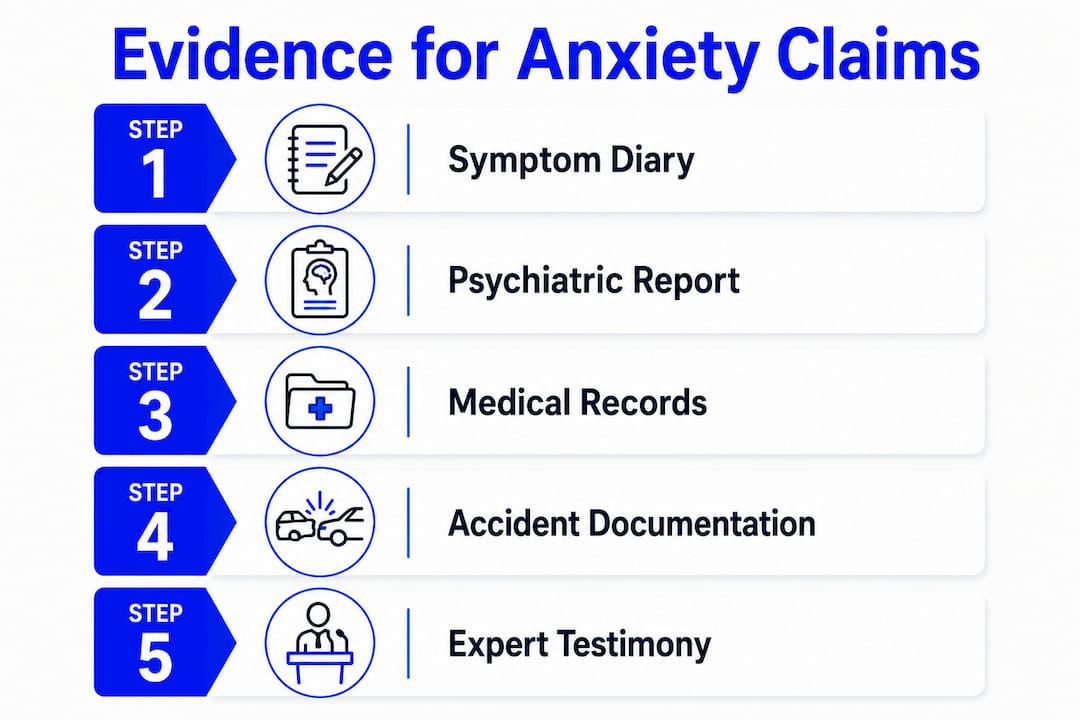
Strong evidence is the foundation of every successful mental health accident claim. Four pillars of evidence define what attorneys and courts look for: medical records from your primary care physician, an independent psychiatric report linking your condition to the accident, consistent treatment records showing ongoing therapy or medication, and detailed personal impact notes. Each pillar serves a distinct purpose, and a weak link in any one of them gives insurers room to dispute the claim.
The independent psychiatric report carries the most weight. A qualified psychiatrist must examine you, review the accident details, and produce a written opinion that your anxiety disorder was caused or significantly worsened by the accident. This report is not the same as a note from your therapist. It is a formal medico-legal document prepared specifically for litigation.
Treatment records show that your condition is real and persistent. Gaps in treatment give defense attorneys an opening to argue that your symptoms resolved or were never serious. Attend every scheduled appointment and follow your treatment plan consistently.
Personal impact evidence fills the gaps that clinical notes miss. Consider these key documentation types:
- Symptom diary: A daily log of anxiety episodes, panic attacks, sleep disruption, and avoidance behaviors. Symptom diaries provide crucial ongoing evidence of your experience that medical notes alone cannot capture.
- Witness statements: Written accounts from family members, coworkers, or friends who observed changes in your behavior, mood, or daily functioning after the accident.
- Employment records: Documentation of missed workdays, reduced hours, or performance issues tied to your anxiety symptoms.
- Personal journals: Narrative entries describing how anxiety affects your relationships, hobbies, and quality of life.
Pro Tip: Start your symptom diary within the first week after the accident. Documentation that begins within weeks of the incident establishes a clear causal timeline that is far harder for insurers to challenge than records started months later.
How do legal systems assess anxiety disorder claims?
Courts draw a firm line between compensable psychological injury and normal emotional reactions to a stressful event. Emotional distress as a legal term requires proof of suffering that is intolerable to a reasonable person. Transient worry or sadness after an accident generally does not meet that threshold. This distinction matters because it shapes what your attorney must prove and what evidence carries the most weight.
The role of expert psychiatric testimony is decisive. Strong, objective psychiatric expert testimony significantly influences both the outcome and the dollar value of anxiety disorder claims. A psychiatrist who can explain your diagnosis, its functional consequences, and its prognosis in plain language gives a judge or jury a concrete basis for awarding damages.
"Courts require that emotional distress claims show a level of suffering beyond normal emotional reactions, focusing on objective evidence of functional impairment. The claim must demonstrate that the anxiety disorder has materially disrupted the claimant's ability to work, maintain relationships, or carry out daily activities."
Prognosis also affects compensation value directly. A condition expected to resolve within six months commands a lower settlement than one projected to require years of treatment or that carries a risk of permanent impairment. Your psychiatric expert's opinion on recovery outlook is not just a medical detail. It is a financial variable that your attorney will use to calculate and argue for the full value of your claim. You can learn more about how attorneys evaluate these factors in this emotional injury evaluation guide.
What types of anxiety disorders are compensable after accidents?
Several specific psychiatric conditions qualify as compensable under personal injury law when caused by an accident. Compensable anxiety disorders include generalized anxiety disorder, PTSD, panic disorder, and phobias directly related to accident circumstances, such as a fear of driving or riding in vehicles. Diagnosis by a qualified mental health professional is a legal requirement, not just a medical formality.
The table below outlines the most commonly recognized conditions, their key symptoms, and their typical impact on daily life relevant to damages calculations.
| Condition | Key symptoms | Impact on daily life |
|---|---|---|
| Generalized anxiety disorder | Persistent worry, restlessness, fatigue, difficulty concentrating | Reduced work performance, strained relationships |
| PTSD | Flashbacks, nightmares, hypervigilance, emotional numbness | Avoidance of driving, social withdrawal, job loss |
| Panic disorder | Sudden intense fear, chest pain, shortness of breath | Inability to drive or travel, emergency room visits |
| Accident-related phobia | Intense fear triggered by vehicles, roads, or accident reminders | Inability to commute, loss of independence |
| Depression with anxiety | Low mood, hopelessness, anxiety, sleep disruption | Impaired work capacity, relationship breakdown |
Physical manifestations of anxiety are also legally relevant. Chronic headaches, gastrointestinal problems, and cardiovascular symptoms caused by persistent anxiety all contribute to the damages picture. Courts recognize that psychological injury produces real physical consequences, and those consequences add to the total harm you suffered.
Delayed onset symptoms deserve special attention. PTSD, in particular, can emerge weeks or months after the accident rather than immediately. Legal systems in most U.S. states recognize delayed onset psychological symptoms as compensable, provided you can establish the causal link to the accident through medical records and expert testimony. For a detailed breakdown of PTSD claims specifically, this guide on PTSD after accident claims explains your rights and the required evidence.
How to file and pursue an anxiety disorder accident claim successfully
The steps you take in the weeks immediately after an accident determine the strength of your claim months or years later. Follow this sequence to build the strongest possible case.
-
Seek medical and psychiatric treatment immediately. Visit your primary care physician within days of the accident and request a referral to a mental health professional. Timely medical documentation enhances claim strength by proving onset and causation. Delayed treatment gives insurers grounds to argue your condition was not caused by the accident.
-
Start a symptom diary on day one. Record every anxiety episode, panic attack, sleep disturbance, and avoidance behavior with dates and descriptions. This diary becomes one of the most persuasive pieces of evidence your attorney will use.
-
Attend all scheduled appointments. Consistent treatment records signal that your condition is genuine and ongoing. Gaps in care undermine credibility and give defense counsel an argument that symptoms resolved.
-
Manage your social media activity carefully. Insurance investigators monitor social media and use photos or posts showing normal activity to discredit claims of severe anxiety or impairment. Avoid posting content that contradicts your claimed limitations.
-
Consult a specialized attorney early. Anxiety disorder compensation claims involve medical, legal, and procedural complexity that general practitioners may not handle well. Carcollisionlawyer offers a free evaluation to connect you with attorneys who specialize in psychological injury claims, so you understand your options before committing to anything.
-
Know your filing deadlines. Personal injury statutes of limitations vary by state, typically ranging from one to three years from the date of the accident. Missing the deadline ends your right to compensation entirely.
Pro Tip: Never give a recorded statement to the at-fault party's insurance company without your attorney present. Adjusters are trained to ask questions that minimize the severity of your symptoms and reduce settlement value.
Compensation for anxiety disorders can include medical expenses, lost wages, pain and suffering, and therapy costs. The final amount depends on the severity of your condition, its impact on your work and relationships, and the quality of your evidence. An experienced attorney maximizes every category of damages.
Key Takeaways
An anxiety disorder accident claim succeeds when you combine a formal psychiatric diagnosis, objective expert testimony, and consistent documentation that proves the accident caused measurable, lasting harm to your daily functioning.
| Point | Details |
|---|---|
| Formal diagnosis is required | A qualified mental health professional must diagnose your condition for the claim to be legally valid. |
| Four evidence pillars matter | Medical records, an independent psychiatric report, treatment records, and a symptom diary all strengthen your case. |
| Expert testimony drives value | A psychiatrist's opinion on prognosis and functional impairment directly affects your compensation amount. |
| Social media can sink a claim | Avoid posting content that contradicts your claimed anxiety symptoms, as insurers actively monitor accounts. |
| Act fast on documentation | Starting records within weeks of the accident establishes causation and prevents insurers from disputing onset. |
What I've learned from watching anxiety claims succeed and fail
I've reviewed a lot of psychological injury cases over the years, and the pattern is consistent. The claims that succeed are not necessarily the most severe. They are the best documented. People with genuine, debilitating anxiety lose cases because they waited three months to see a psychiatrist, or because they posted vacation photos on Instagram two weeks after telling their doctor they couldn't leave the house.
The most common misconception I encounter is that psychological injury claims are inherently weaker than physical ones. That is simply not true. Courts award substantial compensation for PTSD and anxiety disorders every year. What makes them harder is that the evidence is less automatic. A broken leg shows up on an X-ray. Anxiety does not. You have to build the case deliberately, from the first week after the accident.
The second misconception is that you need to exaggerate to win. The opposite is true. Objective demonstration rather than exaggeration is the key to claim success. Psychiatric experts and judges are experienced at identifying inflated claims, and exaggeration destroys credibility on every other point. Honest, detailed, consistent documentation of real symptoms is far more persuasive than dramatized accounts.
My strongest advice: get legal support early and get it from someone who understands psychiatric injury specifically. General personal injury attorneys often undervalue psychological claims because they lack the medical knowledge to argue prognosis and functional impairment effectively. Carcollisionlawyer connects you with attorneys who handle these cases regularly and know how to build them to their full value.
— Gerard
How Carcollisionlawyer supports your anxiety disorder claim
Pursuing compensation for a psychological injury after an accident is a process that rewards preparation and penalizes delay. Carcollisionlawyer specializes in connecting accident victims with attorneys who have direct experience in mental health accident claims, including PTSD, generalized anxiety disorder, and panic disorder cases.
The free evaluation process means you can understand your legal options and the strength of your claim without any upfront commitment. Attorneys in the network know how to gather psychiatric evidence, work with expert witnesses, and calculate the full value of your accident injury compensation. Whether your accident involved a car, motorcycle, or truck, Carcollisionlawyer matches you with the right legal support for your specific situation.
FAQ
What is an anxiety disorder accident claim?
An anxiety disorder accident claim is a legal process where you seek compensation for a diagnosed psychiatric condition caused by another party's negligence in an accident. It requires medical evidence, a formal diagnosis, and proof that the accident caused the condition.
How do I prove anxiety was caused by an accident?
Proof requires an independent psychiatric report linking your diagnosis to the accident, consistent treatment records, and a symptom diary documenting daily impact. Early documentation, started within weeks of the accident, establishes the causal timeline most effectively.
What anxiety disorders qualify for compensation?
Generalized anxiety disorder, PTSD, panic disorder, and accident-related phobias are all recognized as compensable conditions. A qualified mental health professional must provide the formal diagnosis for the claim to be legally valid.
How much compensation can I receive for an anxiety disorder claim?
Compensation varies by severity and includes medical expenses, therapy costs, lost wages, and pain and suffering. The prognosis in your psychiatric report directly affects the total value, with longer recovery timelines typically resulting in higher awards.
How long do I have to file an anxiety disorder accident claim?
Statutes of limitations for personal injury claims vary by state, typically ranging from one to three years from the accident date. Consulting an attorney as early as possible protects your right to file and strengthens your evidence.