
Watch for five clusters of reaction after a crash: re-experiencing (flashbacks, nightmares), avoidance (dodging driving or certain roads), hyperarousal (jumpiness, insomnia), mood and cognition shifts (guilt, numbness), and physical complaints (racing heart, headaches). If several of these show up and stick around, the single most useful thing you can do right now is document what you're noticing and contact a clinician, or get a free case evaluation from Carcollisionlawyer to understand what that documentation could mean for a claim. Clinical frameworks like ICD-10-AM group these reactions into recognized categories, and researchers studying the New Injury Severity Score have linked physical injury severity to higher psychological risk.
Some reactions demand action today, not documentation later.
- Suicidal thoughts: Call or text 988 (U.S. Suicide & Crisis Lifeline) immediately.
- Severe dissociation (feeling detached from your body or surroundings for extended periods): Get to an emergency room.
- Inability to care for yourself or dependents: Call a family member or emergency services now.
Pro Tip: Before you do anything else, write down today's date and jot a few words about what you're feeling. That single line becomes the first entry in a record that can matter medically and legally later. Save witness contact info, snap photos of anything relevant, and book a mental health screening this week if symptoms feel unmanageable.
Key Takeaways
Documenting PTSD symptoms immediately after a crash, with dates, severity, and witnesses, strengthens both clinical care and any compensation claim that follows.
| Point | Details |
|---|---|
| Watch five symptom clusters | Track re-experiencing, avoidance, hyperarousal, mood/cognition shifts, and physical symptoms starting now. |
| Treat crisis signs as urgent | Suicidal thoughts, severe dissociation, or inability to self-care require calling 988 or going to the ER immediately. |
| Document with specifics | Log date, symptom detail, trigger, severity (0 to 10), functional impact, and witnesses for every episode. |
| Litigation can slow recovery | Pending suits are linked to slower improvement in anxiety and depression, so keep treatment independent of claim timing. |
| Get a free legal review | Carcollisionlawyer's free case evaluation connects your documentation to an attorney who can coordinate medico-legal evidence. |
Table of Contents
- What Does an Accident PTSD Symptoms Checklist Look Like?
- When Should You Seek a Mental Health Evaluation?
- How Do You Document Symptoms for a Compensation Claim?
- Can Filing a Claim Slow Down Your Recovery?
- What Role Does an Attorney Play in Documenting Emotional Injury?
- Get a Free Case Evaluation Before Symptoms Go Undocumented
- Frequently Asked Questions
- Sources
What Does an Accident PTSD Symptoms Checklist Look Like?
A useful checklist isn't a diagnostic tool. It's a way to notice patterns and put language to what your body and mind are doing after a crash. Nobody should self-diagnose off a list like this, but everybody benefits from knowing what's common.
Re-experiencing. This includes flashbacks, intrusive memories that arrive uninvited, and nightmares that replay the collision. A driver who hears squealing brakes in a parking lot and suddenly feels their chest tighten, heart pounding, is experiencing a textbook trigger response.
Avoidance. Refusing to drive, taking long detours around the crash site, or going emotionally flat when the topic comes up all count. Some survivors avoid conversations about the accident entirely, even with people trying to help.
Hyperarousal. Look for an exaggerated startle response (jumping at loud noises), trouble falling or staying asleep, and difficulty concentrating at work or school.

Mood and cognition. Persistent negative beliefs ("I'll never be safe again"), unwarranted guilt, and a sense of detachment from people you used to feel close to.
Physical symptoms. Heart palpitations, headaches, stomach issues, and muscle tension frequently show up even when there's no clear injury explaining them.
Functional impacts. Missed workdays, strained relationships, and trouble managing caregiving responsibilities are often the clearest signs something has shifted.
Research on injury predictors also flags who's more likely to develop lasting symptoms: prior depression, fear of dying during the crash, and dissociation at the moment of impact all raise risk.
Pro Tip: Families often spot changes before the survivor does. Withdrawal from usual activities, skipped medical appointments, or a noticeable uptick in drinking are worth writing down gently, with dates, rather than confronting head-on.
When Should You Seek a Mental Health Evaluation?
Two different clocks are running here: the crisis clock and the evaluation clock.
Suicidal ideation, an inability to function day to day, or severe dissociation call for urgent care immediately, not a scheduled appointment. Everything else falls into a different category: symptoms that persist beyond two to four weeks, or that seem to be getting worse rather than better, are a signal to book a formal evaluation.
Different clinicians serve different purposes:
- Primary care doctors can screen initial symptoms and refer you onward.
- Psychologists provide talk therapy and structured symptom assessment.
- Psychiatrists manage medication when it's needed.
- Licensed clinical social workers and trauma counselors offer ongoing therapy and coping skills.
- Medico-legal evaluators produce the kind of documentation a compensation claim requires.
Most people see some symptom relief within the first month. When that doesn't happen, and especially when function at work or home keeps declining, that persistence itself becomes part of the record worth building. If you're in crisis, call 988 or go to the nearest emergency room. Whatever contact you make, write down who you spoke to and when.
How Do You Document Symptoms for a Compensation Claim?
Documentation is what turns "I've been struggling" into evidence a clinician or attorney can actually use. Here's the sequence:
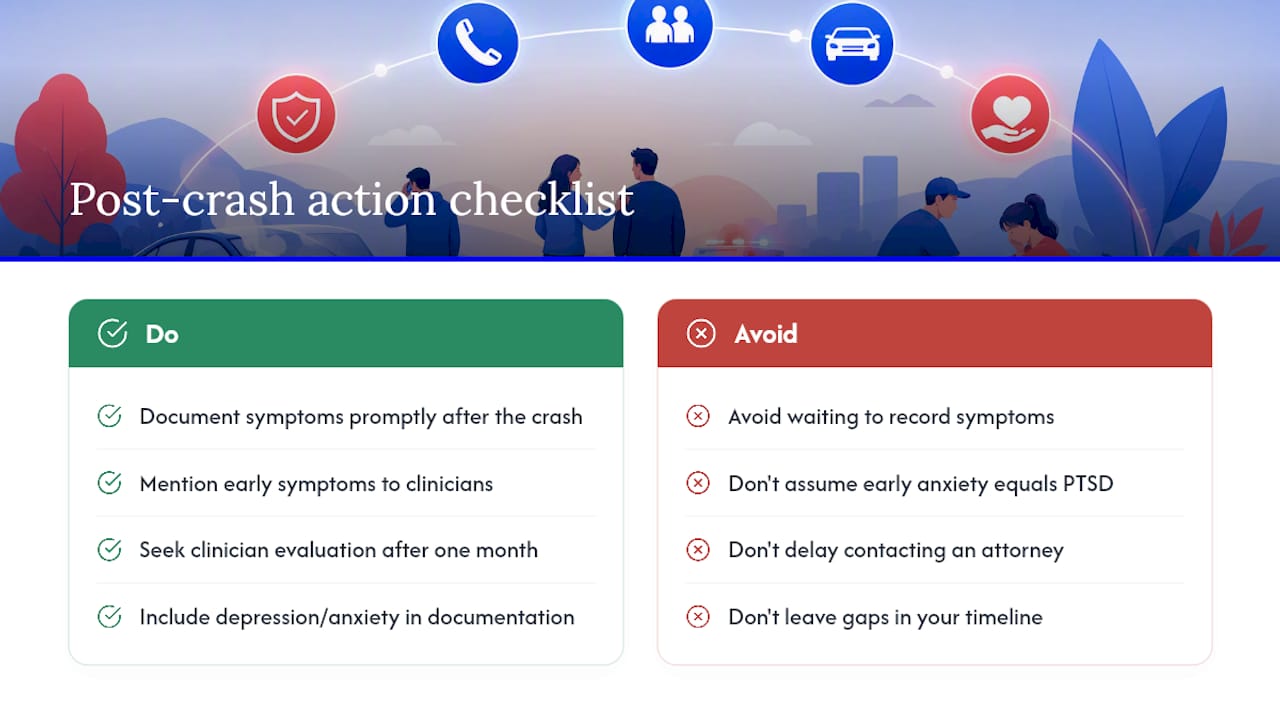
- Record date and time for every notable symptom episode.
- Describe the symptom in plain language, including what triggered it.
- Rate severity on a 0 to 10 scale.
- Note functional impact, missed work, canceled plans, caregiving gaps.
- Name witnesses who saw the episode or its aftermath.
- Attach photos or video where relevant, such as visible panic reactions or physical symptoms.
Two sample entries show the level of detail that holds up:
"March 3, 8:15 PM. Heard tires screech outside the apartment. Heart racing, couldn't breathe for about two minutes, had to sit down. Husband witnessed it. Severity: 8/10."
"April 14. Third week in a row I've canceled therapy intake because I couldn't make myself leave the house. Missed a half day of work. Severity: 6/10, but persistent."
Attorneys and clinicians tend to look for the same evidence: clinical visit notes, therapy records, prescriptions, employer absence documentation, witness statements, your contemporaneous diary, and any objective testing. Forensic evaluation protocols emphasize inter-measure consistency across these sources, since consistent documentation across time and source is what distinguishes a credible claim from an easily challenged one.
Pro Tip: When you request medical records, ask the clinician to explicitly note functional impact and the treatment plan, not just symptoms. A note that says "patient unable to return to work due to panic symptoms" carries far more weight than a checkbox diagnosis.
Guides on evidence best practices cover the broader preservation steps that pair with this.
Can Filing a Claim Slow Down Your Recovery?
Here's an uncomfortable truth: the legal process meant to help you can sometimes complicate healing.
A statewide retrospective study found that a minority of musculoskeletal injury claimants were diagnosed with psychological distress during the claims process, and that distress correlated with longer settlement times and higher costs. Separately, a longitudinal study of 132 crash victims found that litigants had higher initial PTSD symptoms than nonlitigants, and those with pending suits showed less improvement in anxiety and depression over 12 months. This is a correlation, not proof of cause, but it's a pattern worth planning around.
Clinical and legal reviews describe how the legal process itself can feel alienating, compounding feelings of injustice that make recovery harder even as the case moves toward resolution.
A few things help: For guidance on what to expect during the claims process, see claims processes explained by insurance brokers.
- Keep treatment scheduling independent of the claim timeline.
- Stick with one clinician for continuity rather than switching providers mid-process.
- Ask your attorney for realistic timeline expectations up front.
- Expect some disappointment or a sense of feeling unheard by the system, and know that's common, not a sign anything's going wrong.
What Role Does an Attorney Play in Documenting Emotional Injury?
A good attorney isn't just filing paperwork. On the emotional injury side, they typically:
- Review your existing documentation and flag gaps before insurers do.
- Request and organize medical and therapy records across every provider you've seen.
- Refer you to a neutral psychological evaluator when a formal assessment strengthens the claim.
- Secure statements from witnesses who saw your symptoms firsthand.
- Subpoena records when a provider won't release them voluntarily.
- Present functional-impact evidence, missed work, damaged relationships, disrupted caregiving, to insurers or a jury in terms they can act on.
Bring what you have to a free evaluation: your symptom diary, dates of key medical visits, and any witness contacts. An attorney can tell you quickly whether that record is strong enough or where it needs shoring up. Resources like the attorney evaluation guide walk through what that review typically covers.
A Note From the Author
I've spent time writing about PTSD claims after accidents, and the thing that strikes me every time is how normal these reactions are and how often people doubt themselves for having them. You're not overreacting. Documenting what you're feeling, starting today, does double duty: it supports your own care and it strengthens any claim you decide to pursue later.
Get a Free Case Evaluation Before Symptoms Go Undocumented
Carcollisionlawyer connects accident survivors with vetted local attorneys who know how to turn a scattered set of symptoms and medical visits into a case an insurer takes seriously, without charging you anything to find out where you stand.
Before you request a free evaluation, gather what you can: basic facts about the crash, your symptom diary if you've started one, notes from any recent medical visits, contact information for witnesses, and records of missed work. You don't need everything perfectly organized. Attorneys who work with Carcollisionlawyer routinely help clients fill in the gaps, including coordinating referrals for psychological evaluation when that documentation is missing.
Reaching out is optional and comes with no obligation. If you're ready, start your free compensation evaluation now, and review the site's privacy policy if you have questions about how your information gets used.
Frequently Asked Questions
How long do PTSD symptoms need to last after a car accident to be significant? Clinical thresholds typically look for symptoms persisting beyond one month, but even symptoms in the first two to four weeks are worth documenting and mentioning to a clinician if they're not easing up.
Is it normal to feel anxious driving again right after a crash, or is that already PTSD? Short-term anxiety, jumpiness, or reluctance to drive in the days after a collision is a common stress reaction, not automatically PTSD. It becomes more concerning when it persists for weeks, worsens, or starts interfering with work and relationships.
Can depression or anxiety from an accident be included alongside a PTSD claim? Yes. Comorbid depression and anxiety are common after crashes and are typically documented alongside trauma symptoms, since both affect functional impact and treatment needs. Guides on depression's effect on claim value and anxiety disorder claims cover this in more depth.
Do I need a therapist's diagnosis before contacting an attorney? No. You can request a free case evaluation before or after seeking mental health care. Attorneys often help coordinate referrals to evaluators as part of building your case.
What's the biggest documentation mistake people make? Waiting. Symptoms noted weeks or months after the fact carry far less weight than contemporaneous entries, and gaps in the timeline give insurers room to question the connection between the crash and your symptoms.
This article is general information, not a substitute for advice from a qualified doctor. Consult a qualified healthcare professional about your own circumstances before acting on anything here.
Sources
- Psychological distress following a motor vehicle crash: evidence from a statewide retrospective study examining settlement times and costs of compensation claims
- The psychological impact of litigation: compensation neurosis, malingering, PTSD, secondary traumatization, and other lessons from MVAs
- Effects of litigation settlements on posttraumatic stress symptoms in motor vehicle accident victims
- Assessing psychological injury in motor vehicle insurance compensation claims: validating a customized protocol
This checklist offers context for recognizing and documenting symptoms. It is not a clinical diagnostic instrument.