
If you got hurt on the job, workers' compensation almost always covers your medical bills and part of your lost wages, no matter who caused the accident. A personal injury claim only comes into play when someone other than your employer, a driver, a contractor, a manufacturer, is legally at fault. In many workplace accidents, both apply at once, and the order you file them in can change how much money you keep.
TL;DR:
- Filing a personal injury claim is worthwhile only when a third party's negligence caused your injury, in addition to workers' comp coverage.
- Claims against third parties can recover full wages and damages for pain and suffering, which workers' comp benefits do not provide.
- Workers' compensation claims handle treatment and wage replacement quickly, but personal injury cases often result in higher payouts that take longer to settle.
- Filing both claims simultaneously is common when multiple parties share responsibility, with lien negotiations potentially reducing your final personal injury recovery.
- Immediate steps include reporting injury to your employer, seeking medical care, collecting evidence, and consulting a lawyer within the relevant deadlines.
Table of Contents
- Workers Comp vs Personal Injury: The Key Differences
- Can You File Both a Workers' Comp and a Personal Injury Claim?
- What Compensation Looks Like Under Each System
- Where You File and What Deadlines Actually Matter
- When to Call a Lawyer and What to Do Right Now
- Practical Takeaways From Handling Workplace Injury Intakes
- Get a Free Evaluation Before You Decide Anything
- Where to Verify State-Specific Deadlines and Rules
- Sources
- FAQ
Workers Comp vs Personal Injury: The Key Differences
The two systems answer different questions. Workers' compensation asks: were you hurt on the job? Personal injury law asks: did someone's carelessness cause your harm?
Workers' compensation is a no-fault system. You get medical treatment and partial wage replacement regardless of who caused the accident, even if the accident was partly your own doing. In exchange for that guaranteed coverage, most states apply what's called the "exclusive remedy" rule: you generally can't sue your employer for additional damages, even if their negligence contributed to your injury.
Personal injury law works the opposite way. Someone has to be at fault, and you have to prove it. There's no guarantee of payment, but the ceiling is much higher. Personal injury claims can recover full lost wages (not a capped percentage), future earning capacity, and pain and suffering, categories workers' comp simply doesn't touch.
Here's how the two systems break downside by side:
- Fault requirement: Workers' comp requires none; personal injury requires proof of negligence or fault.
- Medical coverage: Workers' comp pays approved treatment directly through the carrier; personal injury requires you to front costs or use health insurance, then recover them in the settlement.
- Wage replacement: Workers' comp pays a percentage of average weekly wage, capped by state maximums; personal injury can recover full lost income.
- Pain and suffering: Not available under workers' comp; a central component of personal injury damages, per the American Bar Association.
- Punitive damages: Essentially never available in workers' comp; rare but possible in personal injury cases involving egregious conduct.
The exclusive remedy rule has exceptions, but they're narrow. Intentional harm by an employer, an employer's failure to carry required insurance, and a handful of state-specific carve-outs (Texas allows employers to opt out of workers' comp entirely as "non-subscribers," which changes the legal calculus significantly) can open the door to a direct lawsuit against your employer. These exceptions get tested in court far more often than they succeed, and state rules on this vary enough that you shouldn't assume one applies without a lawyer confirming it.
Can You File Both a Workers' Comp and a Personal Injury Claim?
Yes, and it happens more often than most injured workers realize. The trigger is simple: a third party, someone other than your employer or a coworker acting within their job duties, has to bear some responsibility for what happened to you.
Common scenarios where both claims apply, as explained in detail on Insurance Claims — Blog | Car Geeks Collision:
- A delivery driver rear-ends you while you're driving for work. You file workers' comp through your employer and a personal injury claim against the at-fault driver.
- Defective equipment injures you on a job site. Workers' comp covers your treatment; a product liability claim against the manufacturer can recover far more.
- A subcontractor's negligence causes a construction accident. You're covered by your employer's comp policy, but the subcontractor isn't shielded by exclusive remedy the way your direct employer is.
- A property owner's unsafe conditions cause a workplace fall during a delivery or service call, opening a premises liability claim alongside comp.
When both claims produce money, the workers' comp carrier typically has a subrogation lien on your third-party settlement. That means the insurer that paid your medical bills and wage benefits gets reimbursed out of whatever you win in the personal injury case, since you shouldn't collect twice for the same losses. These liens are negotiable, and attorneys who handle both sides of a case regularly get them reduced by citing attorney fees, litigation costs, or "made whole" arguments that limit how much the carrier can claw back.
Pro Tip: Don't wait to see how the third-party case turns out before filing workers' comp. File comp immediately to get medical care moving and your indemnity checks started, then let your attorney pursue the third-party claim in parallel. Delaying comp to avoid a future lien almost always costs you more than the lien itself.
Start collecting evidence the day it happens: incident reports, photos, witness names, and medical records serve both cases at once.
What Compensation Looks Like Under Each System
The dollar difference between these two paths is often the biggest surprise for injured workers, and it's worth understanding before you sign anything.
Workers' compensation benefits typically include:
- Medical treatment, paid directly by the insurance carrier with no out-of-pocket cost for approved care.
- Temporary total disability, usually calculated at roughly 66.67% of your average weekly wage, subject to a state-set maximum that varies significantly from state to state.
- Permanent impairment benefits, paid according to a state schedule that assigns dollar values to specific injuries (loss of a finger, hearing loss, and so on).
- Vocational rehabilitation, if you can't return to your previous job.
Personal injury damages cast a wider net. They include past and future medical expenses, full lost earnings rather than a capped percentage, loss of future earning capacity, and non-economic damages like pain and suffering. Punitive damages show up occasionally, but only in cases involving reckless or intentional conduct, not ordinary negligence.
The gap between the two can be substantial. Third-party personal injury suits often pay multiple times what a comparable workers' comp claim provides, though they take longer to resolve and carry real litigation risk since fault has to be proven.
Net recovery, what actually lands in your pocket, depends on a few moving parts: attorney fees (typically contingency-based in personal injury cases), repayment of the workers' comp lien, and timing. Comp checks start relatively fast, often within weeks of a claim being accepted. A personal injury settlement or verdict can take a year or more, especially if it goes to trial. Attorneys who work both angles of a claim can often tell you early which combination of comp benefits and third-party recovery nets you the most after the lien is paid.
Where You File and What Deadlines Actually Matter
These two systems don't share a courthouse, and they definitely don't share a clock.
Workers' compensation claims go through an administrative process at your state's workers' compensation board, not civil court. Personal injury claims go through the regular civil court system, where you or your attorney file a lawsuit against the at-fault party.
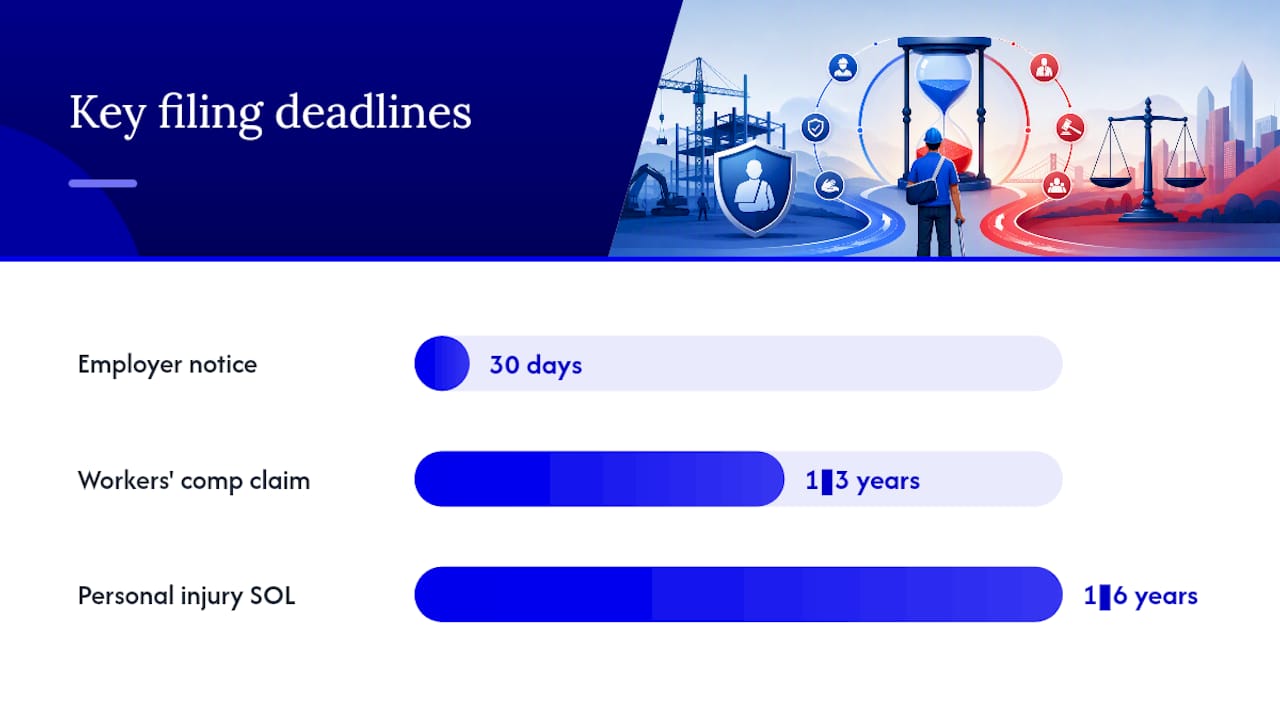
The deadlines are where people get burned. Here's the general sequence, though you need to confirm exact dates with your state:
- Notify your employer immediately. Most states require written notice of a workplace injury within 30 days, and some allow far less time.
- File your formal workers' comp claim with the state board within the window your state sets, commonly ranging from one to three years depending on jurisdiction.
- Track your personal injury statute of limitations separately. These deadlines commonly run from one to six years depending on the state, and filing a workers' comp claim does absolutely nothing to pause or preserve that clock.
- Calendar both deadlines the day you're injured, not after treatment ends or after you've decided whether to pursue a third party.
Evidence matters for both tracks, but the personal injury side demands more. Keep the incident report, all medical records, employer injury forms, witness statements, scene photos, and vehicle or repair records if a crash was involved. For a step-by-step evidence checklist, the details you gather in the first 48 hours often decide how strong the third-party case turns out to be. Personal injury cases frequently also require expert reports, on accident reconstruction, medical causation, or vocational impact, that workers' comp claims rarely need.
When to Call a Lawyer and What to Do Right Now
Not every workplace injury needs an attorney. A straightforward sprained ankle with an accepted comp claim and no third party involved often resolves fine without one. But several situations change that math fast.
Contact a lawyer when your comp claim is denied, when your employer disputes that the injury happened at work, when a third party's negligence is even plausible, when the injury is permanent or disabling, or when a lien negotiation is on the table. Complex causation questions, the kind where an insurer argues your injury was pre-existing or unrelated to work, almost always benefit from legal representation.
Do these things the same day you're hurt, regardless of whether you end up needing a lawyer:
- Report the injury to your employer in writing, even if it seems minor.
- Get medical care immediately and tell the provider it's work-related.
- Photograph the scene, the equipment involved, and your visible injuries.
- Collect names and contact information for any witnesses before they scatter.
- File your workers' comp paperwork without waiting to see how you feel in a week.
Pro Tip: Write down what happened in your own words while it's fresh, including time, location, and anyone involved. Insurance adjusters and defense attorneys will pick apart inconsistent recollections months later, and a same-day account is hard to argue with.
A free case evaluation typically covers liability triage (was a third party involved?), a plain-language walkthrough of how any comp lien would affect your net recovery, and an honest read on whether your situation calls for a personal injury claim, a comp claim alone, or both.
Practical Takeaways From Handling Workplace Injury Intakes
The pattern that shows up again and again is straightforward: workers who secure comp benefits fast while quietly investigating third-party liability come out ahead of those who wait to decide. Comp gets your treatment moving. A parallel look at who else might be responsible protects the bigger recovery if one exists.
Good intake starts with specific questions, what type of injury, how it happened, who else was present or involved, because those details determine how fast an attorney can spot a third-party angle and calendar the right deadlines. Vague intake produces vague outcomes.
— Gerard
Get a Free Evaluation Before You Decide Anything
A free evaluation service exists for exactly this fork in the road, figuring out whether your injury is a comp-only matter or one where a third party owes you significantly more. Instead of guessing whether that lien negotiation or that other driver's insurance is worth pursuing, you can get a no-cost assessment matched to your specific situation before you commit to anything.
Have a few details ready before you start: the date and location of the injury, your employer's name, a short summary of what happened and how you were hurt, the names of any medical providers who treated you, and copies of any police or incident reports already filed. That's enough for a free case evaluation to flag whether a third party might be liable and connect you with an attorney who handles both tracks. If a crash was involved, see how compensation options apply to your situation before deadlines start working against you.
Where to Verify State-Specific Deadlines and Rules
Rules on notice periods, filing windows, and statutes of limitation vary by state. Confirm specifics with the U.S. Department of Labor, your state workers' compensation board, and the American Bar Association.
This article is general information, not a substitute for advice from a qualified lawyer. Consult a qualified legal professional about your own circumstances before acting on anything here.
Sources
- U.S. Department of Labor — Workers' Compensation
- Cornell Law School — Personal injury
- Settlement Insight — Personal Injury vs Workers' Compensation
- Ny
FAQ
Are Personal Injury and Workers' Comp the Same Thing?
No. Workers' comp is a no-fault benefit system for job injuries with capped payouts; personal injury is a fault-based claim against a negligent party that can recover full damages, including pain and suffering.
What Is the Average Payout for a Personal Injury Claim in the USA?
Payouts vary enormously by injury severity, liability clarity, and state, so there's no single reliable average figure to quote. A free case evaluation can give you a realistic range based on your specific facts.
What Are the Disadvantages of Workers' Compensation?
Benefits are capped, generally around 66.67% of your average weekly wage with a state maximum, and you can't recover pain and suffering or full lost earnings, even when your employer's negligence contributed to the injury.
Is It Worth Suing for Personal Injury?
If a third party, not just your employer, caused or contributed to your injury, a personal injury suit can pay substantially more than workers' comp alone, though it takes longer and requires proving fault.
Can I Lose My Workers' Comp Benefits if I File a Personal Injury Claim Too?
No, but the comp carrier will typically expect repayment of its lien from your personal injury settlement, and an attorney can often negotiate that lien down before it's paid.