
A phobic reaction after a crash, like a debilitating fear of driving, riding in cars, or even crossing intersections, can be a legally compensable injury in a personal-injury claim, provided you can show it was caused by the accident and that it has measurably hurt your ability to function. Courts and insurers do not pay out simply because someone says they feel scared. They pay when fear becomes documented, diagnosable harm.
Three things determine whether your claim moves forward:
- What makes it compensable: a provable link between the at-fault party's negligence and a diagnosed decline in your daily functioning, not just discomfort or a bad memory.
- What proof is required: a formal clinical diagnosis, ongoing treatment records, and documentation showing how the fear disrupts work, driving, or routine life.
- What to do immediately: start documented treatment now, preserve every record you generate, and check your state's statute of limitations before evidence or eligibility windows close.
Roughly 25% to 33% of accident survivors develop significant driving-related anxiety after a crash, according to the American Psychological Association. Most of those cases never see a courtroom because the fear fades or resolves with a few counseling sessions. The ones that turn into real claims are the ones where the phobia outlasts recovery and someone put it on paper.
Key Takeaways
Post-accident phobia becomes legally compensable only when documented causation and measurable functional loss connect the accident to your diagnosis.
| Point | Details |
|---|---|
| Compensability depends on proof | Fear alone doesn't count; a diagnosed decline in daily functioning tied to the accident does. |
| Documentation is non-negotiable | Clinical diagnosis, treatment records, and a contemporaneous journal carry more weight than testimony alone. |
| State deadlines and caps matter | Statutes of limitation, no-fault thresholds, and damage caps can limit or eliminate recovery if missed. |
| Get a free evaluation early | Carcollisionlawyer's no-cost case evaluation identifies viability and matches you with a suited attorney. |
Table of Contents
- How Do Courts Decide What Is Phobia After Accident Legally?
- What Evidence Do You Need to Prove a Post-Accident Phobia Claim?
- How Are Emotional Distress Damages Calculated?
- What State Rules Should You Check Before Filing?
- How Do Attorneys and Experts Build a Phobia Claim?
- What Should You Bring to a Free Legal Case Evaluation?
- How Carcollisionlawyer Helps You Move Your Claim Forward
- Sources
How Do Courts Decide What Is Phobia After Accident Legally?
Every state uses one of three legal frameworks to decide whether emotional harm, including a phobic reaction, counts as a compensable injury. Which one applies to your case depends entirely on where the accident happened.
The impact rule is the strictest. It requires some physical contact or physical injury before a court will even consider emotional damages. The zone-of-danger rule loosens that requirement slightly. You don't need to be struck, but you do need to have been close enough to the danger that you reasonably feared for your own safety. The foreseeability standard is the most permissive of the three. It asks whether a reasonable person in the defendant's position should have anticipated that their conduct would cause emotional harm, physical contact or not.
- States following the impact rule generally require documented physical injury alongside the phobia claim.
- Zone-of-danger states typically require proof you were in the immediate path of harm, even without contact.
- Foreseeability states allow claims when the psychological harm was a predictable outcome of the negligent act.
There's also a distinction that trips people up: claims tied to a physical injury (you broke your arm and developed a driving phobia afterward) face a much lower proof burden than standalone emotional-distress claims with no physical injury at all. Standalone claims require a heavier evidentiary lift, because insurers assume, often correctly, that unaccompanied emotional claims are easier to fake or exaggerate.
Causation is the real battleground either way. Your attorney has to connect the at-fault driver's conduct to a specific, identifiable decline in how you function, and rule out other explanations, like a prior anxiety disorder or an unrelated life stressor, that a defense team will inevitably raise.
What Evidence Do You Need to Prove a Post-Accident Phobia Claim?
Insurers and courts expect a specific evidence package before they treat a phobia as a real, compensable injury rather than a claim built on your own testimony. The American Bar Association's guidance on tort litigation makes clear that a formal diagnosis from a licensed mental health professional, psychologist, psychiatrist, or licensed clinical social worker, is the foundation everything else builds on.
Here's what actually moves a claim forward:
- A formal diagnosis (specific phobia, adjustment disorder, or related diagnosis) from a licensed provider, not a general practitioner referral alone.
- Therapy and medication records showing consistent, ongoing treatment.
- A contemporaneous symptom journal, dated entries, not memories reconstructed months later.
- Medical bills and receipts tied to every appointment.
- Lost-wage documentation if the phobia has kept you from working or driving to work.
- Witness statements from family, coworkers, or friends who've seen the functional change firsthand.
A useful journal entry doesn't need to be long. Something like "March 3: Declined a ride to my sister's house, 40 minutes away, because I couldn't stop shaking at the thought of the highway. Called in sick to avoid the commute" tells a much clearer story than "still scared of driving." Treatment notes should do the same work: they should document specific functional limits, not just that a session happened. U.S. News & World Report's guidance on proving emotional distress points to exactly this kind of specificity as the difference between a claim that settles and one that stalls.
Pro Tip: Keep your original appointment receipts, intake forms, and every dated therapy note in one folder from day one. Gaps in treatment, even a two-month lapse because you couldn't find a new therapist, hand the defense an easy argument that your condition wasn't serious enough to warrant continuous care.

For a deeper look at how diagnosis and documentation translate into dollars, our accident phobia diagnosis compensation guide walks through the process step by step.
How Are Emotional Distress Damages Calculated?
Attorneys and insurers rely on two standard frameworks to put a number on emotional distress: the multiplier method and the per diem method. Neither is written into any statute. Both function as negotiation anchors.
The multiplier method takes your documented economic losses (medical bills, lost wages) and multiplies them by a factor, typically between 1.5 and 5, depending on the severity and duration of the psychological harm. The per diem method instead assigns a daily dollar value to your suffering and multiplies it by the number of days from the accident to your maximum medical improvement.
Say your accident-related medical bills and lost wages total $8,000. Under the multiplier method, a moderate case using a factor of 3 lands at $24,000 in non-economic damages. Under per diem, if your treating provider documents 240 days to reach maximum improvement at a rate of $100 per day, you land at $24,000 as well. The methods often converge in the same range, which is exactly why negotiators use both.
| Valuation Factor | How It Affects the Final Number |
|---|---|
| Multiplier method | Applies a 1.5–5x factor to economic losses based on severity and documentation quality. |
| Per diem method | Multiplies a daily rate by days to maximum medical improvement, anchored to treatment timeline. |
| Comparative fault | Reduces the award by your percentage of fault in most states. |
| Insurance policy limits | Often caps actual recovery regardless of the calculated value. |
| State statutory caps | Some states cap non-economic damages outright, overriding a higher calculated figure. |
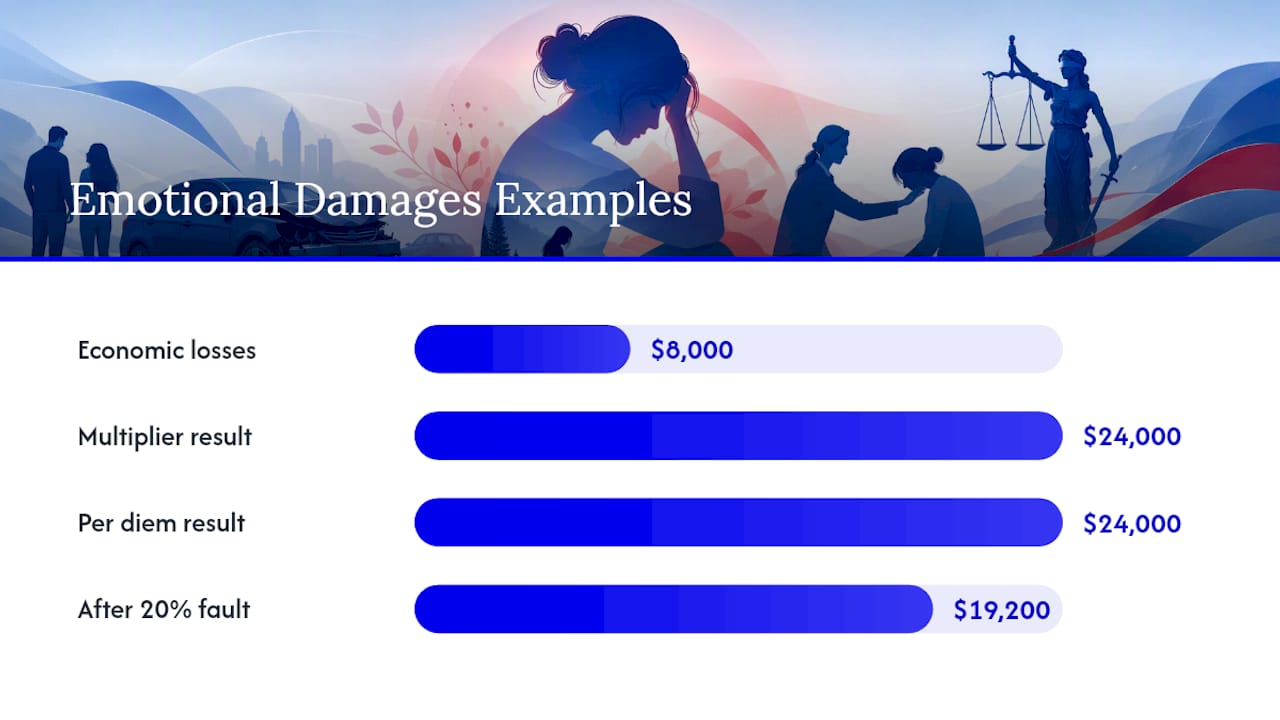
That $24,000 figure rarely survives contact with reality untouched. If you were found 20% at fault, comparative-fault rules cut it to $19,200 in most states. If the at-fault driver only carries the state-minimum liability policy, that policy limit becomes the real ceiling on what you can actually collect, no matter what the math says you deserve. One more wrinkle worth knowing: emotional distress damages tied to a physical injury are generally not taxable, while standalone emotional-distress awards can carry different tax treatment under federal law.
What State Rules Should You Check Before Filing?
Before you go further, verify a handful of state-specific facts. These checkpoints decide whether your claim is viable at all, not just how much it's worth.
- Confirm which framework your state follows: impact rule, zone-of-danger, or foreseeability.
- If you're in a no-fault state, identify the exact threshold, verbal (a description of injury severity) or monetary, required before you can sue beyond your own no-fault benefits.
- Find your state's statutory cap, if any, on non-economic damages.
- Note your state's statute of limitations for personal-injury suits; this typically runs two to three years but varies.
Check the statute of limitations immediately, before anything else. Miss that deadline and no amount of documentation will save your claim. State legislature websites and state bar association resources are reliable starting points, but a licensed attorney can confirm exactly how your state's rules apply to your specific facts in minutes, not hours. Our breakdown of the impact rule and emotional claims covers how these frameworks play out state by state.
How Do Attorneys and Experts Build a Phobia Claim?
Getting a post-accident phobia claim from intake to settlement usually follows a predictable sequence in the first 30 to 90 days.
- Intake and initial assessment, where the attorney gathers the accident report, insurance information, and a summary of your symptoms.
- Evidence preservation, securing photos, witness contacts, and the police report before memories fade or records disappear.
- Referral for a forensic mental-health evaluation, connecting you with a psychologist or psychiatrist qualified to produce a litigation-ready opinion.
- Records requests, obtaining signed releases for your therapy notes, medical bills, and employment records.
- Demand strategy, packaging the diagnosis, documentation, and valuation into a settlement demand to the insurer.
The forensic evaluation is where subjective fear becomes a defensible legal opinion. Evaluators commonly apply a five-stage temporal model: they assess your pre-accident functioning, the onset of symptoms, how those symptoms evolved over time, whether alternative explanations exist, and your likely prognosis. This structure exists specifically to survive Daubert and Frye admissibility challenges, the legal tests courts use to decide whether expert testimony is scientifically sound enough to reach a jury.
A defensible forensic opinion typically combines records review, standardized testing, collateral interviews, and an explicit timeline linking symptom onset to the accident. That combination is what separates an opinion that survives cross-examination from one that gets thrown out before trial.
Defense teams have a predictable playbook: attack causation, point to a pre-existing anxiety history, or argue that gaps in your treatment mean the condition wasn't severe. Attorneys counter with longitudinal documentation and the eggshell plaintiff doctrine, which holds that defendants remain liable for aggravating a pre-existing condition as long as that aggravation is documented. A prior mild anxiety history doesn't kill your claim. It just raises the documentation bar. For more on how this plays out in practice, see our guide on how emotional injury attorneys build cases that win.
What Should You Bring to a Free Legal Case Evaluation?
A little preparation turns a free case evaluation from a vague conversation into a useful, concrete assessment.
Do these things now:
- Get a clinical intake scheduled or completed with a licensed mental health provider.
- Start (or continue) a dated symptom journal.
- Collect medical and therapy bills as they arrive.
- Print copies of the police report and any accident reports.
- Preserve photos and witness contact information from the scene.
- Track time off work and estimated lost income.
When you call or submit an intake form, expect questions along these lines:
- When did the accident happen and what were your immediate injuries?
- What symptoms are you experiencing now, and when did they start?
- Which providers have you seen, and are you currently in treatment?
- Do you know the at-fault driver's insurance coverage limits?
- Have you missed work or turned down activities because of the fear?
A free evaluation produces a viability assessment (whether your facts support a claim), a list of the specific evidence you still need to gather, and, if the case looks solid, a match with an attorney suited to psychological-injury claims. It costs nothing, stays confidential, and carries no obligation to move forward.
A Publisher's Note on Post-Accident Phobia Claims
Carcollisionlawyer exists to connect people carrying invisible injuries with attorneys who know how to make those injuries visible in a legal claim. A phobic reaction after a crash is real harm, and the legal system has a documented, workable path for proving it when the evidence is there. Submitting a case evaluation costs nothing, stays confidential, and puts no pressure on you to move forward if the timing isn't right.
How Carcollisionlawyer Helps You Move Your Claim Forward
Carcollisionlawyer's free legal case evaluation exists specifically for situations like this: an injury that doesn't show up on an X-ray but shows up every time you get behind the wheel. Instead of guessing whether your phobia qualifies, or spending hours researching your state's impact rule on your own, you submit your details once and get matched with an attorney who already handles psychological-injury claims.
Here's what the evaluation actually delivers:
- A quick read on whether your facts support a viable psychological-injury claim.
- A clear list of the documents and records you still need to gather.
- A match with a local attorney if your case looks strong enough to pursue.
The whole process is free, confidential, and comes with zero pressure to sign anything. If you're ready to find out where you stand, submit your case details now and get a straight answer instead of more uncertainty.
Sources
Print or email these to whoever handles your case or treatment. They're the primary references behind the legal standards covered above.
- American Bar Association — Torts and Insurance Practice
- Evaluation decisions by psychologists about causation and damages (Cambridge handbook chapter)
- How to prove emotional distress after a car accident — U.S. News & World Report
Collect copies of whichever of these apply to your situation before your consultation. It saves time and helps your attorney assess your case faster.
This article is general information, not a substitute for advice from a qualified lawyer. Consult a qualified legal professional about your own circumstances before acting on anything here.