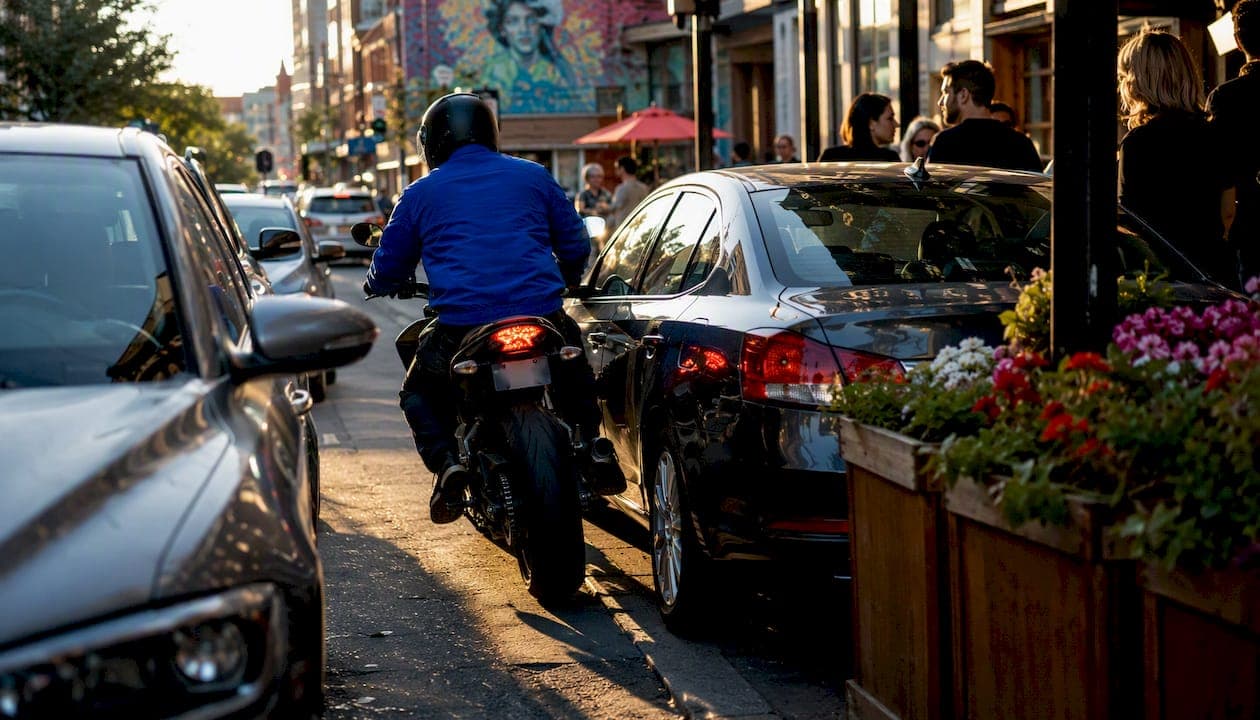
Only California permits full lane splitting between moving vehicles under Vehicle Code §21658.1. A handful of states — Minnesota, Colorado, Utah, Arizona, and Montana — allow limited lane filtering under specific conditions. Everywhere else, the maneuver is effectively illegal and riders risk citations for reckless driving or unsafe lane usage. See the state comparison table below for exact limits and effective dates. Legal status is jurisdiction-specific and changes as legislatures act, so always verify your state's current statute or agency guidance before riding.
This article provides general legal information, not legal advice. Confirm current rules with your state's DOT, highway patrol, or a licensed attorney in your jurisdiction.
Table of Contents
- What states allow lane splitting or filtering?
- Lane splitting vs. lane filtering: what the terms actually mean
- What the official rules actually require in permissive states
- How law enforcement handles lane splitting citations
- Who's at fault when a crash happens during lane splitting?
- How to split or filter safely and legally
- What to do if you're cited or injured while lane splitting
- Key Takeaways
- The legal risk most riders underestimate
- Injured while lane splitting? Here is how Carcollisionlawyer can help
- Authoritative sources for lane splitting and filtering laws
What states allow lane splitting or filtering?
| State | Legal Status | Type Allowed | Conditions / Speed Limits | Excluded Locations | Effective Date / Citation |
|---|---|---|---|---|---|
| California | Allowed | Lane splitting (moving traffic) | No statutory speed cap; CHP guidance recommends ≤10–15 mph differential | Not specified by statute | — — Veh. Code §21658.1 |
| Minnesota | Allowed | Both splitting and filtering | Splitting: ≤25 mph, ≤15 mph over traffic; Filtering: ≤15 mph differential, traffic not moving | School zones, work zones, roundabout approaches | July 1, 2025 — Minnesota Statute |
| Colorado | Limited | Filtering only | ≤15 mph; traffic in rider's lane AND adjacent lanes must be at a complete stop; pass on left; lane must be wide enough | Shoulders, roundabouts | Aug 7, 2024 — Colo. Rev. Stat. |
| Utah | Limited | Filtering only | ≤15 mph; traffic stopped at signal | Highways, shoulders | — |
| Arizona | Limited | Filtering only | ≤15 mph; traffic stopped | Highways | — |
| Montana | Limited | Filtering only | ≤20 mph; traffic stopped | Highways, shoulders | — |
| All other states | Not permitted | N/A | Treated as moving violation | N/A | Varies by state |
As of 2026: Several states now permit some form of lane splitting or filtering, with California alone allowing the practice between moving vehicles. Minnesota's law, effective recently, is among the most detailed in the country.
Statutes and agency guidance can change. The Minnesota Department of Public Safety and the Colorado State Patrol both maintain updated guidance pages worth bookmarking.
Lane splitting vs. lane filtering: what the terms actually mean
These two terms are not interchangeable, and confusing them is one of the most common reasons riders get cited even in permissive states.
Lane splitting means riding a motorcycle between rows of vehicles that are moving. Picture a freeway where traffic is crawling at 25–30 mph: a rider who moves between two lanes of slow-moving cars is splitting. California's Vehicle Code §21658.1 defines it precisely as driving between rows of "stopped or moving vehicles in the same lane."
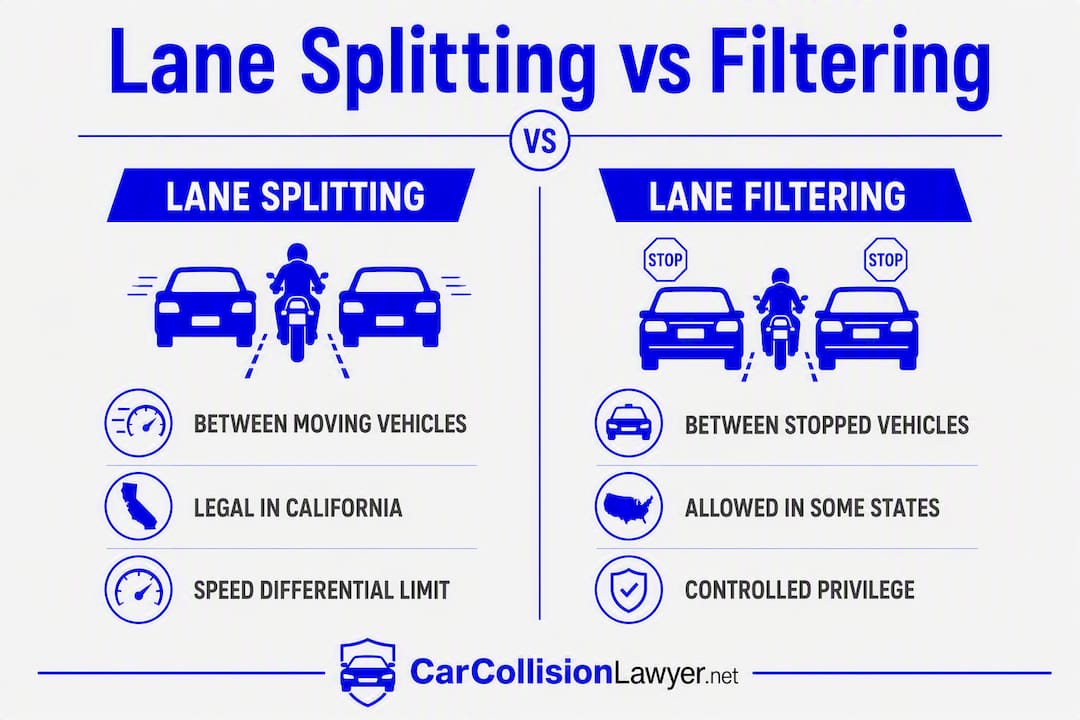
Lane filtering is narrower. It applies when traffic is stopped or nearly stopped, such as at a red light, and the rider moves to the front of the queue. Colorado's law, for example, requires that traffic in both the rider's lane and the adjacent lane be at a complete stop before filtering is permitted.
Related terms riders often encounter:
- Lane sharing: Two motorcycles riding side by side in a single lane. Legal in most states; distinct from splitting or filtering.
- Shoulder riding: Using the paved shoulder to pass stopped traffic. This is not lane splitting and is illegal in virtually every U.S. jurisdiction. Attempting it where filtering is legal does not make it legal.
- Filtering at roundabouts: Specifically prohibited in Minnesota and Colorado even where general filtering is allowed.
The legal distinction between splitting and filtering also affects civil liability. Performing a split in a state that only authorizes filtering is a statutory violation, and that violation will follow you into any insurance claim or lawsuit.
Pro Tip: The CHP recommends a speed differential of no more than 10–15 mph above surrounding traffic when splitting. Minnesota's statute codifies a similar concept with a hard 15 mph cap over traffic speed. Use whichever is lower for your jurisdiction.
What the official rules actually require in permissive states
Knowing a state allows filtering is only half the picture. The operational limits are where riders get tripped up.

| State | Max Speed (Rider) | Max Speed Differential | Traffic Condition Required | Lane Width Rule | Shoulder Allowed? |
|---|---|---|---|---|---|
| California | No statutory cap | ≤10–15 mph (CHP guidance) | Stopped or moving | Must accommodate safely | No |
| Minnesota | ≤25 mph (splitting) | ≤15 mph over traffic | Not moving (filtering) / moving (splitting) | Must be wide enough | No |
| Colorado | ≤15 mph | Not specified separately | Complete stop in both lanes | Must be wide enough | No |
| Utah | ≤15 mph | Not specified | Stopped at signal | Not specified | No |
| Arizona | ≤15 mph | Not specified | Stopped | Not specified | No |
| Montana | ≤20 mph | Not specified | Stopped | Not specified | No |
Beyond the numbers, every permissive state layers on location-based exclusions:
- School zones: Prohibited in Minnesota; most other states treat them as heightened-caution areas.
- Work zones: Minnesota explicitly excludes them; Colorado guidance discourages filtering where lane geometry is altered.
- Roundabout approaches: Banned in Minnesota and Colorado, where merging geometry makes the maneuver particularly unpredictable.
- On-ramps and highway entrance lanes: Generally excluded because traffic speed is variable and lane width narrows.
- Shoulders: Universally prohibited as a pass-through lane, regardless of whether filtering is otherwise legal.
The Minnesota Motorcycle Safety Center and the Colorado State Patrol's lane filtering page both publish the full exclusion lists for their states. Check those pages directly rather than relying on secondhand summaries, including this one.
One underappreciated point: state transportation agencies frame filtering as a controlled privilege, not a rider's right. Colorado's guidance explicitly positions the practice as something riders earn by following every condition precisely, and it notes that the safety benefit — reducing rear-end collision risk by moving riders out of brake zones — disappears the moment a rider exceeds the speed cap or filters where prohibited.
How law enforcement handles lane splitting citations
In states where splitting or filtering is illegal, officers do not need a specific "lane splitting" statute to write a ticket. They reach for general traffic codes instead.
Common citation types riders face in non-permissive states:
- Reckless driving (most serious; can carry criminal penalties in some states)
- Unsafe lane change or lane usage
- Failure to maintain a lane
- Impeding traffic
Even in California, where the practice is legal, the CHP can cite a rider for unsafe speed or reckless operation if the speed differential is excessive. The statute legalizes the maneuver; it does not immunize the rider from every traffic law on the books.
On the driver side, California's CHP guidance warns motorists not to intentionally block or impede a rider who is lane splitting. Drivers who open doors, swerve, or accelerate to close a gap can face their own citations.
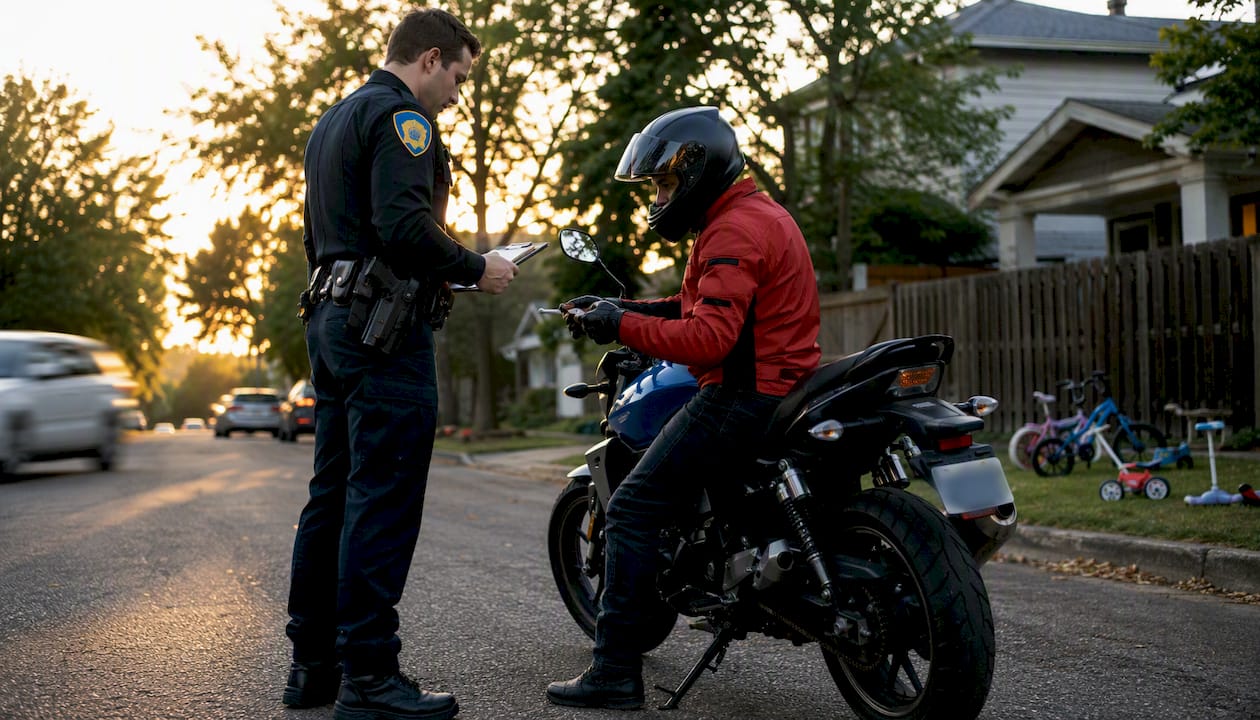
Pro Tip: If you are stopped after a lane split or filter, identify the maneuver factually and briefly. Do not volunteer an opinion about whether it was safe. Anything you say about your speed or the gap you chose can be used to establish fault in a later civil claim. Let your attorney make those arguments.
Penalty ranges vary widely. A basic moving violation in most states carries fines plus court costs. A reckless driving charge can mean license suspension, points, and in some states a misdemeanor conviction. Where lane splitting is treated as a moving violation rather than a criminal offense, the financial hit is smaller, but the insurance consequences can be significant.
Who's at fault when a crash happens during lane splitting?
The short answer: in most situations, the rider carries the heavier burden. When a motorcycle is the only vehicle moving through stopped or slow traffic, courts and insurers tend to start with the assumption that the rider created the risk.
Colorado's State Patrol guidance states this plainly: if a crash occurs during filtering, the rider will likely be found at fault because they were the only vehicle in motion. That framing reflects a broader pattern across permissive and non-permissive states alike. Even where filtering is fully legal, courts and insurers frequently place the burden on the rider because motorcycles have fewer passive-protection factors, which raises the evidentiary bar for anyone trying to argue they rode safely.
The distinction between criminal fault and civil liability matters here. A rider might avoid a traffic citation in California because the maneuver was legal, yet still be found partially or fully negligent in a civil lawsuit if the speed differential was excessive or the lane width was marginal.
Insurers evaluate these claims using:
- Photos and video from dashcams, traffic cameras, or bystander phones
- Witness statements about the rider's speed and lane position
- Vehicle telemetry (event data recorders in newer cars)
- Police report language, especially whether the officer noted a statutory violation
- Whether the rider was in an excluded zone (school zone, roundabout approach)
Understanding how motorcycle accident compensation works in the context of lane splitting is worth reading before you talk to an insurer. The statutory allowance in your state is a starting point, not a shield. A rider who filtered legally but at 22 mph in a 15 mph state is in a weaker position than one who followed every condition precisely.
Motorcycle insurance coverage also responds differently depending on the jurisdiction's legal status. In non-permissive states, an insurer may argue the rider was engaged in an illegal maneuver and attempt to reduce or deny the claim. Reviewing your motorcycle insurance policy for exclusions related to traffic violations before you ride is a practical step most riders skip.
How to split or filter safely and legally
One rule covers everything: if you cannot do it safely and within your state's specific limits, do not attempt it.
For riders in permissive states, here is the sequence that keeps a maneuver both legal and survivable:
- Confirm your state's current law. Check the official statute or agency page. Minnesota's law took effect July 1, 2025; Colorado's on Aug 7, 2024. Laws change; your memory of what you read two years ago may not.
- Check your speed. In Minnesota, you must be at or below 25 mph to split. In Colorado, Utah, Arizona, and Montana, the cap is 15–20 mph. In California, there is no statutory cap, but CHP guidance recommends staying within 10–15 mph of surrounding traffic.
- Assess the gap. The lane must be wide enough for your motorcycle and the adjacent vehicle with a safe margin. If you are squeezing, the lane is not wide enough.
- Avoid large vehicles. The CHP specifically warns against splitting between big rigs, buses, and large SUVs. Blind spots are larger, wind buffeting is unpredictable, and drivers cannot see you.
- Check for excluded zones. School zone, work zone, roundabout approach, on-ramp? Stop. The maneuver is prohibited regardless of traffic conditions.
- Re-enter your lane cleanly. Signal your intent, match traffic speed, and merge before the lane narrows or an intersection approaches.
Pro Tip: CHP guidance recommends treating the 10–15 mph differential as a ceiling, not a target. In practice, the safest splits happen at 5–10 mph over surrounding traffic, where you have more time to react to a door opening or a vehicle changing lanes.
The Minnesota Motorcycle Safety Center frames the practice as a skill requiring deliberate preparation, not a reflex maneuver. That framing is worth internalizing: riders who treat filtering as a casual shortcut are the ones who end up in the fault-allocation conversation described in the previous section.
What to do if you're cited or injured while lane splitting
The first 30 minutes after a crash or citation shape everything that follows. Here is what to do, in order.
At the scene:
- Photograph everything: lane markings, vehicle positions, skid marks, road surface, traffic control devices, your motorcycle's damage, and any visible injuries.
- Collect witness names and phone numbers before anyone leaves. Bystander accounts are often the most credible evidence in a disputed lane-splitting claim.
- Request the police report number and the responding officer's name. Do not leave without it.
- Do not make statements about your speed, the gap, or whether you thought the maneuver was safe. Identify yourself and the basic facts; let the report speak.
- Seek medical care immediately, even if you feel fine. Adrenaline masks injuries, and a gap in medical records is one of the first things an insurer will use against you.
After the scene:
- Preserve your motorcycle and gear in their post-crash condition. Do not repair or clean anything until an attorney or adjuster has documented it.
- Obtain and save any dashcam or surveillance footage from nearby businesses or vehicles before it is overwritten, typically within 24–72 hours.
- Document your injuries with photos over the following days; bruising and swelling often peak 48–72 hours after impact.
Attorneys evaluating lane-splitting cases look at how motorcycle accident lawyers build and win cases: scene reconstruction, vehicle telemetry, statutory compliance in the jurisdiction, witness credibility, and the rider's prior traffic record. A rider who followed every statutory condition and has photos to prove it is in a fundamentally different position than one who cannot account for their speed.
Your motorcycle accident legal rights checklist is worth reviewing before you speak to any insurer. Insurers open claims quickly; riders who engage without understanding their rights often concede ground they cannot recover.
Key Takeaways
California is the only U.S. state that permits full lane splitting between moving vehicles; five other states allow limited filtering under strict speed and traffic conditions, and everywhere else the maneuver is treated as a moving violation or worse.
| Point | Details |
|---|---|
| California stands alone | Only California allows splitting between moving vehicles under Veh. Code §21658.1; all other permissive states restrict riders to stopped-traffic filtering. |
| Speed caps are hard limits | Minnesota and other permissive states have established speed caps for splitting or filtering, with variation among them. |
| Excluded zones apply everywhere | School zones, work zones, roundabout approaches, and shoulders are off-limits in every permissive state, regardless of traffic conditions. |
| Fault defaults to the rider | Colorado's guidance states that if a crash occurs during filtering, the rider will likely be found at fault as the only moving vehicle. |
| Carcollisionlawyer offers free evaluation | Riders injured while lane splitting can get a free case evaluation and attorney match through Carcollisionlawyer to understand their compensation options. |
The legal risk most riders underestimate
Most of the debate around lane splitting focuses on whether it is legal. That is the wrong question to lead with. The more consequential question is: what happens to you legally if something goes wrong while you are doing it?
Permissive states have not eliminated rider liability. They have created a narrow corridor where the maneuver is not automatically a statutory violation. Step outside that corridor — exceed the speed cap by 5 mph, filter through a work zone, or split between a bus and a concrete barrier — and you are back in the same position as a rider in a state where the practice is banned outright. Worse, in some ways, because you had explicit rules to follow and did not.
The deeper issue is that motorcycles carry an inherent evidentiary disadvantage in civil claims. No crumple zones, no airbags, no event data recorder in most older bikes. When a crash happens between a motorcycle and a car, the physical evidence skews toward the car's perspective. Dashcam footage from the car, the car's EDR data, the car driver's statement. The rider's account is often the only counter-narrative, and it carries less weight when the rider cannot demonstrate statutory compliance.
That is not an argument against lane splitting where it is legal. It is an argument for riding with the precision the law actually demands, not the casual interpretation most riders apply. The CHP's 10–15 mph differential recommendation exists because it gives you reaction time. Minnesota's exclusion of roundabout approaches exists because merging geometry makes the maneuver unpredictable. These are not bureaucratic obstacles. They are the conditions under which the practice is defensible.
If you are injured while lane splitting, the legal outcome depends heavily on whether you can show you followed every applicable condition. That is why evidence preservation matters more in these cases than in a standard rear-end collision. The burden is higher, the documentation requirements are more specific, and the window to collect useful evidence closes fast.
Injured while lane splitting? Here is how Carcollisionlawyer can help
Motorcycle crash victims who were lane splitting or filtering face a specific legal challenge: proving statutory compliance while managing injuries, insurer pressure, and a police report that may not tell the full story.
Carcollisionlawyer connects injured riders with vetted attorneys who handle exactly this type of case. The process starts with a free online case evaluation — no retainer, no commitment, no upfront cost. You describe your crash, the jurisdiction, and your injuries; the intake process matches you with an attorney who has handled lane-splitting liability claims in your state. Your information is handled under the site's privacy policy, and the initial evaluation costs you nothing. If you were cited or injured while splitting or filtering, the time to act is now — evidence disappears within days, and the insurer's clock is already running. Start your free evaluation and find out where your claim stands.
Authoritative sources for lane splitting and filtering laws
| Source | Coverage | Effective Date / Notes |
|---|---|---|
| California Veh. Code §21658.1 | Full statutory definition of lane splitting | — |
| California Highway Patrol — Motorcyclist Safety | CHP safety guidance, speed differential recommendations | Updated periodically; check for current version |
| Minnesota DPS — Motorcycle Safety Center | Minnesota splitting and filtering rules, exclusions | Effective July 1, 2025 |
| Minnesota Statute | Full statutory text for Minnesota lane splitting | Effective July 1, 2025 |
| Colorado State Patrol — Lane Filtering | Colorado filtering conditions, fault guidance | Effective Aug 7, 2024 |
| LegalSynopsis — Lane Splitting State Guide | Overview of permissive states with effective dates | Check publication date; statutes change |
When using these sources, always check the effective date on the agency page, not just the statute number. Minnesota's law is less than a year old as of this writing; Colorado's took effect in August 2024. Both states' patrol pages are updated when guidance changes, making them more reliable than third-party summaries for operational details.