
What is a TBI from a motorcycle accident?
A traumatic brain injury, or TBI, is an acquired brain injury caused by an external force to the head. In the context of a motorcycle crash, that force typically comes from a direct blow to the skull, a violent jolt that snaps the brain against the inner walls of the cranium, or penetrating debris that breaches the skull entirely. The Mayo Clinic defines TBI as damage to brain tissue resulting from exactly these mechanisms, and motorcycle riders face them with almost no structural protection between their bodies and the road.
What makes motorcycle TBI particularly serious is the range of outcomes it produces. NHTSA classifies TBI into four categories based on intracranial injury and loss of consciousness:
- Severe TBI: evidence of intracranial injury or moderate to prolonged loss of consciousness
- Moderate TBI: no intracranial injury, but loss of consciousness under one hour or undocumented
- Mild TBI: head injury with no intracranial injury and no loss of consciousness
- Potential TBI: unspecified head injury that does not meet the criteria above
Physical consequences range from headaches and dizziness at the mild end to paralysis, coma, and permanent cognitive impairment at the severe end. Cognitive effects include memory loss, difficulty concentrating, slowed processing speed, and personality changes. The injury does not have to look catastrophic at the scene to cause lasting damage.
What causes TBI in motorcycle accidents?
The physics of a motorcycle crash create several distinct injury mechanisms, and understanding them helps explain why riders are so vulnerable compared to car occupants.

Direct head impact is the most obvious cause. When a rider is thrown from a bike and strikes pavement, a guardrail, or another vehicle, the skull absorbs a concentrated force that the brain cannot fully withstand. Rapid acceleration and deceleration, even without a direct blow, can cause the brain to slam against the inside of the skull. Lane departure crashes, where a rider leaves the roadway and hits a fixed object like a tree or utility pole, are associated with higher TBI risk because the impact forces are typically greater and more sudden.
Beyond crash mechanics, several rider behaviors and conditions raise the odds substantially:
- No helmet: Riders without helmets face significantly higher odds of sustaining a TBI or spinal cord injury compared to helmeted riders
- Alcohol or drug intoxication: Intoxicated riders have substantially higher odds of sustaining a TBI in a crash
- High engine displacement: Motorcycles with engines of 1,000 cc or greater are linked to elevated TBI risk
- Speeding: Though harder to measure precisely in crash data, speed consistently appears as a contributing factor
- Lane departure: Riders involved in lane departure crashes face notably higher odds of TBI compared to those who stay in their lane
Key finding: Among hospitalized motorcycle operators who sustained a TBI, a notably higher proportion were intoxicated on alcohol or drugs at the time of the crash compared to riders without TBI. Alcohol is not just a risk factor; it increases the presence of TBI in crash hospitalizations.
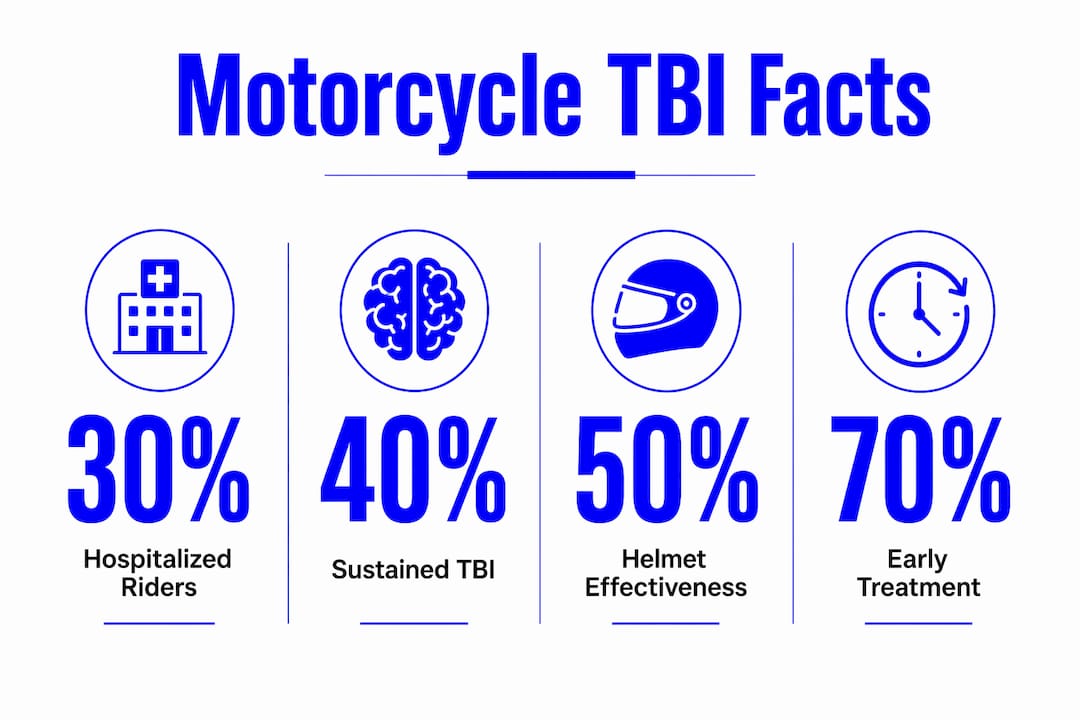
A significant portion of motorcycle operators hospitalized after a crash sustain a TBI or spinal cord injury. Studies in various states report consistently elevated TBI rates among hospitalized riders.
How do you recognize TBI symptoms after a crash?
Symptoms of a motorcycle accident brain injury do not always announce themselves dramatically. A rider who walks away from a crash and feels "a little off" may have sustained a concussion, which is the most common form of mild TBI. The problem is that mild TBI can still produce lasting effects if it goes unrecognized and untreated.
Common symptoms to watch for after any head impact:
- Loss of consciousness, even briefly
- Confusion, disorientation, or feeling "foggy"
- Persistent headache or pressure in the head
- Dizziness, loss of balance, or nausea
- Blurred or double vision
- Ringing in the ears
- Memory gaps, including not remembering the crash itself
- Seizures
- Slurred speech
- Unequal pupil size (a red flag for severe injury)
Symptom severity tracks closely with TBI classification. A mild TBI may produce only a brief headache and some confusion that clears within hours. A severe TBI can cause prolonged unconsciousness, repeated seizures, and immediate neurological deficits. The tricky middle ground is moderate TBI, where a rider may seem alert but has sustained damage that will not fully surface until days later.
Pro Tip: If a rider was involved in any crash that involved a head impact, seek emergency evaluation immediately, even if they feel fine. Some TBI symptoms, particularly those linked to slow intracranial bleeding, can take hours to appear.
How do doctors diagnose and treat motorcycle TBI?
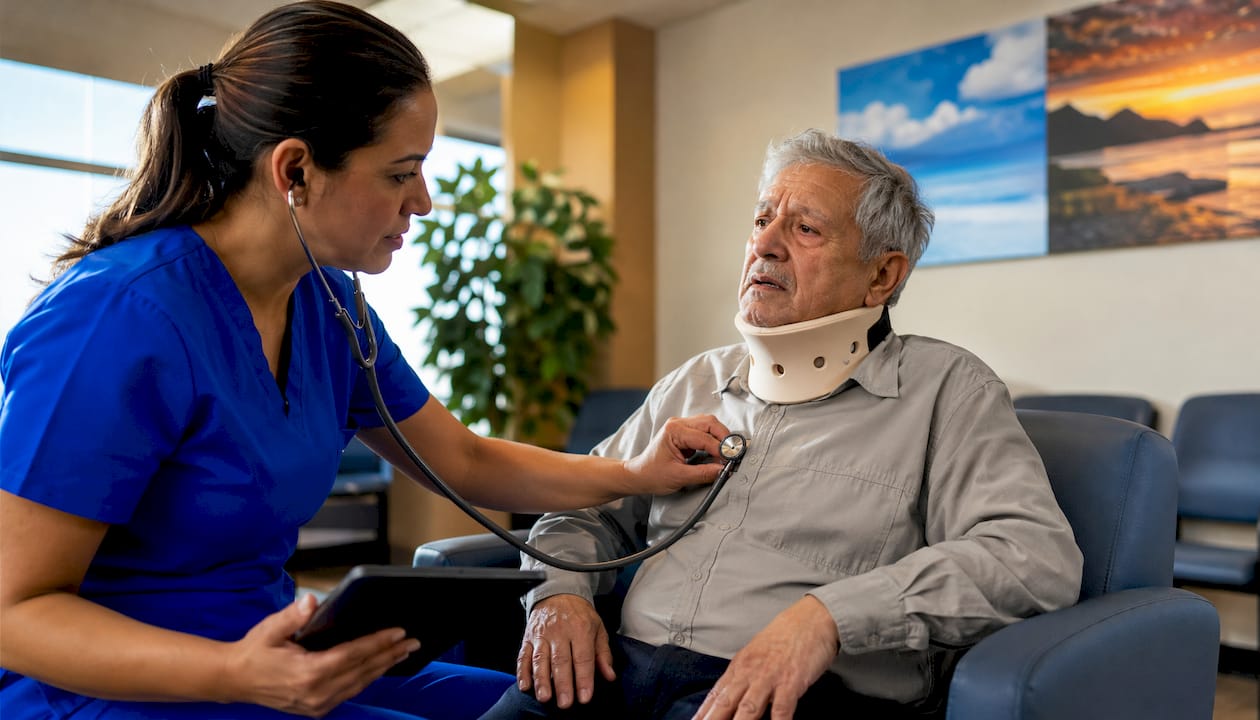
Diagnosis begins the moment emergency responders arrive. Paramedics assess level of consciousness using the Glasgow Coma Scale, check pupil response, and look for visible head trauma. At the hospital, the diagnostic process typically includes:
- Neurological examination: Testing reflexes, motor function, and cognitive responses
- CT scan: The standard first-line imaging tool for detecting skull fractures, bleeding, and swelling
- MRI: Used for more detailed imaging, particularly when CT results are inconclusive or when diffuse axonal injury is suspected
- Intracranial pressure monitoring: For severe TBI cases where brain swelling is a concern
Treatment depends entirely on severity. Mild TBI usually requires rest, pain management, and close monitoring for worsening symptoms. Moderate to severe TBI demands more aggressive intervention:
- Emergency stabilization of airway, breathing, and circulation
- Surgery to relieve intracranial pressure, remove blood clots, or repair skull fractures
- Medications to reduce swelling, prevent seizures, and manage pain
- Sedation in cases where brain activity needs to be controlled
- Intensive care unit monitoring during the acute phase
Early hospital care matters enormously. Delayed treatment after a TBI worsens both mortality and long-term outcomes, which is why getting a rider to a trauma center quickly is one of the most consequential decisions made at the crash scene.
What are the long-term effects of a motorcycle TBI?
The gap between surviving a TBI and fully recovering from one is wide, and for many riders it never fully closes. Long-term effects depend on injury severity, the rider's age and overall health, and how quickly treatment began.
Physical effects that can persist for months or years include chronic headaches, fatigue, sleep disorders, seizure disorders, and motor impairments ranging from weakness in a limb to full paralysis. Cognitive effects are often more disruptive to daily life: memory problems, difficulty with attention and concentration, slowed thinking, and trouble with language. Behavioral changes, including increased irritability, impulsivity, and emotional dysregulation, frequently strain relationships and employment.
The financial toll is staggering. Median hospital charges for motorcyclists who survived to discharge were 13 times higher for those with a TBI compared to those without one ($31,979 versus $2,461). That figure covers only the initial hospitalization. Rehabilitation, long-term care, lost income, and ongoing therapy push lifetime costs far higher.
Recovery considerations for riders and their families:
- Rehabilitation typically involves physical therapy, occupational therapy, speech therapy, and neuropsychological support
- Prognosis improves with early intervention, younger age, and less severe initial injury
- Severe TBI survivors face dramatically worse discharge outcomes: only 56% are discharged home compared to over 85% of motorcyclists without TBI
- Permanent disability is a realistic outcome for a portion of severe TBI survivors
- Cognitive recovery can continue for years, but a plateau is often reached within 12–24 months post-injury
Understanding motorcycle injury compensation categories is critical for anyone navigating the financial aftermath of a TBI, since medical costs, lost wages, and long-term care all factor into what a claim may recover.
Do helmets actually prevent TBI in motorcycle crashes?
The data on helmets is unambiguous. Helmeted riders consistently sustain TBI at lower rates and at lower severity levels than unhelmeted riders. According to NHTSA crash data, 15% of helmeted riders treated at hospitals sustained a TBI, compared to 21% of unhelmeted riders. The difference is even sharper at the severe end.
| Helmet Status | Mild to Moderate TBI Rate | Severe TBI Rate |
|---|---|---|
| Helmet worn | 15% | lower than unhelmeted |
| No helmet worn | 21% | higher than helmeted |
Key helmet safety facts:
- Full-face helmets reduce cranial impact forces more effectively than open-face or half helmets, providing coverage to the chin and face that partial designs leave exposed
- Helmet effectiveness is not uniform across designs; the type of helmet matters, not just whether one is worn
- Unhelmeted riders face roughly twice the risk of TBI compared to helmeted riders, a finding consistent across multiple state-level studies
- Universal helmet laws are associated with lower TBI rates in states that enforce them
Most U.S. states have some form of helmet law, though requirements vary. Some states mandate helmets for all riders; others require them only for riders under a certain age. Riders in partial-law states who choose to ride without a helmet are accepting a measurably higher TBI risk, not just a legal one.
What does recent research reveal about motorcycle TBI outcomes?
The research picture on motorcycle TBI has sharpened considerably, and a few findings stand out beyond the headline statistics.
One of the most clinically significant is the role of diffuse axonal injury, or DAI. DAI can occur without skull fracture or any loss of consciousness, yet it causes severe cognitive deficits by shearing microscopic nerve fibers throughout the brain. Because DAI is often invisible on initial CT scans, it can be missed in the acute phase, leaving riders discharged without a full picture of their injury. MRI is more sensitive to DAI, but it is not always ordered in emergency settings.
Research finding: While 17% of all hospitalized motorcyclists had TBI, they accounted for 54% of all admitted riders who did not survive. TBI is not just the most serious injury category in motorcycle crashes. It is the dominant driver of in-hospital mortality.
Timing of hospital admission also matters. Riders who reach a trauma center quickly after injury have better survival outcomes than those whose care is delayed. This finding reinforces the value of bystander emergency response and rapid EMS activation at crash scenes.
Public safety researchers consistently identify reducing alcohol-impaired riding as the single most modifiable factor for lowering TBI incidence. Helmet use is protective, but a rider who is intoxicated is already operating at a cognitive and physical deficit before the crash even happens, making avoidance maneuvers less effective and crash severity higher.
How does TBI affect mental health after a motorcycle accident?
Brain injury and psychological trauma are not separate problems. They overlap in ways that complicate both diagnosis and recovery. Many TBI survivors experience depression, anxiety, and post-traumatic stress disorder (PTSD) as direct consequences of the injury itself, not just as reactions to the crash experience.
The neurological damage from a TBI can disrupt the brain's regulation of mood, impulse control, and emotional processing. A rider who was previously calm and even-tempered may find themselves prone to anger outbursts or emotional swings that feel foreign and uncontrollable. This is not a personality flaw. It is a documented neurological consequence of brain tissue damage, particularly in the frontal lobes.
Depression is common among TBI survivors, and it compounds the physical recovery process. Chronic pain, sleep disruption, and cognitive frustration all feed into it. Anxiety about returning to normal activities, including riding again, is also typical. For riders who develop PTSD, the psychological injury can be as disabling as the physical one. Understanding your rights after accident trauma is part of building a complete recovery plan, since psychological injuries are compensable in personal injury claims just as physical ones are.
Treatment for the psychological effects of TBI should run parallel to physical rehabilitation, not after it. Neuropsychologists, psychiatrists, and trauma-informed therapists all play a role in a complete recovery team.
What can riders do to prevent TBI beyond wearing a helmet?
Helmet use is the most evidence-backed prevention measure, but it is not the whole picture. Several riding behaviors and environmental choices meaningfully reduce TBI risk.
Avoid alcohol and drugs entirely before riding. The data on intoxication is stark. Impaired riders have 150% higher odds of sustaining a TBI in a crash. No skill level compensates for the reaction time and judgment deficits that alcohol creates.
Manage speed, especially in unfamiliar areas. Speed amplifies the force of any impact. Riders who exceed posted limits or ride faster than road conditions allow give themselves less time to react and more kinetic energy to absorb in a crash.
Wear full protective gear, not just a helmet. Armored jackets, gloves, and boots reduce the severity of secondary impacts when a rider is thrown. Keeping the body intact reduces the chance of a head impact occurring in the first place.
Take a certified safety course. The Motorcycle Safety Foundation (MSF) offers courses that teach hazard recognition, emergency braking, and evasive maneuvering. Riders who complete formal training handle unexpected road situations more effectively.
Choose your riding environment deliberately. Night riding, wet roads, and high-traffic urban corridors all increase crash probability. Riders who understand their own skill limits and choose routes accordingly reduce their exposure to the conditions most likely to produce a serious crash.
Maintain your motorcycle. Tire condition, brake function, and lighting all affect a rider's ability to avoid a crash. A blowout at highway speed is a TBI risk that has nothing to do with riding skill.
Road safety awareness extends beyond the individual rider. Advocating for better road surface maintenance, improved signage at high-risk intersections, and driver education about motorcycle visibility all contribute to a safer environment for everyone on two wheels.
Key Takeaways
TBI is the leading driver of in-hospital mortality among motorcycle crash victims, and the gap in outcomes between helmeted and unhelmeted riders is measurable and consistent across multiple national studies.
| Point | Details |
|---|---|
| TBI severity classification | NHTSA classifies motorcycle TBI into four levels: severe, moderate, mild, and potential, each with distinct outcomes. |
| Helmet use reduces TBI rate | Helmeted riders sustain TBI at 15% versus 21% for unhelmeted riders. Severe TBI rates are significantly higher among unhelmeted riders compared to helmeted riders, consistent across multiple national studies. |
| Intoxication doubles TBI odds | Intoxicated riders face 150% higher odds of TBI; 28% of hospitalized TBI victims were intoxicated versus 13% without TBI. |
| Financial impact is severe | Median hospital charges for TBI survivors are 13 times higher than for riders without TBI ($31,979 versus $2,461). |
| Discharge outcomes diverge sharply | Only 56% of severe TBI survivors are discharged home, compared to over 85% of motorcyclists without TBI. |
Did you sustain a TBI in a motorcycle accident?
A TBI changes everything, from your ability to work to your daily quality of life, and the medical bills arrive fast. If you or someone you know suffered a motorcycle accident brain injury, Carcollisionlawyer connects you with trusted attorneys who handle exactly these cases. The evaluation is free, there is no commitment required, and the process is built for people dealing with urgent, stressful situations. Get a free case evaluation and find out what compensation you may be entitled to.