
Your state decides everything here: in a no-fault state, you file with your own insurer for medical bills first under Personal Injury Protection (PIP). You can only sue the at-fault driver if your injury clears a legal threshold. In an at-fault state, you go straight after the other driver's liability coverage for medical costs, lost wages, and pain and suffering, with no threshold standing in your way.
TL;DR:
- No-fault states require filing with your own PIP coverage for faster medical payment, with minimum limits ranging from $3,000 to unlimited, depending on the state.
- At-fault states allow direct claims against the responsible driver’s liability policy, but fault can take weeks to determine, potentially delaying claim resolution.
- PIP in no-fault states covers medical bills and some lost wages regardless of fault, while at-fault states typically pay these costs only if the driver is found liable.
- Legal thresholds for suing in no-fault states depend on monetary or verbal injury criteria, with verbal thresholds requiring objective evidence like imaging.
- Claims or disputes involving denied benefits or permanent injuries often benefit from early legal consultation, supported by prompt documentation and police reports.
Table of Contents
- No Fault vs At Fault: The Key Differences at a Glance
- How No-Fault Insurance (PIP) Actually Works
- How At-Fault (Tort) Claims Work
- Which States Are No-Fault, Choice, or At-Fault?
- Tort Thresholds: What They Mean for Your Right to Sue
- What to Do After a Crash: Claims, Evidence, and Deadlines
- How Fault Claims Affect Your Insurance Premiums
- When to Talk to an Attorney About Your Claim
- Get a Free Case Evaluation Before Your Claim Deadline Passes
- Sources
No Fault vs At Fault: The Key Differences at a Glance
The two systems split on one question: who do you bill first?
- Who files first: No-fault sends you to your own PIP coverage; at-fault sends you to the other driver's liability insurer.
- What's covered: PIP pays medical bills and a share of lost wages regardless of blame; liability coverage in at-fault states pays medical costs, wages, and pain and suffering, but only when the other driver caused the crash.
- Vehicle damage: Both systems generally route car repairs through collision coverage or the at-fault driver's property damage liability, separate from the medical claim.
- Lawsuits: No-fault states cap your right to sue unless you meet a tort threshold; at-fault states let you sue the responsible driver directly, no threshold required.
That last point trips people up more than any other. No-fault does not mean nobody is at fault. It means your medical bills get paid faster, in exchange for giving up some of your right to sue over a minor injury.
How No-Fault Insurance (PIP) Actually Works
Personal Injury Protection pays your medical bills, a portion of lost income, and sometimes housekeeping or funeral costs after a crash, no matter who caused it. You file the claim with your own carrier, not the other driver's, which is the entire point of the system: faster payment, less arguing over blame before the bills get paid.
PIP minimums vary more than most drivers realize. Utah requires just $3,000 in PIP coverage, while Michigan lets drivers opt into unlimited lifetime medical benefits. Florida sits at the other end, capping PIP at $10,000, which explains why a serious injury in Tampa can blow through coverage in a single hospital stay while the same injury in Detroit might stay fully covered for life.
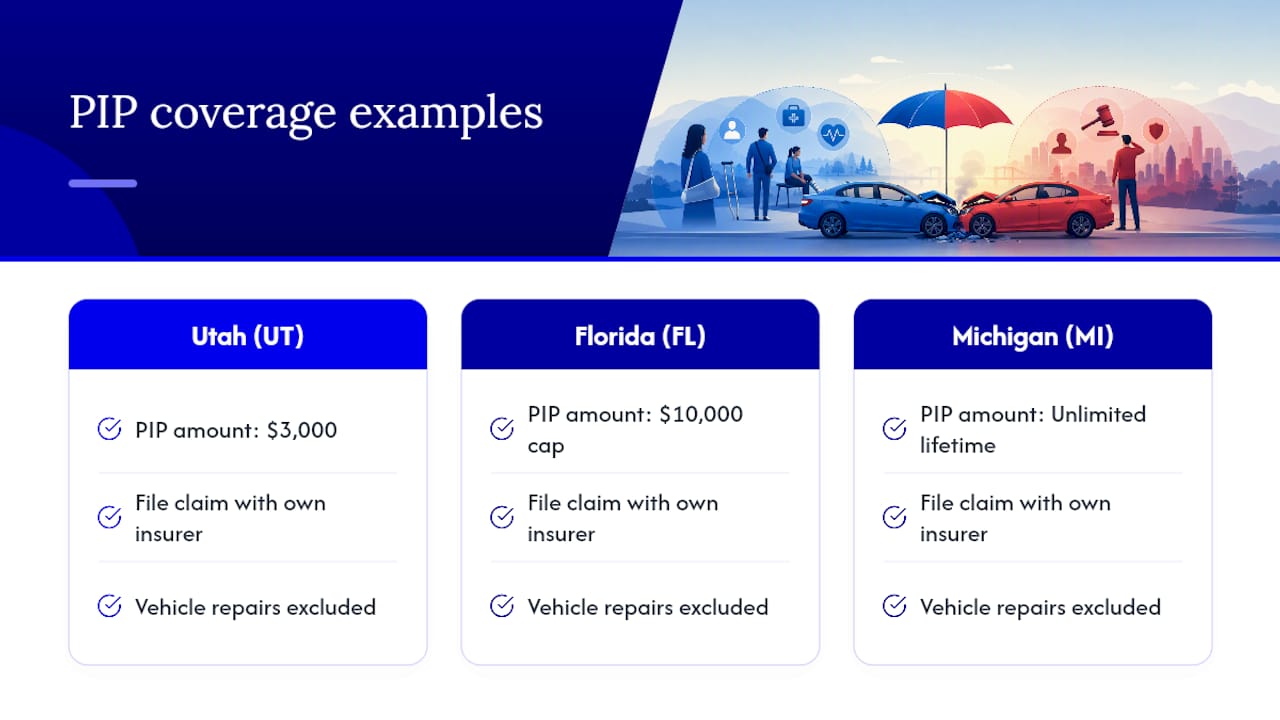
PIP almost never touches your car. Vehicle repairs run through collision coverage or the other driver's property damage liability, and insurers sort out reimbursement through subrogation later. On the paperwork side, many states require prompt notice and a PIP claim within 14 to 30 days, so treating providers' itemized bills need to start flowing to your insurer almost immediately.
How At-Fault (Tort) Claims Work
At-fault states run on a simpler premise: the driver who caused the crash, and their insurer, pays for it. That covers medical costs, lost wages, and pain and suffering, which PIP typically does not touch at all.
- You file against their policy. The at-fault driver's liability insurer handles your claim, not your own carrier.
- Fault gets investigated. Police reports, adjuster interviews, and physical evidence at the scene all feed into who's found responsible.
- Comparative negligence usually applies. Most states reduce your payout by your percentage of fault rather than barring recovery entirely, though a handful of contributory-negligence states still deny recovery if you're even 1% at fault.
- Your own collision coverage can bridge the gap. Filing under your own policy gets repairs moving immediately while your insurer pursues subrogation against the at-fault driver's carrier behind the scenes.
Fault determination is rarely instant, and disputed claims can drag for weeks while adjusters compare accounts. That delay is exactly why so many drivers turn to their own collision coverage rather than waiting on someone else's insurer to make a decision.
Which States Are No-Fault, Choice, or At-Fault?
Twelve states run true no-fault systems, and three more let drivers choose. Kentucky, New Jersey, and Pennsylvania are choice no-fault states, meaning drivers can opt into a traditional tort system instead of PIP-first coverage when they buy their policy. Every other state runs on pure at-fault rules, though some of those states still let drivers buy optional PIP or MedPay for faster medical payment without giving up their right to sue.
| System type | Example states | PIP requirement |
|---|---|---|
| No-fault (mandatory PIP) | Michigan, Florida, New York, Hawaii | Required; limits range from $10,000 (Florida) to unlimited (Michigan) |
| Choice no-fault | Kentucky, New Jersey, Pennsylvania | Optional; drivers select PIP or traditional tort at purchase |
| At-fault (tort) | Most remaining states, including California, Texas, Ohio | Not required; optional PIP or MedPay often available |
That $3,000 to unlimited spread in PIP minimums is the widest gap in American auto insurance, and it means two drivers hurt in identical crashes, one in Salt Lake City and one in Detroit, can end up with wildly different medical coverage simply because of a state line.
Tort Thresholds: What They Mean for Your Right to Sue
A tort threshold is the legal bar you have to clear before a no-fault state lets you sue for pain and suffering, and it comes in two forms. A monetary threshold sets a dollar figure in medical bills, often a few thousand dollars, that your treatment costs must exceed. A verbal threshold ignores dollar amounts entirely and instead requires a defined category of injury: permanent disfigurement, significant and permanent loss of a body function, or death.
- Monetary thresholds are easier to clear; a few emergency room visits and physical therapy sessions can push you over the line.
- Verbal thresholds demand statutory-level proof, like imaging showing permanent damage or documented, lasting functional loss, which is a much higher bar.
- Attorneys building a verbal-threshold case lean heavily on objective medical evidence rather than pain complaints alone.
Pro Tip: Get imaging and a written diagnosis as early as possible after a crash. Waiting weeks to see a specialist can cost you the exact documentation a verbal threshold requires later.
What to Do After a Crash: Claims, Evidence, and Deadlines
The sequence you follow in the first 48 hours often decides whether a claim gets paid smoothly or fought for months.
- Get medical care immediately, even for injuries that feel minor. Delayed treatment is the single easiest excuse an insurer uses to deny a claim later.
- Call the police and get a report number. Some carriers accept alternative documentation without one, but a report almost always strengthens your position.
- Photograph the scene, both vehicles, license plates, and any visible injuries before anything gets moved or repaired.
- Collect witness names and contact information on the spot; people are far harder to track down a week later.
- File with your own insurer first in a no-fault state, or notify the at-fault driver's carrier in an at-fault state, within your state's PIP filing window (commonly 14 to 30 days).
- Start a collision claim for vehicle repairs right away and let your insurer handle subrogation afterward.
Save every itemized bill and treatment note. Building a threshold case, or maximizing a liability settlement, both depend on paperwork you generate now, not paperwork you reconstruct later.
How Fault Claims Affect Your Insurance Premiums
An at-fault finding tends to raise your premium at renewal, sometimes by a meaningful percentage depending on your carrier and driving history. No-fault claims can move your rate too, particularly when the claim is large or you have prior claims on record, even though you weren't the one who caused the crash.
- Accident forgiveness programs can prevent your first at-fault accident from triggering a rate hike.
- Safe-driver discounts sometimes offset part of the increase over the following renewal cycles.
- Shopping other carriers after a claim often turns up better rates than staying loyal out of habit.
- A minor no-fault PIP claim with no liability finding against you usually has a smaller premium impact than a clear at-fault accident.
When to Talk to an Attorney About Your Claim
Denied PIP benefits, a permanent injury, or a dispute over whether you've met your state's tort threshold are the clearest signs it's time to get legal advice. A free case evaluation can clarify whether your injury qualifies you to step outside PIP and pursue the at-fault driver directly, something many injured drivers assume isn't an option until someone actually reviews their medical records and police report.
Attorneys move faster with documentation already in hand: your police report, itemized medical bills, and photos from the scene. Getting that intake started early tends to produce stronger outcomes than waiting until a claim is already stuck.
— Gerard
Get a Free Case Evaluation Before Your Claim Deadline Passes
The service connects you with vetted attorneys in your state for free, with no upfront cost and no obligation to hire anyone after the evaluation.
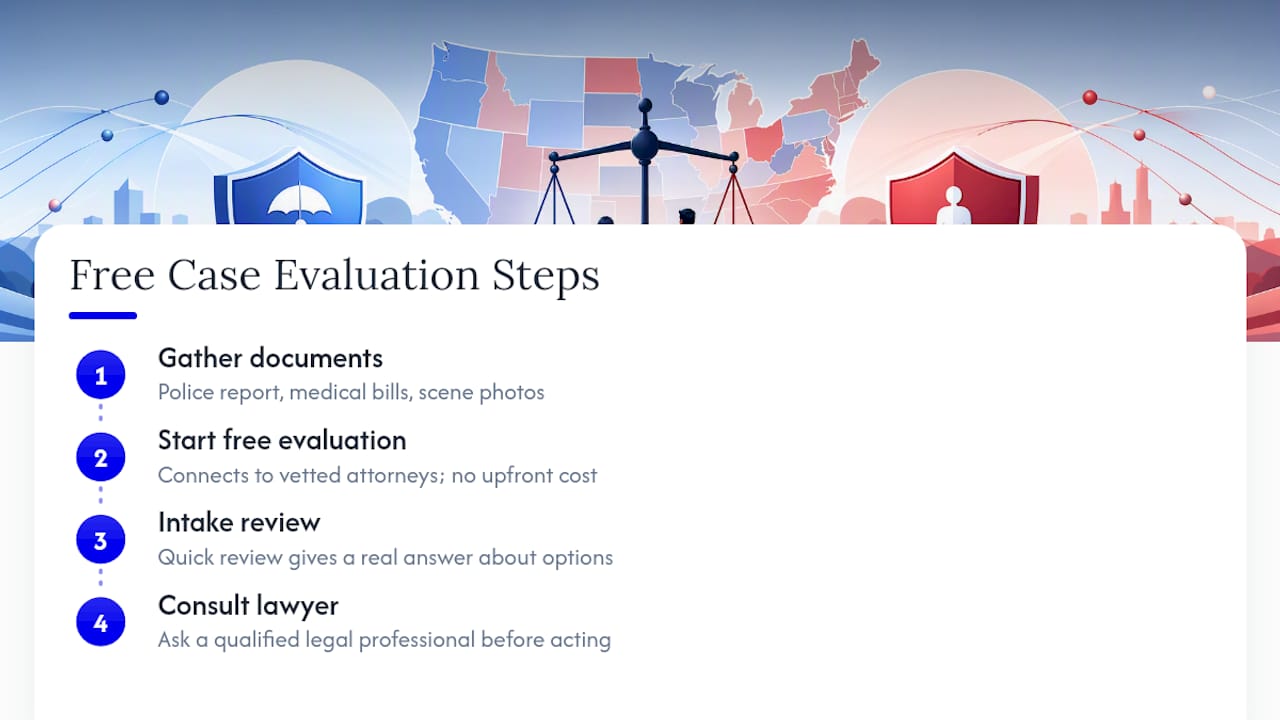
If you're stuck wondering whether your injury clears a verbal threshold, whether PIP was wrongly denied, or whether the at-fault driver's insurer is lowballing your settlement, a quick intake review answers that faster than guessing on your own. Before you start, gather your police report, medical bills, and any scene photos. That's what attorneys need to evaluate a case quickly and give you a real answer about your options.
Start your free case evaluation to find out whether your situation qualifies for compensation beyond what your own PIP coverage pays.
This article is general information, not a substitute for advice from a qualified lawyer. Consult a qualified legal professional about your own circumstances before acting on anything here.