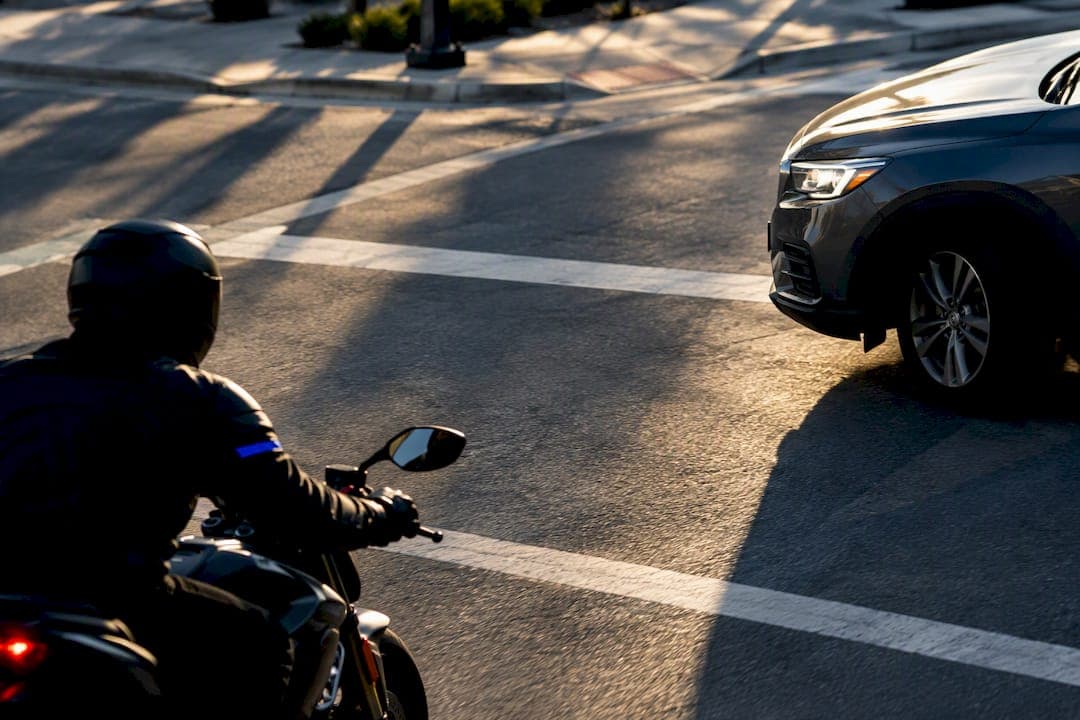
Left-turn, across-path collisions are the most frequent fatal two-vehicle motorcycle crash pattern in the United States, accounting for 26% of such crashes between 2017 and 2021. If you or a family member has been hit this way, get medical care first, photograph everything before the bike is moved or repaired, and request a legal evaluation to understand your rights before talking to an insurer.
TL;DR:
- Left-turn across-path crashes cause 26% of fatal two-vehicle motorcycle accidents, but only represent a portion of all reported motorcycle crashes.
- Most crashes result from drivers misjudging motorcycle speed or distance at intersections, driveways, or mid-block turns, often due to perception errors.
- Severe rider injuries are common in these crashes because cars strike motorcycles broadside, causing fractures, brain trauma, or spinal injuries.
- Fault typically lies with the left-turning driver who fails to yield, but specific circumstances like signal timing and sight-line obstructions influence legal liability.
- Immediate steps after a crash include seeking medical care, documenting scene evidence, collecting witness info, and consulting a lawyer to understand your case.
Table of Contents
- Left Turn Motorcycle Accident Statistics: What the Data Actually Shows
- How Left Turn Motorcycle Crashes Happen
- Why Left Turn Crashes Cause Such Severe Rider Injuries
- Who's at Fault in a Left Turn Motorcycle Accident?
- What to Do Immediately After a Left Turn Motorcycle Collision
- Preventing Left Turn Motorcycle Accidents
- Our Perspective on Left Turn Motorcycle Crash Claims
- Get a Free Evaluation After Your Left Turn Motorcycle Accident
- Sources
- FAQ
Left Turn Motorcycle Accident Statistics: What the Data Actually Shows
A peer-reviewed analysis of U.S. two-vehicle fatal and police-reported crashes from 2017 through 2021 found that left-turn across-path collisions were the single most common fatal crash pattern involving a motorcycle and another vehicle, representing 26% of fatal two-vehicle motorcycle involvements. That 26% figure applies specifically to fatal crashes between a motorcycle and one other vehicle. It does not mean a quarter of all motorcycle crashes, or even all reported crashes, involve a left turn.
Percentages you see elsewhere often measure something different: total police-reported crashes (which include single-vehicle wrecks and low-speed fender-benders), state-specific datasets, or crashes involving any vehicle type rather than motorcycles alone. Reading the denominator matters as much as the number itself.
Sources worth knowing:
- Fatal two-vehicle crash analyses isolate the deadliest patterns and show left turns leading the list.
- State DOT crash databases track all reported incidents, diluting the left-turn share with less severe crash types.
- NHTSA data captures national trends and informs the safety guidance discussed later in this article.
How Left Turn Motorcycle Crashes Happen
Three scenarios show up again and again in crash reconstructions and insurance files:
- Intersection left-turn-across-path (LTAP). A driver waiting to turn left misjudges the motorcycle's speed or distance and pulls into its path as it approaches or enters the intersection.
- Driveway and parking-lot turns. A driver turning left out of a driveway or lot cuts across a lane just as a motorcycle passes, often at lower speeds but with little reaction time.
- Mid-block cutting across. A driver turning left across multiple lanes misses a motorcycle riding in the curb lane, where research on turning trajectories shows riders traveling straight in the curb lane face elevated risk when the opposing driver's turning path is imprecise.
The common thread is perception, not recklessness on the rider's part. A motorcycle presents a narrower visual profile than a car, so drivers scanning for cross traffic sometimes register the gap as clear when it isn't. Drivers also tend to misjudge how fast a smaller object is closing, a phenomenon researchers call gap acceptance error. Add an improper turning trajectory, where the driver swings wide or cuts the corner instead of tracking a tight arc, and the two vehicles end up converging exactly where the rider has no room to brake or swerve.
Why Left Turn Crashes Cause Such Severe Rider Injuries
The physics are unforgiving. A car turning left typically strikes a motorcycle broadside or at an angle, throwing the rider off the bike rather than absorbing impact through a crumple zone the way two cars would. Common injuries include fractured legs and pelvises, traumatic brain injury, spinal trauma, and road rash severe enough to require skin grafts.
Helmets change the outcome without changing who's at fault. NHTSA guidance points to DOT-compliant helmets meeting FMVSS 218 as one of the most effective ways to reduce head injury severity, but wearing or not wearing one has no automatic bearing on who caused the crash. It does affect the medical damages a claim can pursue: more severe injuries typically mean higher medical expense categories, longer-term care costs, and larger claims for pain and suffering.

Who's at Fault in a Left Turn Motorcycle Accident?
Most states impose a straightforward duty: a driver turning left must yield to oncoming traffic already in or near the intersection. New York's version of that rule, Vehicle and Traffic Law Section 1141, requires the left-turning driver to yield to any vehicle "within the intersection or so close thereto as to constitute an immediate hazard." Most states word their statutes similarly, though the exact phrasing and penalties vary.
Violating that kind of statute often counts as negligence per se, meaning the violation itself establishes a breach of duty. But that's rarely the end of the story. A 2025 New York appellate decision shows courts can still find triable factual disputes over whether the motorcycle was actually close enough to be an immediate hazard even when the statute clearly applies. Fault isn't automatic just because a law exists.
What actually moves these cases:
- Traffic signal timing and whether the left-turning driver had a protected arrow.
- Sight-line obstructions like parked trucks, foliage, or building placement.
- Video footage from dash cams, traffic cameras, or nearby businesses.
- Skid marks, debris patterns, and post-crash vehicle positioning.
Comparative negligence rules, which most states apply in some form, can reduce a rider's recovery if they contributed to the crash, say by speeding or lane-splitting where it's illegal. That's why the physical evidence matters so much: it's what separates "I never saw the motorcycle" as a plausible excuse from a plausible admission of failing to look.
What to Do Immediately After a Left Turn Motorcycle Collision
- Get medical evaluation first, even if you feel fine. Adrenaline masks injury, and delayed treatment creates gaps insurers exploit later.
- Photograph the scene before vehicles are moved: final resting positions, skid marks, traffic signals, and any sight-line obstructions.
- Photograph the motorcycle itself before it goes to a repair shop or salvage yard. Damage patterns and even the bike's electronic data can matter later.
- Collect witness names and phone numbers. People who saw the turn happen rarely stick around once police arrive.
- File a police report and exchange insurance information, but avoid speculating about fault out loud or in writing.
- Request a legal evaluation early to learn your state's filing deadline and what damages categories might apply to your case.
Pro Tip: Ask the responding officer for the report number before you leave the scene. Insurance adjusters move fast, and having that number ready saves days when you request medical documentation and the official crash report later.
Our legal rights checklist for riders walks through evidence preservation in more depth, and general crash evidence best practices apply just as well to a motorcycle collision as a car crash.
Preventing Left Turn Motorcycle Accidents
No single fix eliminates left-turn risk, but layered countermeasures cut it substantially.
For riders: hold a lane position that maximizes visibility rather than hugging the curb, run headlights on low beam during the day, wear high-visibility gear, and complete a formal rider training course. Avoid riding directly beside cars as you approach an intersection, since that position is exactly where a turning driver's eye tends to skip past you.

For drivers and road planners: protected left-turn signal phases and clear sight lines at intersections reduce the split-second misjudgments that cause LTAP crashes.
On the technology side, intersection-focused driver assistance systems (I-ADAS) show meaningful promise, with U.S. crash-reconstruction modeling estimating that these systems could prevent between 18% and 84% of left-turn-across-path crashes depending on system configuration and scenario. That's a wide range, and it reflects how much system design matters, but even the low end represents a real reduction in a leading fatal crash type.
Our Perspective on Left Turn Motorcycle Crash Claims
Every left-turn case we see hinges on the same question: can you prove what the driver should have seen and when? That's why we built our intake around the specifics, injury type, scene evidence, witness accounts, rather than a generic form. Riders often assume a police citation settles fault. It doesn't. Courts look past the ticket to signal timing, sight lines, and physical evidence, which means the strength of your claim often comes down to what you preserved in the first 48 hours. If your injuries are serious or the driver disputes fault, don't wait to find out where you stand.
— Gerard
Get a Free Evaluation After Your Left Turn Motorcycle Accident
Carcollisionlawyer is a different starting point than calling an insurance adjuster or guessing at a law firm from a billboard. Our free evaluation is built around your specific scenario, a left-turn collision, and reviews the details that actually drive these cases: how the crash happened, what evidence exists, your injury severity, and which damages categories your case might support, from medical costs to lost income to pain and suffering.
This evaluation has no cost and no obligation to move forward. Users answer a short set of questions about the crash and injuries and are matched with an attorney with relevant practice experience rather than a general referral list. For more detail on what those recovery categories typically include, our guide to motorcycle injury compensation categories is worth a read before you submit anything. If a family member died in the collision, our separate breakdown of wrongful death versus injury claims covers how those cases differ. Start your free case evaluation today to find out where you stand.
This article is general information, not a substitute for advice from a qualified lawyer. Consult a qualified legal professional about your own circumstances before acting on anything here.
Sources
- Left-turn crashes and motorcycle safety
- Motorcycle Safety Month: Help Prevent Motorcycle Deaths | NHTSA
- New York Vehicle and Traffic Law §1141
- NY courts opinion: collision and failure to yield right-of-way (2025)
FAQ
What Percent of Motorcycle Accidents Are Caused by Left Turns?
Left-turn across-path crashes account for 26% of fatal two-vehicle motorcycle crash involvements in a 2017–2021 analysis, making it the most common fatal crash pattern of its kind. That figure covers fatal two-vehicle crashes specifically, not every motorcycle crash reported nationwide.
Who Is at Fault in a Left Turn Motorcycle Accident?
The driver turning left generally has a legal duty to yield to oncoming traffic already in or near the intersection, as illustrated by New York's Vehicle and Traffic Law §1141. Fault still depends on evidence like signal timing, sight lines, and video, since courts routinely evaluate whether the motorcycle actually posed an immediate hazard.
What State Has the Most Motorcycle Accidents?
State-by-state rankings shift year to year and depend on total registered motorcycles, rider miles, and reporting practices, so no single state holds a fixed, permanent ranking. Larger, warmer-climate states with heavy year-round riding tend to report higher raw crash counts, but per-capita risk is a different comparison entirely.
What Is the 12 Second Rule on a Motorcycle?
The scanning habit involves looking ahead on the road to spot hazards like a car preparing to turn left. It's a rider training concept rather than a legal standard, and it pairs well with staying out of a driver's blind spot near intersections.
Should I Get a Legal Evaluation After a Left Turn Crash?
A legal evaluation helps you understand filing deadlines, likely damages categories, and how state comparative-negligence rules might apply to your specific facts. Carcollisionlawyer's free evaluation reviews your injury type and available evidence at no cost before you decide whether to move forward with an attorney.