
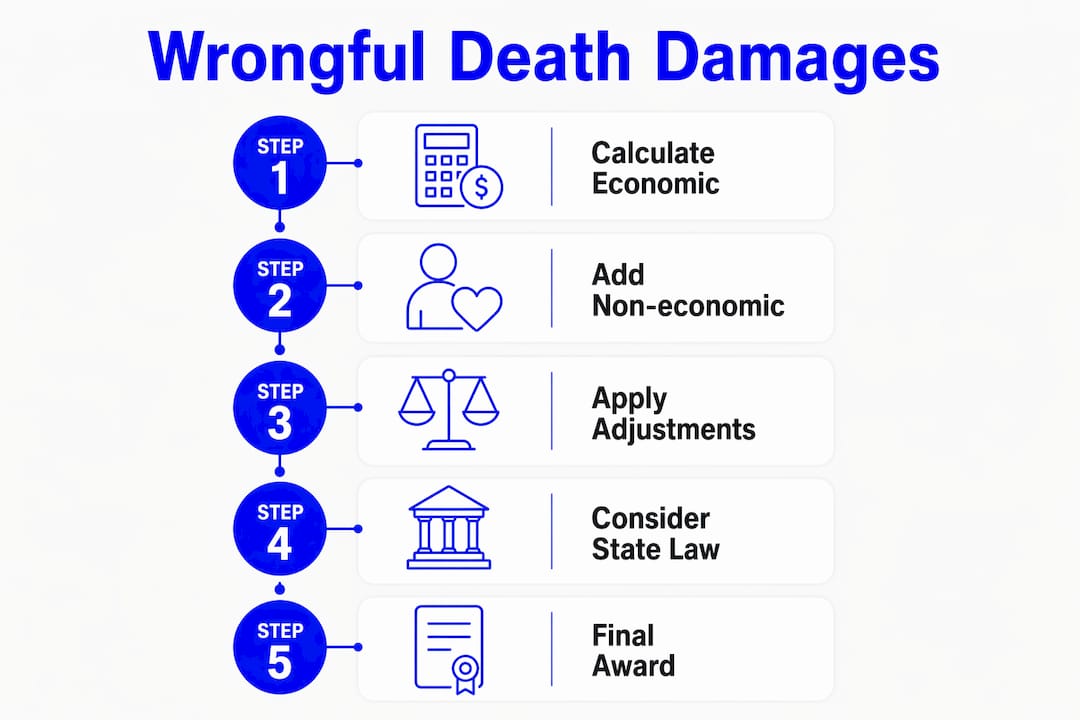
Wrongful death damages equal economic losses plus non-economic losses, then adjusted downward for the decedent's share of fault, the defendant's insurance and asset ceiling, attorney contingency fees, case costs, and any medical liens. That is the core formula — and the gap between the gross number and what a family actually receives can be substantial. Get a specialized legal evaluation immediately: state caps, filing deadlines, and available insurance limits can change the recoverable total before you ever file.
Economic damages cover lost future earnings, lost fringe benefits, household services the decedent provided, pre-death medical bills, and funeral costs. Non-economic damages cover loss of companionship, parental guidance, grief, and — in states that allow survival actions — the decedent's own pain and suffering before death. Both categories feed into the gross figure, and then the practical ceiling kicks in.
The difference between a wrongful death and a personal injury claim matters here: wrongful death compensates survivors for their losses, while a survival action compensates the estate for what the decedent experienced. Many states allow both to run simultaneously.
Table of Contents
- How are wrongful death damages calculated step by step?
- What formulas do forensic economists actually use?
- What factors raise or lower a wrongful death award?
- How does state law change what you can recover?
- What does the wrongful death claim process look like, and how long does it take?
- When should you bring in a forensic economist or other experts?
- Key Takeaways
- What families often underestimate about wrongful death valuation
- A free evaluation can clarify your family's actual recovery range
- Authoritative sources for further research
How are wrongful death damages calculated step by step?
Start with economic damages, add non-economic damages, then apply the adjustments that determine what the family actually collects. Here is how each piece works.
Economic damages: components, documents, and a present-value example
Lost future earnings typically dominate the economic total. The core formula: annual compensation base × work-life expectancy, adjusted for wage growth, minus a personal consumption deduction, then discounted to present value. Fringe benefits — health insurance, retirement contributions, employer-paid taxes — commonly add 15%–30% on top of base wages.

A personal consumption deduction removes the share of earnings the decedent would have spent on themselves rather than dependents. Most models apply a deduction of 20%–35%, with 25%–30% being the most common default.
Compact numeric example. Suppose the decedent earned $95,000 per year, had 27 years of work-life remaining, and a fringe rate of 22%:
- Compensation base: $95,000 + 22% fringe = $115,900/year
- Gross lifetime earnings (with modest wage growth): roughly $3.9M over 27 years
- Minus personal consumption deduction (28%): approximately $1.09M
- Discount to present value: reduces the total further depending on the chosen rate
- Add pre-death medical bills and funeral costs: typically $8,000–$15,000 for funeral expenses alone, though some sources cite ranges up to $25,000
Young dependents, high wages, and a long work-life horizon push the economic number up. Proximity to retirement age, minimal dependents, and a low base wage pull it down.
| Economic Component | Typical Range / Note |
|---|---|
| Funeral and burial costs | typical traditional expense range |
| Fringe benefits add-on | 15%–30% of base wages |
| Personal consumption deduction | 20%–35% of gross earnings |
| Attorney contingency fee | commonly about one-third of the gross recovery |
| Pre-death medical bills | variable amounts which may be reduced by hospital liens |
Documents to gather now:
- W-2s and paystubs for the last 3–5 years
- Employer benefits statements (health, retirement, life insurance)
- Federal tax returns
- Medical bills from the injury through death
- Funeral and burial invoices
- Any employment contracts or bonus documentation
Non-economic damages: what they cover and how attorneys value them
Non-economic damages compensate for losses that have no invoice: the spouse's loss of companionship, a child's loss of parental guidance, grief and mental anguish, and — where a survival action is available — the decedent's own pain and suffering during the period between injury and death.

Valuing these losses requires a different approach. The most common planning tool is the multiplier method: take the economic subtotal and multiply it by a factor, typically between 0× and 5×, to estimate non-economic damages for settlement discussions. Forensic economists and attorneys use this as a negotiation heuristic, not a guaranteed jury outcome.
Example: Economic damages of $200,000 × a multiplier of 2.5 = $500,000 in estimated non-economic damages. Total gross claim: $700,000 before adjustments.
Some venues use a per-diem approach instead, assigning a daily dollar value to the loss and multiplying by life expectancy. Mediators often work from jury-verdict databases for the specific jurisdiction to bracket a realistic range.
Warning: State caps or statutory restrictions can limit or eliminate non-economic recovery entirely in some jurisdictions. The multiplier result is a planning estimate, not a legal determination of what you will recover.
What formulas do forensic economists actually use?
The lost-earnings calculation follows a growing-annuity structure. In plain terms: each year's projected earnings grows at a wage-growth rate g, and the entire stream is discounted back to today at a discount rate r over n years of remaining work life.
Step-by-step:
- Build the compensation base: base salary + fringe benefits (commonly 15%–30% of salary)
- Choose the work-life horizon: Bureau of Labor Statistics work-life expectancy tables or the decedent's expected retirement age
- Apply wage growth (g): many calculators default to approximately 2% annually
- Subtract the personal consumption deduction (20%–35%)
- Discount to present value at rate r: many calculators default to approximately 2.5%
The relationship between g and r matters more than most families realize. If g rises from 2% to 3% while r stays at 2.5%, the present value of a 27-year earnings stream can increase by hundreds of thousands of dollars. Conversely, a higher discount rate compresses the present value significantly. Expert witnesses often disagree on these inputs, and that disagreement is where negotiation happens.
For non-economic damages, the multiplier range runs 0×–5× in most settlement contexts. A multiplier below 1× typically appears when liability is disputed or the decedent had minimal dependents. Multipliers above 3× tend to appear in cases with young children, a primary caregiver loss, or egregious defendant conduct. Per-diem methods and jury-verdict comparisons serve as cross-checks.
Pro Tip: Ask any prospective attorney what discount rate and wage-growth rate their forensic economist uses as defaults. A shift from 2.5% to 3.5% on the discount rate can reduce the present value of a 25-year earnings stream by 15% or more — that is a real negotiating variable, not a technicality.
Documents and data experts need: federal tax returns (3–5 years), Social Security earnings statements, employer benefits summaries, BLS occupational wage data for the decedent's role, Social Security Administration life tables, and any vocational or medical records affecting work-life expectancy.
What factors raise or lower a wrongful death award?
The gross calculation is only the starting point. Several practical factors determine what a family can actually collect.
Value drivers that raise the number: young decedent with decades of earnings ahead; high base wages or strong career trajectory; minor children who lost a primary caregiver; extraordinary household services (a stay-at-home parent's replacement cost can be substantial); strong, clear liability evidence with no comparative fault; and a defendant with deep pockets or high policy limits.
Practical limits that reduce recovery: the defendant's insurance policy is the most common ceiling. A paper case worth $2.4M means little if the at-fault driver carried only $1M in liability coverage and has no significant personal assets. Uninsured/underinsured motorist (UIM) coverage on the decedent's own policy can extend recovery when the at-fault driver's limits are low, but UIM disputes over stacking and setoff are common and require careful policy review.
After the gross recovery is established, the family's net looks like this: gross recovery minus attorney contingency fee (commonly ~33.3%) minus case costs minus medical and hospital liens. Hospital and provider liens often attach to the recovery for pre-death medical bills, and lien negotiation is usually part of the settlement process.
Punitive damages are possible but rare in ordinary negligence cases. They require proof that the defendant acted with malice, fraud, or gross recklessness — a standard that a typical car collision rarely meets. When they do apply, they can multiply the headline number, but counting on them in a planning estimate is a mistake.
For families dealing with commercial defendants, truck accident wrongful death cases often involve higher policy limits and multiple liable parties, which changes the practical ceiling considerably.
How does state law change what you can recover?
State law controls three things that directly affect the recoverable total: who may file, whether non-economic damages are capped, and how long you have to act.
Who may sue varies significantly. Most states allow a spouse, children, and parents to bring a wrongful death claim. Some states require the claim to be filed by the estate's personal representative on behalf of beneficiaries (New York follows this model). A few states extend standing to siblings or financially dependent relatives.
Wrongful death vs. survival actions: wrongful death compensates survivors for their own losses. A survival action compensates the estate for what the decedent experienced — pain, suffering, and medical bills between injury and death. Both can run simultaneously in many states, which can meaningfully increase total recovery.
Non-economic damage caps are the biggest state-law variable in estimating wrongful death compensation. Some states impose hard caps; others have none.
| State | Non-Economic Cap | Statute of Limitations |
|---|---|---|
| California | medical malpractice non-economic damages cap exists | 2 years |
| Texas | non-economic damage cap applies in medical malpractice cases only | 2 years |
| Colorado | a statutory non-economic damage cap applies | 2 years |
| Ohio | non-economic damages capped by statute at a set amount or multiple of economic damages | 2 years |
| Missouri | non-economic damage cap exists as provided by state law | 3 years |
| Florida | no cap on non-economic damages following recent ruling | 2 years |
| New York | No cap | 2 years |
| Illinois | no non-economic damage cap after prior cap was invalidated | 2 years |
| Georgia | no non-economic damage cap following court decision | 2 years |
| Indiana | a statutory cap on non-economic damages is in place | 2 years |
Comparative fault rules also reduce recovery. Under pure comparative negligence (used in California and New York, among others), a decedent who was 30% at fault reduces the award by 30%. Under modified comparative negligence with a 51% bar (used in Texas and many other states), a decedent who was 51% or more at fault recovers nothing. A handful of states still use contributory negligence, which bars recovery entirely if the decedent bore any fault at all.
The statute of limitations in most states is two years from the date of death, though some states allow three. Missing that deadline typically ends the claim permanently. Check your state's specific statute — the Texas wrongful death statute and California's Code of Civil Procedure § 377.60 are good examples of how differently states frame standing and recovery.
What does the wrongful death claim process look like, and how long does it take?
Most wrongful death cases move through four stages, and the timeline depends heavily on complexity, the number of defendants, and how quickly insurance companies respond.
Typical timeline:
- Months 1–3: Retain counsel, gather initial evidence, send a preservation demand to the defendant, and begin collecting employment and medical records.
- Months 3–9: Discovery phase. Depositions, document requests, and expert retention. A forensic economist is typically engaged during this window.
- Months 6–18: Mediation and settlement negotiations. Most cases resolve here. A formal demand package with the forensic economist's report is the centerpiece.
- Year 2+: Trial preparation and trial, if settlement fails. Complex cases with disputed liability or multiple defendants can run longer.
Simple cases with clear liability and cooperative insurers can settle in under a year. Contested cases with disputed fault, multiple defendants, or a corporate defendant can take two to three years or more.
Evidence that supports higher valuations:
- Employment records and tax returns establishing the earnings base
- Employer benefits statements for fringe calculations
- Medical records documenting the injury, treatment, and cause of death
- Funeral invoices
- Testimony from family members about household services and caregiving
- Forensic economist's present-value report
- Vocational expert opinion on work-life expectancy
- Life-care planner report (if survival damages are at issue)
- Proof of relationship for loss-of-consortium claims (marriage certificate, birth certificates)
On liens: Medicare, Medicaid, and private health insurers often assert subrogation rights against the recovery for medical bills they paid. Hospital liens can attach directly to the settlement proceeds. Gross recovery is reduced by these demands, and lien negotiation is a standard part of finalizing any settlement. Families sometimes receive significantly less than the headline settlement figure once liens are resolved.
Settlement offers certainty and speed. Trial offers the possibility of a higher award but introduces risk, delay, and cost. When the defendant's policy limits are already on the table, the upside of trial is often limited — you cannot collect more than the defendant can pay.
When should you bring in a forensic economist or other experts?
Any case where lost future earnings are a significant component needs a forensic economist. That covers most wrongful death cases involving a working-age decedent. The economist builds the present-value lost-earnings model, selects the wage-growth and discount rates, quantifies household services, and prepares exhibits suitable for mediation or trial testimony.
Other experts serve specific damage lines. A vocational expert opines on work-life expectancy when the decedent's career trajectory is disputed. A medical expert establishes causation and, in survival-action cases, the nature and duration of pre-death pain and suffering. A life-care planner is more common in serious injury cases but can appear in wrongful death cases where survival damages are substantial.
A forensic economist's report typically includes a present-value schedule of lost earnings broken out by year, a fringe benefits summary, a household services valuation, and a non-economic multiplier rationale prepared for mediation. That document becomes the anchor for every settlement discussion.
Practical advice: when evaluating attorneys, ask specifically about their expert network, who advances expert fees during litigation (many plaintiff firms front these costs and recover them from the settlement), and when expert reports are typically ordered. Ordering too early wastes money if the case settles quickly; ordering too late can delay mediation. Most experienced wrongful death attorneys time expert retention after initial discovery but before the intensive settlement push. An attorney evaluation guide can help you ask the right questions before you commit to representation.
Understanding how attorneys charge families in wrongful death cases is equally important — contingency arrangements mean the attorney's fee comes from the recovery, not your pocket upfront, but the percentage and cost-recovery terms vary by firm.
Key Takeaways
Wrongful death damages are calculated by adding economic and non-economic losses, then reducing for fault, insurance limits, attorney fees, and liens — and the family's net recovery is often substantially less than the gross case value.
| Point | Details |
|---|---|
| Core formula | Economic + non-economic damages, adjusted for fault, insurance ceiling, fees, and liens. |
| Lost earnings dominate | Present-value math using wage growth (~2%) and a discount rate (~2.5%) drives the largest number. |
| Insurance limits cap recovery | A $2.4M paper value means little against a $1M policy with no significant defendant assets. |
| State law changes the total | Non-economic caps range from $250K (Ohio) to none; most states impose a 2-year filing deadline. |
| Carcollisionlawyer free evaluation | Start with paystubs, W-2s, funeral invoices, and medical bills for a free attorney-matching evaluation. |
What families often underestimate about wrongful death valuation
The number that gets discussed most in wrongful death cases is the gross case value — the forensic economist's present-value figure before any deductions. Families understandably focus on it. But the net figure, after the attorney fee, case costs, lien payoffs, and any fault reduction, is what actually arrives. Those deductions routinely reduce gross recovery by 40%–50% in cases with significant medical bills and standard contingency arrangements.
There is also a tendency to treat the multiplier method for non-economic damages as a formula rather than a starting point. It is a negotiation tool. Juries in the same jurisdiction can award wildly different amounts for identical facts, which is exactly why experienced attorneys study local verdict databases rather than applying a fixed multiplier and calling it done.
The other thing families often miss: the defendant's insurance limits are not always obvious at the outset. A thorough attorney will send an early coverage demand to identify all available policies — the at-fault driver's liability coverage, any umbrella policy, and the decedent's own UIM coverage. That coverage map, not the forensic economist's report, often determines the realistic settlement range. The categories of damages available to collision victims and the practical limits on collecting them are two very different conversations, and conflating them is where families leave money on the table.
A free evaluation can clarify your family's actual recovery range
Knowing the formula is useful. Knowing what it produces for your specific case — your state's caps, the available insurance, the decedent's earnings history, and the applicable fault rules — requires a real legal evaluation.
Carcollisionlawyer connects families with vetted local wrongful death attorneys through a free online evaluation. The intake process asks about the incident, the decedent's relationship to the claimants, basic wage information, and the location — enough to identify jurisdictional rules, likely policy ceilings, and the right type of attorney for the case. Families pay nothing to be matched; attorneys handle wrongful death cases on a contingency fee basis, meaning fees come from the recovery, not your pocket.
Before you start, gather: contact information, the date and location of the incident, your relationship to the decedent, any medical bills or funeral invoices you have received, and basic wage information (a recent paystub or W-2 is enough). You do not need everything organized — a case specialist will follow up to help fill gaps.
Start your free evaluation now and get matched with an attorney who handles wrongful death cases in your state.
This article is general information, not legal advice. Wrongful death laws vary by state, and you should confirm the rules for your specific situation with a qualified attorney.
Authoritative sources for further research
When you or your attorney begin building the case, these are the primary sources that support the models described throughout this article.
- State wrongful death statutes: Each state's legislature publishes its wrongful death and survival action statutes. Examples include the Texas wrongful death statute (Chapter 71, Civil Practice and Remedies Code) and California CCP § 377.60. Look up your state's equivalent for standing, caps, and deadlines.
- Bureau of Labor Statistics (BLS): BLS publishes occupational employment and wage statistics used to establish earnings baselines, as well as work-life expectancy tables that forensic economists rely on for the work-life horizon input.
- Social Security Administration (SSA) life tables: SSA publishes actuarial life tables used to project life expectancy for present-value calculations. These are standard inputs in forensic economist reports.
- National Funeral Directors Association (NFDA): The NFDA publishes annual statistics on funeral and burial costs, which support the funeral-expense component of economic damages.
- State bar association resources: Most state bars publish plain-language guides to wrongful death law in their jurisdiction, including who may sue, applicable caps, and procedural requirements.
- Wrongful death practice guides: Law school clinics and bar-affiliated legal aid organizations often publish jurisdiction-specific guides that explain how courts in that state have interpreted damage caps and comparative fault rules.
Bring statute citations and any relevant BLS or SSA data to your first attorney consultation. Attorneys who handle wrongful death cases regularly will already know these sources, but arriving with them signals that you understand the framework and are prepared to build a strong evidentiary record.