
A loss of consortium claim lets a spouse, and in limited cases a parent or child, seek compensation for the loss of companionship, intimacy, or household support caused by another person's negligence. It covers a severe or lasting injury to your husband, wife, or family member, but whether you qualify and how much the claim is worth depends heavily on your state.
This is a separate category from medical bills or lost wages. Those are economic damages tied to the injured person's own losses. Loss of consortium compensates the healthy spouse or family member for what the relationship lost, not what the hospital charged.
- Spouses are the most common claimants, in nearly every state.
- Some states allow limited parental or filial claims, usually tied to wrongful death.
- Unmarried partners are excluded from this claim in most states.
Quick fact: Damages in catastrophic-injury consortium cases range from tens of thousands of dollars to more than $1 million, depending on jurisdiction and jury discretion. Talk to an attorney before you sign any settlement release, since that document can waive this claim without you realizing it.
Key Takeaways
A loss of consortium claim compensates a spouse (or, in limited states, a parent or child) for lost companionship, intimacy, and household support after a severe, negligence-caused injury, and eligibility, damages, and evidentiary rules all hinge on state law.
| Point | Details |
|---|---|
| Eligibility depends on marriage | Spouses, including same-sex spouses, qualify in nearly every state; unmarried partners almost never do. |
| Damages are non-economic | Recoverable losses include companionship, intimacy, emotional support, and household services, separate from medical bills or wages. |
| Discovery gets invasive | Defense attorneys probe relationship history and sex life, so prepare for uncomfortable depositions in advance. |
| State law controls survival | Some states end the claim if the injured spouse dies; others fold it into a wrongful-death action instead. |
| Get matched with an attorney | Carcollisionlawyer offers a free, no-obligation case evaluation to connect you with attorneys experienced in consortium and catastrophic injury claims. |
Table of Contents
- What Does Loss of Consortium Actually Mean?
- Who Can File a Loss of Consortium Claim?
- What Damages Can You Recover?
- How Do Courts Calculate These Claims?
- What Should You Do Next?
- Why the Standard Advice on This Claim Falls Short
- Sources
What Does Loss of Consortium Actually Mean?
Consortium refers to the intangible benefits of a relationship: companionship, affection, sexual relations, and the practical support one partner gives another. When a car crash, workplace accident, or medical error leaves someone permanently disabled, the uninjured spouse can lose all of that, even though they weren't physically hurt themselves.
That's different from a loss-of-services claim, which focuses narrowly on the economic value of chores or labor a spouse used to provide. Consortium is broader. It reaches the emotional and relational fabric of a marriage, not just the division of household labor.
State law treats this claim inconsistently. Some states, including Washington, don't recognize loss of consortium as its own independent cause of action at all. Instead, they fold it into the injured spouse's personal injury or wrongful-death case as an element of damages.
- Consortium covers companionship, affection, sexual relations, and household services.
- It is not the same as economic loss-of-services damages.
- Some states bundle it into the main injury claim rather than treating it as separate.
Knowing which model your state uses changes how the claim gets filed and who signs on as a party to the lawsuit.
Who Can File a Loss of Consortium Claim?
Spouses file the overwhelming majority of these claims, and that includes same-sex spouses, whose right to sue for loss of consortium followed directly from marriage equality rulings across the U.S. If you're legally married at the time of the injury, you're almost always eligible to pursue the claim in your state.
Parents and children face a much narrower path. A handful of states permit filial consortium claims, where a parent sues over the loss of a child's companionship, or parental consortium, where a child sues over a parent's diminished capacity to provide guidance and care. These claims typically only survive in wrongful-death contexts, not standard injury cases.

Unmarried partners, no matter how long they've been together, almost never qualify. Courts have consistently drawn the eligibility line at legal marriage, not at cohabitation or engagement.
Here's where it gets complicated: eligibility rules and their strictness vary enormously by state, and so does what happens if the injured spouse later dies. In some jurisdictions, the consortium claim dies with them. In others, it converts into a wrongful-death claim that carries forward.
- Married spouses (including same-sex spouses) are eligible nearly everywhere.
- Parental and filial claims exist in limited states, mostly for wrongful death.
- Unmarried and domestic partners are usually excluded outright.
Before you file: check whether your state extinguishes the claim upon the injured person's death, or preserves it under wrongful-death law. That single detail can determine whether your family has a case at all.
What Damages Can You Recover?
Loss of consortium falls under non-economic damages, meaning there's no invoice or pay stub to point to. Instead, courts and insurers try to put a dollar figure on things that don't naturally have one. The main recoverable categories include:
- Loss of companionship — the day-to-day presence, conversation, and shared life a couple loses when one partner is severely impaired.
- Loss of sexual relations — a recognized and often litigated category, though one that opens the door to invasive questioning.
- Loss of emotional support — the partner who used to help you through hard days can no longer function in that role.
- Loss of household services — cooking, childcare, home repairs, and other contributions the injured spouse can no longer perform.
- Loss of parental guidance — relevant when a parent's injury limits their ability to raise or guide their children.
Picture a spinal cord injury after a highway collision. The injured spouse survives but is now paralyzed. Beyond the medical bills, which are the injured person's own economic damages, the healthy spouse has lost intimacy, shared parenting duties, and a partner who used to handle half the household. That's the consortium claim.
These damages don't replace medical expenses or wage loss; they sit alongside them. Some states cap non-economic damages in personal injury or medical malpractice cases, which can limit what a consortium claim ultimately pays out, regardless of how compelling the facts are.
How Do Courts Calculate These Claims?
There's no formula. Juries and insurance adjusters weigh a mix of factors, and two similar cases can produce very different numbers depending on the people involved. Courts typically look at how permanent the injury is, how long the couple has been together, the ages and life expectancy of both spouses, and how dramatically the household roles have shifted since the accident.
Proving the claim usually requires more than testimony from the couple themselves. Expert witnesses, including psychologists and life-care planners, often testify about the emotional and practical toll. Medical records, witness statements from friends and family, and documentation of the couple's prior relationship help build the picture.
- Permanence and severity of the injury weigh heavily in the calculation.
- Relationship length and history matter, especially with newer marriages.
- Age and life expectancy affect how many years of loss the claim covers.
- Shifts in household roles (who now handles what) get scrutinized closely.
Defense attorneys don't take these claims at face value. Expect probing depositions and interrogatories that dig into your sex life, therapy records, and relationship history, all aimed at minimizing the payout. It's uncomfortable, and you should know that going in.
Pro Tip: Keep a written timeline of shared activities, household responsibilities, and changes since the injury. It's far easier for a jury to understand your loss when it's documented chronologically rather than recalled from memory months later.
Statutes of limitation apply here just like any injury claim, typically running from the date of the accident, though the exact window depends on your state.
What Should You Do Next?
Act before you sign a release or give a recorded statement to an insurance adjuster, and learn more about uninsured motorist coverage which can affect available compensation in your claim. Both can limit or waive your consortium claim without you realizing it.
- Gather medical records, photos of the accident and injuries, and any documentation of your prior household roles.
- Collect contact information for friends or family who can corroborate how your relationship and daily life have changed.
- Track your state's statute of limitations closely, since missing it ends the claim entirely.
An attorney who has handled these cases before knows how to frame intimate evidence carefully and prepare you for discovery, which can materially affect your settlement value. Carcollisionlawyer's free case evaluation connects you with attorneys who handle consortium and related injury claims across the country, at no cost to you.
A loss of consortium claim is often won or lost in how well the evidence is framed before discovery even begins.
Why the Standard Advice on This Claim Falls Short
Most articles on this topic treat loss of consortium like a footnote to the "real" injury claim. That's backwards. In catastrophic cases, especially spinal cord injuries, traumatic brain injuries, and paralysis, the consortium claim can represent a meaningful share of the total recovery, sometimes rivaling the injured spouse's own non-economic damages.
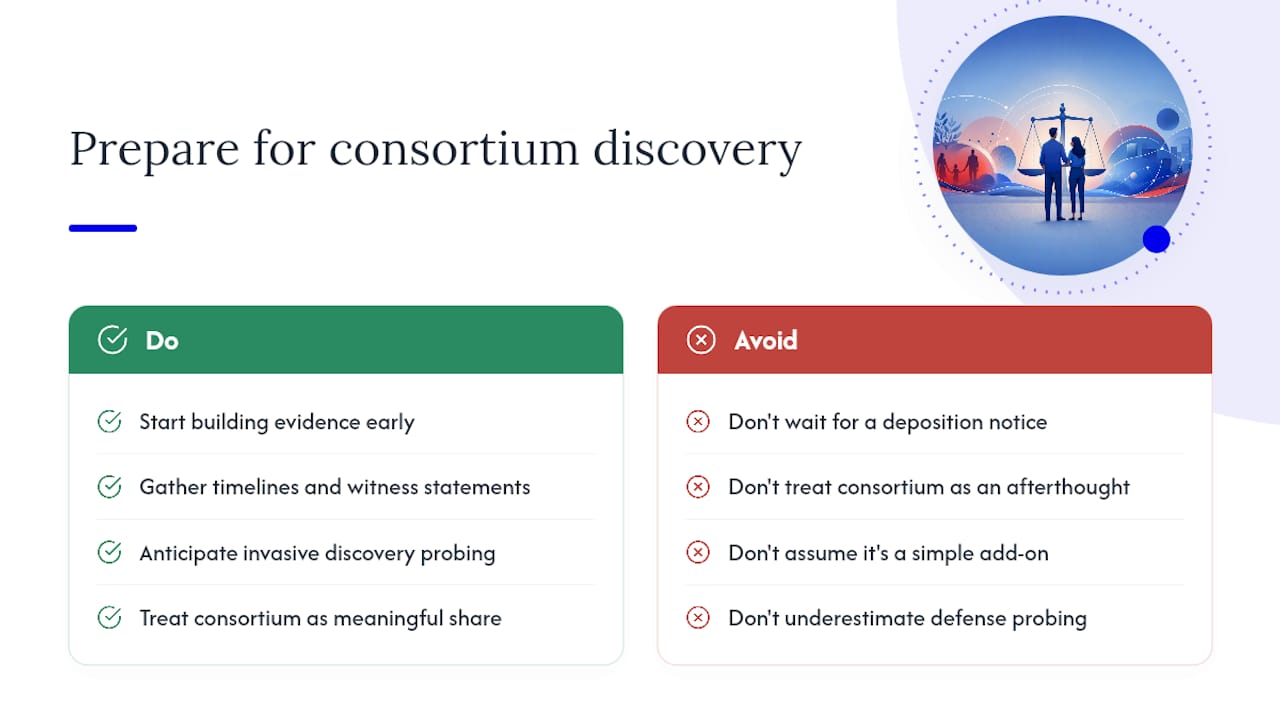
What gets underestimated is the discovery process. Readers hear "loss of consortium" and picture a simple add-on to the lawsuit. They don't expect defense attorneys probing their sex life, their therapy records, or the exact frequency of household chores before the accident. That's the part conventional advice glosses over, and it's exactly where an unprepared claimant loses leverage.
My take: don't wait until a deposition notice arrives to think about this claim seriously. The single biggest mistake families make is treating consortium as an afterthought instead of building the evidence, timelines, and witness statements early, before memories fade and before an adjuster gets the first crack at framing the narrative.
— Gerard
Get a Free Case Evaluation Before You Talk to the Insurance Company
Insurance adjusters move fast after a serious accident, often faster than families can process what a loss of consortium claim is even worth. Carcollisionlawyer's free, no-commitment evaluation connects you directly with attorneys who handle these exact cases, at no cost and with no obligation to hire anyone.
Before you submit, have the basics ready: the date and details of the accident, the nature of the injury, and a rough sense of how your household roles or relationship have changed since. That's enough to start a proper case review. An intake specialist matches your situation to attorneys who focus on catastrophic injury and consortium claims in your state, so you're not stuck cold-calling firms on your own.
If you're ready to see what your case might be worth, start your free evaluation now and get matched with an attorney who can walk you through your options.
Sources
- Law
- What Is Loss of Consortium In a Personal Injury Case? | Nolo
- What Is Loss of Consortium In a Personal Injury Case? | LawyerDamages
This article is general information, not a substitute for advice from a qualified lawyer. Consult a qualified legal professional about your own circumstances before acting on anything here.