
If another driver caused your crash, you can usually file a diminished value claim against their liability insurer, since nearly every state recognizes this loss. Michigan is the main exception.
TL;DR:
- Diminished value claims are generally enforceable against liability insurance in all states except Michigan, which blocks third-party recovery in most cases.
- Most insurers use the 17c formula, which caps the claim at 10% of pre-accident value and applies damage and mileage multipliers, potentially undervaluing the loss.
- Filing quickly is crucial, as delays increase mileage and reduce the claim's potential value, with costs for independent appraisals ranging from $150 to $400.
- Successful claims are more likely when the car is recent, has low mileage, and sustained structural damage, but may not be worthwhile for older, high-mileage vehicles.
- Filing against the other driver's insurer does not usually affect your premiums, but claims through your uninsured motorist coverage might depend on your policy and state rules.
Table of Contents
- What Is a Diminished Value Claim, and Why Does It Matter?
- What Are the Three Types of Diminished Value?
- Who Can File, and Does Your State Allow It?
- How Do Insurers Calculate Diminished Value? (The 17c Formula Explained)
- How Do You File a Diminished Value Claim, Step by Step?
- Is Filing a Diminished Value Claim Worth Your Time?
- Will a Diminished Value Claim Raise Your Insurance Premiums?
- Private Party Claims vs. Insurance Company Claims: What Changes?
- What's Carcollisionlawyer's Take on Diminished Value Disputes?
- Ready to Find Out What Your Diminished Value Claim Is Worth?
- Sources
What Is a Diminished Value Claim, and Why Does It Matter?
A diminished value claim covers the gap between what your car was worth right before the crash and what it's worth after repairs are finished. Even a flawless repair job doesn't erase the fact that your car now has an accident on its record, and that record follows the vehicle for as long as you own it.
The reason is simple market psychology: buyers pay less for a car with a reported accident, full stop. Vehicle history reports like CARFAX and AutoCheck flag the incident permanently, and many shoppers walk away from a listing the moment they see one, regardless of repair quality.
Liability insurance exists to make accident victims financially whole again, and diminished value is the piece of that promise that repair estimates don't touch. Building a case means collecting:
- Your car's pre-accident value from NADA or KBB guides
- Itemized repair invoices showing parts and labor
- Timestamped photos of the damage before and after repair
- The police report from the crash
- A current CARFAX or AutoCheck report showing the accident entry
One practical note worth remembering: this is a property-damage claim you file against the at-fault driver's liability insurer, not typically through your own collision coverage.
What Are the Three Types of Diminished Value?
Not every diminished value claim rests on the same argument. Insurers and appraisers generally sort losses into three buckets, and knowing which one applies to your car changes what evidence you need.
- Inherent diminished value: the stigma of a reported accident lowers resale price even when repairs are perfect. This is the most common and the easiest to prove with comparable listings.
- Repair-related diminished value: the shop used aftermarket parts, mismatched paint, or left panel gaps, and the car is now worth less because the repair itself was subpar.
- Immediate diminished value: the value lost the moment the damage happened, before any repair occurred. This type comes up rarely, mostly in total-loss disputes or pre-sale situations.
For inherent loss, gather comparable used-car listings without accident history. For repair-related loss, document the shop's workmanship with photos and a second mechanic's opinion. Either way, an independent appraisal strengthens your number more than a guide value alone.
Who Can File, and Does Your State Allow It?
Third-party diminished value claims, meaning claims filed against the other driver's liability insurer, are the standard path in nearly every state. If you caused the accident, you typically cannot claim diminished value against your own policy, since most collision sections exclude this type of loss for the at-fault driver.
Where things get more complicated is uninsured or underinsured motorist situations. If the at-fault driver has no insurance or too little coverage, your ability to recover diminished value may shift to your own UM/UIM coverage, and whether that applies depends heavily on your specific policy language and your state's rules.
Michigan stands out as the notable exception, where state regulations effectively block third-party diminished value recovery in most typical crash scenarios. If you're in Michigan, don't assume the standard playbook applies to you.
Before filing anywhere, check two things:
- Your state insurance department's guidance on diminished value recovery
- Your state's statute of limitations for property-damage claims, which is often shorter than the injury-claim deadline
How Do Insurers Calculate Diminished Value? (The 17c Formula Explained)
Most insurers lean on a formula that traces back to a Georgia lawsuit, Mabry v. State Farm, commonly called the 17c method. It's not a law everywhere, but it's the default math adjusters reach for because it produces a fast, defensible number.
The process runs in three steps:
- Find the pre-accident market value. Pull a figure from NADA or KBB based on your car's exact trim, mileage, and condition before the crash.
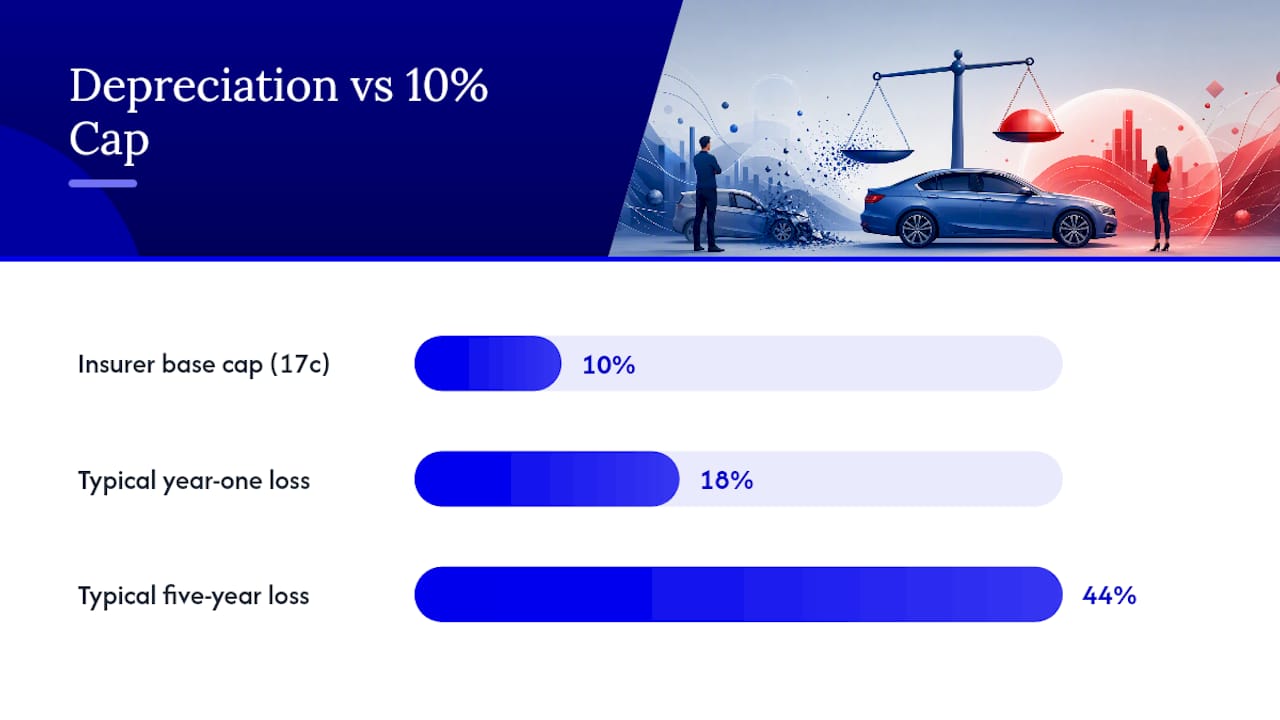
- Apply the 10% base cap. Insurers commonly treat 10% of that market value as the maximum possible diminished value, regardless of how severe the damage looks.
- Apply damage and mileage multipliers. A damage multiplier (typically 0.00 to 1.00) reflects how serious the structural harm was, and a mileage multiplier reduces the number further as odometer readings climb.
Here's a worked example. Say your car was worth $25,000 before the crash. If the damage multiplier reflects moderate structural repair and the mileage multiplier corresponds to moderate mileage, the diminished value claim is calculated by multiplying the base cap by these factors accordingly.
That's the ballpark insurers will likely offer, not necessarily what your car actually lost. Mileage bites harder than most owners expect. Used-car data shows depreciation of roughly 18% in year one alone, and about 44% over five years, plus a loss of around $1,617 per 10,000 miles driven, and 17c's mileage multiplier is built to mirror that curve.
The formula has real flaws. Some versions effectively double-count mileage, and it tends to understate losses on desirable, low-mileage cars where buyers are pickiest. If your car sits low on the odometer and 17c spits out a number that feels light, an independent appraisal using local comparable listings often supports a stronger figure than a national guide ever will.
How Do You File a Diminished Value Claim, Step by Step?
Speed matters here more than most owners realize. Waiting weeks to start the process lets your mileage climb and market comparables shift, both of which shrink whatever diminished value you might recover.
- Document the scene immediately. File the police report, photograph all damage, and hold on to every receipt tied to the vehicle's pre-accident condition.
- Compile your valuation package. Pull NADA/KBB figures for pre-accident value, get a current CARFAX or AutoCheck report, gather itemized repair invoices, and, for larger claims, hire an independent appraiser.
- Write the demand letter. Lay out your calculation clearly, attach every supporting document, state a reasonable response deadline (two to three weeks is typical), and signal you're open to negotiation, not just a fixed number.
- Send it to the at-fault driver's insurer, referencing the claim number and the police report.
Your demand letter should include:
- A clear statement of the claim and the accident date
- Your calculated diminished value figure with the math shown
- Copies of the appraisal, CARFAX report, and repair invoices
- A specific dollar amount requested and a response deadline
If the insurer denies the claim or lowballs the offer, you have real options to follow a clear process for a siniestro rechazado: cómo reclamar y defender tus derechos. An independent appraisal often moves the number more than another phone call will. Small claims court works well for modest amounts, while an attorney becomes worth considering once the dollar figure or the dispute gets complicated. If you're already dealing with a denied claim, the escalation path looks similar: more documentation, a firmer deadline, and a willingness to go over the adjuster's head.
Is Filing a Diminished Value Claim Worth Your Time?
Not every fender bender justifies the paperwork. Filing tends to pay off when several factors line up in your favor.
- The car is newer, often under five years old
- Mileage is on the lower end for its age
- The damage involved structural or frame repair, not just cosmetic panels
- The pre-accident market value was high enough that even a 10% cap produces a meaningful dollar figure
Run a quick break-even check before committing real time. If an independent appraisal costs $150 to $400 and your estimated diminished value sits at $600, the math still works in your favor. If your estimate comes in under $300 on an older, high-mileage car, the appraisal fee might eat most of your recovery.
An attorney earns their keep when fault is disputed, the payout is large, or the insurer has already denied you once. Many work on contingency, taking a percentage only if they recover money for you, which lowers your risk on bigger claims.
Pro Tip: Get your independent appraisal before you send the demand letter, not after the insurer counters. A number backed by a professional appraisal on day one carries more weight than one you scramble to justify after a lowball offer.
Will a Diminished Value Claim Raise Your Insurance Premiums?
Filing a diminished value claim against the other driver's insurer generally doesn't touch your own premiums, since you're not making a claim against your policy. Your insurer isn't the one paying out, so there's typically no rate action tied to the claim itself.
Where premiums can shift is around the accident that caused the damage in the first place. If you were found at fault in the underlying crash, that fault determination is what drives a premium increase, not any diminished value paperwork that follows. The diminished value claim is a separate, downstream action against the other party's coverage.
There's one wrinkle worth flagging: if you end up filing through your own uninsured or underinsured motorist coverage because the other driver had no insurance or too little, that does technically touch your policy. Whether it affects your renewal rate depends on your insurer's specific rules and your state's regulations on UM/UIM claim history. Some carriers treat UM claims like any other claim on your record; others don't, especially when you clearly weren't at fault.
The safest approach is to ask your own agent directly, before filing, how a UM-route diminished value claim would be treated on renewal. That's a five-minute phone call that can save you from an unpleasant surprise eight months later.
Private Party Claims vs. Insurance Company Claims: What Changes?
The process looks different depending on who's paying, and that difference catches a lot of car owners off guard.
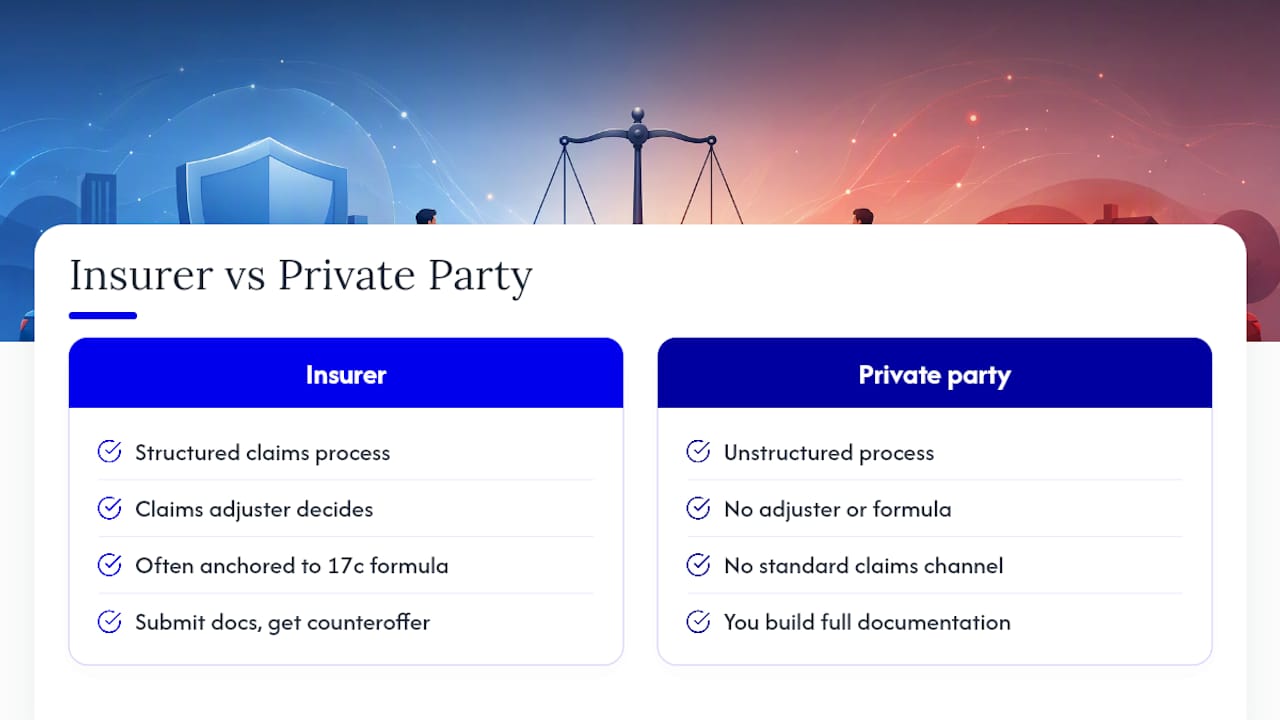
When you're dealing with an insurance company, you're negotiating with a claims adjuster who has seen thousands of diminished value demands and often leans on the 17c formula as a starting anchor, sometimes as a ceiling they'd rather not cross. The process is relatively structured: submit documentation, get a counteroffer, negotiate, escalate if needed.
A private party claim, where you're pursuing an uninsured individual directly rather than their insurer, plays out very differently. There's no adjuster following an internal formula, no standard claims process, and often no meaningful assets to collect from even if you win. You're more likely to end up in small claims court simply because there's no other structured channel to resolve the dispute.
Private party cases also demand more of your own documentation, since there's no insurance company internal file, no claims number, and no built-in appeals process. You'll want your appraisal, your CARFAX report, and your repair invoices organized before you ever file paperwork, because you're essentially building the entire case yourself rather than responding to an adjuster's counteroffer. Collection after a judgment is a separate hurdle, too. Winning in small claims court doesn't guarantee the other party can actually pay, which is a real risk private party claims carry that insurance company claims mostly avoid.
What's Carcollisionlawyer's Take on Diminished Value Disputes?
Diminished value claims are one of the more winnable arguments an accident victim can make, yet most people never file one because the math looks intimidating on paper. It isn't. The 17c formula is three multiplications anyone can do with a calculator, and the real skill isn't the arithmetic, it's knowing when the insurer's number is deliberately conservative.
Where this gets complicated fast is disputed fault, denied claims, or cars where the payout could run into the thousands. That's exactly the situation Carcollisionlawyer's free evaluation was built for. Submit your VIN, repair invoices, police report, and any appraisal you've already gathered, and get matched with an attorney who handles these disputes regularly. For readers who want more on what a fair settlement can include beyond diminished value, our breakdown of settlement factors is worth a read before you negotiate anything.
— Gerard
Ready to Find Out What Your Diminished Value Claim Is Worth?
Our service connects you with an attorney experienced in property-damage disputes. You can get matched with an attorney who negotiates diminished value claims.
Before you start, pull together your VIN, your repair invoices, your police report, and your independent appraisal if you already have one. The more documentation you bring to the evaluation, the faster an attorney can tell you whether your case is worth pursuing and roughly what range to expect. If the insurer has already denied your claim once, that's still worth submitting, since a denial often strengthens the case for attorney involvement rather than weakening it.
Start your free case evaluation today and find out where your diminished value claim actually stands.
This article is general information, not a substitute for advice from a qualified lawyer. Consult a qualified legal professional about your own circumstances before acting on anything here.
Sources
- What is diminished value? - Triple-I®
- Diminished Value Claims Explained - ValuePenguin
- Car depreciation analysis - ForCar
- Diminished Value of a Car: Estimations After an Accident - Kelley Blue Book