
An administrator of an estate is a person appointed by a probate court to manage and settle a deceased person's financial affairs when no valid will names an executor. The court grants this person legal authority to collect assets, pay debts, file taxes, and distribute what remains to heirs. Their power comes entirely from the court and ends the moment the estate closes.
Key Takeaways
An estate administrator is a court-appointed fiduciary whose authority begins with Letters of Administration and ends only when the probate court formally closes the estate.
| Point | Details |
|---|---|
| Core definition | An administrator manages a decedent's estate under court supervision when no valid executor exists. |
| Source of authority | Authority comes from Letters of Administration issued by the probate court, not from any document the decedent left. |
| Primary duties | Collect assets, notify creditors, pay debts and taxes (including Form 1041), account to the court, and distribute to heirs. |
| Fiduciary liability | Administrators are personally liable for breaches of duty, including self-dealing, missed deadlines, and mismanaged assets. |
| When to get legal help | Hire a probate attorney for complex assets, contested claims, tax exposure, or any estate tied to an accident or wrongful death. |
Table of Contents
- What "administrator of an estate" means in U.S. probate practice
- How and when a court appoints an administrator
- Core duties and powers every administrator must carry out
- Executor vs. administrator: what actually differs
- Who courts typically appoint and what disqualifies someone
- What the probate timeline actually looks like
- How administrators get paid and what beneficiaries should expect
- Fiduciary duties and what happens when they're breached
- What beneficiaries should do to protect their rights
- How an administrator can be removed and replaced
- Small-estate shortcuts and non-probate alternatives
- When you should consult a probate attorney
- An editorial perspective on estate administration
- Sources
What "administrator of an estate" means in U.S. probate practice
Administration of an estate) is the court-supervised process of managing a decedent's assets and liabilities. An administrator steps in specifically when no personal representative is named in a will, or when the named executor cannot or will not serve. The role is formal, legally binding, and carries real personal liability if mishandled.

Courts across the country don't always use the same word for this role. Many states, including California, Florida, and Texas, use the umbrella term "personal representative" to cover both executors and administrators. New York courts use "administrator" for intestate estates and "executor" for testate ones. Some jurisdictions allow a "voluntary administrator" for very small estates that skip the full probate process. Terminology and procedure vary by state, so always check your local probate court's rules before assuming a label applies.
The core concept stays consistent regardless of the label: this is a fiduciary role, supervised by a court, with defined duties and hard limits on personal gain.
How and when a court appoints an administrator
A probate court appoints an administrator when someone dies intestate (without a will) or when the named executor is unavailable. The administrator's authority derives from the probate court and ends when the estate is fully settled. Here is how the appointment typically unfolds:
- A petition is filed. An interested party, usually the surviving spouse, an adult child, or another close relative, files a petition for administration with the probate court in the county where the decedent lived.
- The court schedules a hearing. Most courts set a hearing date, notify other interested parties, and review whether the petitioner qualifies under state law.
- The court issues Letters of Administration. If approved, the court issues this official document, which is the administrator's proof of authority. Banks, title companies, and financial institutions will not release assets or allow transfers without it.
- The administrator posts a bond (often). Many states require a surety bond to protect beneficiaries from mismanagement, though courts can waive this requirement.
- Administration begins. With Letters of Administration in hand, the administrator can access accounts, notify creditors, and begin inventorying the estate.
For very small estates, many states offer a simplified path. A small-estate affidavit or voluntary administration procedure can bypass the full court process entirely, depending on the estate's total value and the type of assets involved.
Core duties and powers every administrator must carry out
Executors, administrators, and voluntary administrators are fiduciaries required to act faithfully for the estate and settle it according to state law. The IRS confirms that an administrator's first responsibilities include collecting assets, paying creditors, and filing a formal accounting with the court.
In practice, that breaks down into the following duties:
- Secure and inventory all assets. This includes bank accounts, real estate, vehicles, investments, jewelry, and personal property. Securing documentary evidence of asset value and chain of title early lowers dispute risk and speeds distributions. For estates that include jewelry or collectibles, a professional appraisal is often necessary; a resource like the executor's guide to jewelry assets can help administrators understand what documentation is needed.
- Notify creditors. Most states require the administrator to publish a notice to creditors in a local newspaper and send direct notice to known creditors, giving them a set period to file claims.
- Pay valid debts and expenses. Funeral costs, outstanding bills, and administrative expenses are paid in a court-defined priority order before any distribution to heirs.
- File required tax returns. The administrator must file the decedent's final individual income tax return and, if the estate earns income during administration, Form 1041 (the fiduciary income tax return). For very large estates, Form 706 may also apply.
- Account to the court. The administrator must provide the probate court with a formal accounting of all assets received, debts paid, and distributions made.
- Distribute remaining assets. Once debts and taxes are settled, the administrator distributes what remains according to the will or, if there is no will, the state's intestacy statutes.
Pro Tip: Open a dedicated estate checking account the day you receive Letters of Administration. Running estate funds through a personal account is one of the most common mistakes that triggers a breach-of-fiduciary-duty claim.
Executor vs. administrator: what actually differs
The distinction matters because it determines where the administrator's authority comes from and what limits apply. Many states use "personal representative" as a catchall for both roles.
| Feature | Executor | Administrator |
|---|---|---|
| Source of authority | Named in the decedent's will | Appointed by the probate court |
| Trigger for appointment | Decedent left a valid will | No will, or named executor cannot serve |
| Selection process | Chosen by the testator | Court follows statutory priority order |
| Core powers | Collect assets, pay debts, distribute per will | Collect assets, pay debts, distribute per intestacy law |
| Supervision level | Court-supervised; varies by state | Court-supervised; often more scrutiny |
| Common term used | Executor (or personal representative) | Administrator (or personal representative) |
An administrator can be appointed even when a will exists. If the named executor dies before the testator, declines the role, or is disqualified, the court appoints an administrator with will annexed (sometimes called an "administrator c.t.a."), who carries out the will's instructions but derives authority from the court, not the document itself.
Who courts typically appoint and what disqualifies someone
Courts don't pick administrators at random. State statutes set a priority order, and most follow a similar pattern:
- Surviving spouse (highest priority in nearly every state)
- Adult children of the decedent
- Parents of the decedent
- Siblings
- Other next of kin, in order of closeness
- Creditors or public administrators (last resort, varies by state)
Common disqualifiers include a felony conviction, being a minor, being a non-U.S. resident in some states, or having a conflict of interest so severe the court deems it incompatible with the fiduciary role. A creditor of the estate can sometimes serve as administrator, but courts scrutinize that appointment carefully. Cornell Law's Wex definition notes that state law governs the appointment, so local statutes can shift this order or add requirements. Always verify the priority rules with your state's probate court before filing a petition.
What the probate timeline actually looks like
Probate rarely moves as fast as families hope. Proceedings often open within a few weeks to a few months after death, but full administration can stretch well beyond that depending on estate complexity.
- Days 1–30: Death certificate obtained, assets secured, probate petition filed.
- Days 30–90: Court hearing held, Letters of Administration issued, estate bank account opened, creditor notices published.
- Months 3–6: Asset inventory completed and filed with the court, appraisals obtained, creditor claims period runs (typically 3–6 months depending on state).
- Months 6–12: Debts and taxes paid, tax returns filed (Form 1041 due by the 15th day of the fourth month after the estate's tax year ends), preliminary distributions possible.
- Months 12–24+: Final accounting filed, court approval obtained, final distributions made, estate closed.
Common delay factors include contested creditor claims, real estate that needs to be sold, incomplete financial records, multi-state assets, and family disputes over distribution. An estate with a small business or cryptocurrency holdings can easily run two years or more.
Pro Tip: Set calendar reminders for every statutory deadline from the day Letters of Administration are issued. Missing a creditor notice deadline or a tax filing date can expose you to personal liability.
How administrators get paid and what beneficiaries should expect
Administrators don't work for free, and the fees come out of the estate before heirs receive anything. Some states set statutory percentage schedules for this compensation; others leave it to court approval based on a "reasonable fee" standard.
- Statutory percentage states: California is the most cited example. Its schedule runs 4% of the first $100,000 of estate value, 3% of the next $100,000, 2% of the next $800,000, and so on down through higher brackets. Other states use similar graduated models.
- Reasonable fee states: Courts in these jurisdictions approve fees based on the time spent, complexity of the work, and local norms. The administrator typically submits a fee petition with a detailed time log.
- Waived fees: A family member serving as administrator sometimes waives compensation, particularly in smaller estates, to simplify the process and preserve assets for heirs.
- Attorney fees: If the administrator hires a probate attorney (which courts allow and often encourage), those fees are also paid from the estate and must be separately approved.
Beneficiaries have the right to review and object to fee requests before the court approves them.
Fiduciary duties and what happens when they're breached
An administrator is a fiduciary, which means the law holds them to a higher standard than an ordinary business relationship. The core obligations are loyalty (act in the estate's interest, not your own), impartiality (treat all beneficiaries fairly), prudence (manage assets as a careful person would), and full accounting (keep complete records and report to the court).
Poor performance can expose the administrator to personal liability, and courts take breaches seriously. Common violations include:
- Self-dealing: Buying estate assets at below-market prices or paying yourself excessive fees without court approval.
- Failing to notify creditors: Skipping required notices can leave the administrator personally responsible for unpaid debts.
- Mismanaging or wasting assets: Letting real estate fall into disrepair, making speculative investments, or simply failing to act in a timely way.
- Failing to file taxes: Missing IRS deadlines or not filing Form 1041 when required can lead to penalties and complications for the estate.
Beneficiaries who suspect a breach can petition the court for a formal accounting, seek a surcharge (a court order requiring the administrator to personally repay losses), or move to have the administrator removed. Damages in serious cases can exceed the value of the loss itself if the court finds willful misconduct.
Pro Tip: If you are a beneficiary and something feels off, request a written accounting before escalating. Many disputes resolve once the administrator produces clear records. If records aren't forthcoming within a reasonable time, that itself is grounds for court intervention.
What beneficiaries should do to protect their rights
Being a beneficiary doesn't mean sitting and waiting. You have legal standing to monitor the administration and take action if something goes wrong.
- Request a copy of the will and the Letters of Administration. These are public court documents in most states. Knowing who has authority is the first step.
- Ask for a formal inventory. The administrator is required to file one with the court. Review it for assets you know existed that aren't listed.
- Track the creditor claims period. Know when it ends so you can anticipate when distributions might begin.
- Request an accounting. You are entitled to a formal accounting of all income received, expenses paid, and proposed distributions. If the administrator resists, the court can compel one.
- Review tax filings. Ask whether Form 1041 was filed if the estate earned income. Unfiled returns can delay closing and create penalties that reduce your share.
- Consult an attorney if you see red flags. Unexplained delays, missing assets, or an administrator who won't communicate are all reasons to get legal advice. Families dealing with a death that involved an accident may also have wrongful death claims that interact with the estate, adding another layer of complexity worth reviewing with counsel.
How an administrator can be removed and replaced
Courts appoint administrators, and courts can remove them. The process is formal but not uncommon.
- A petition for removal is filed by an interested party (a beneficiary, creditor, or co-administrator) with the probate court.
- The court schedules a hearing and notifies the current administrator, who has the right to respond.
- The court evaluates the grounds. Common grounds include incompetence, misconduct, self-dealing, failure to perform required duties, a conflict of interest, or incapacity.
- If removal is granted, the court issues an order stripping the administrator's authority. Letters of Administration are revoked.
- A successor administrator is appointed following the same priority rules used for the original appointment, unless the court has reason to deviate.
Once a successor is in place, the removed administrator must turn over all estate assets, records, and accounts. Any actions taken after the revocation of Letters of Administration are void.
Small-estate shortcuts and non-probate alternatives
Full probate administration isn't always required. Many estates qualify for faster, cheaper alternatives.
- Small-estate affidavit: Most states allow heirs to collect assets by signing a sworn affidavit if the estate's total value falls below a statutory threshold. Thresholds vary widely by state, with some states setting relatively low values and others much higher thresholds. No court appointment is needed.
- Transfer-on-death (TOD) accounts: Bank accounts and brokerage accounts with a named TOD beneficiary pass directly to that person outside of probate entirely.
- Joint ownership with right of survivorship: Property held jointly passes automatically to the surviving owner without court involvement.
- Beneficiary designations: Life insurance, retirement accounts (IRAs, 401(k)s), and annuities with named beneficiaries bypass the estate and go directly to those individuals.
- Payable-on-death (POD) designations: Similar to TOD, these apply to bank accounts and certificates of deposit.
Even when these shortcuts apply, some court involvement may still be needed if there are disputes, if a minor is a beneficiary, or if the decedent owned real estate in multiple states.
When you should consult a probate attorney
Some estates are genuinely simple enough to handle without a lawyer. Most aren't. Here are the situations where professional help is worth every dollar:
- The estate includes a business, rental property, cryptocurrency, or assets in more than one state.
- There is a contested will or a dispute among heirs about who should serve as administrator.
- A creditor is making a claim you believe is invalid.
- The estate may owe federal estate tax (the federal exemption is $13.61 million per individual as of 2024, but state estate taxes kick in at much lower thresholds in states like Massachusetts and Oregon).
- You suspect the current administrator is mismanaging assets or acting in bad faith.
- The decedent was killed in an accident and the estate may have a wrongful death claim to pursue alongside probate.
Courts allow fiduciaries to be represented by a lawyer, and many practitioners recommend it for any estate with complexity or family conflict. Attorney fees paid from the estate are a legitimate administrative expense.
Pro Tip: When interviewing a probate attorney, ask specifically: "Have you handled estates in this county's probate court?" Local court familiarity matters more than general legal credentials for routine probate work.
If you're dealing with an estate that involves an accident, a wrongful death, or any personal injury claim, the legal picture gets more complicated fast. Carcollisionlawyer offers a free case evaluation to help connect you with an attorney who understands both sides of that equation.
This article provides general legal information, not legal advice. Laws vary by state and change over time. Consult a qualified probate attorney or your local probate court for guidance specific to your situation.
An editorial perspective on estate administration
Estate administration is one of those legal processes that looks straightforward on paper and turns genuinely complicated in practice. The gap between "collect assets, pay debts, distribute to heirs" and the reality of a grieving family, a disputed creditor claim, and a real estate sale that falls through mid-probate is enormous.
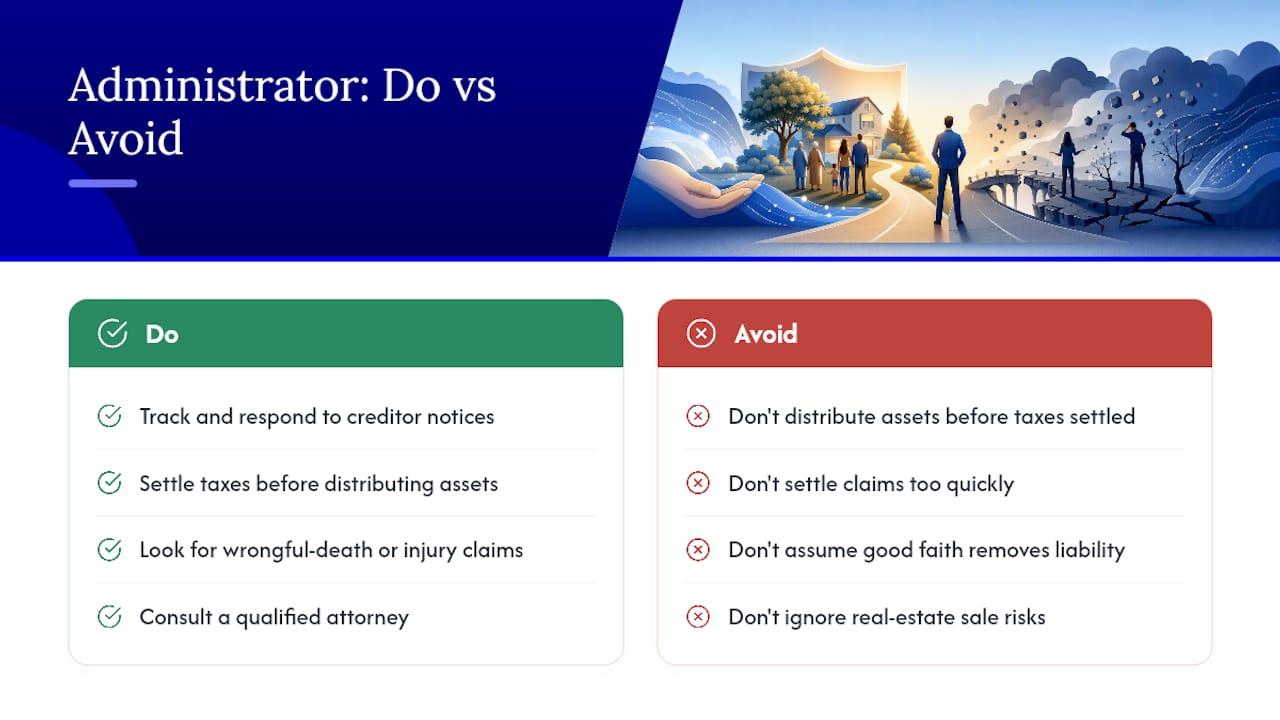
What most guides understate is the personal liability exposure. Administrators aren't just managing paperwork. They are personally on the hook if they miss a creditor notice, make a bad investment decision with estate funds, or distribute assets before taxes are settled. That liability doesn't disappear because the administrator was acting in good faith. Courts have ordered administrators to repay losses out of their own pockets for mistakes that were entirely unintentional.
The other thing worth saying plainly: if the person who died was killed in an accident, the estate may have a wrongful death or personal injury claim that is worth more than everything else in the estate combined. Those claims have their own deadlines, their own legal standards, and their own attorneys. An administrator who doesn't know to look for that claim, or who settles it too quickly without understanding its value, can cost the family far more than any probate fee. Understanding why wrongful death differs from personal injury claims is a starting point, but a qualified attorney is the only reliable guide through that territory.
Sources
These official and authoritative resources are worth bookmarking if you are navigating estate administration:
- Responsibilities of an estate administrator | Internal Revenue Service
- Administration (Of An Estate) Definition | Nolo
- What Are the Duties of an Estate Administrator? - LegalClarity
- How Much Do Will Executors Get Paid in Each State? | Fabric (blog)
- Administrator of an estate — Wikipedia
This article is general information, not a substitute for advice from a qualified lawyer. Consult a qualified legal professional about your own circumstances before acting on anything here.