
What role does a deposition play in your accident case?
A deposition is formal, sworn testimony taken outside of court during the discovery phase of your accident case. Think of it as your story going on record before anyone sets foot in a courtroom. What you say gets transcribed by a court reporter, and that transcript follows your case everywhere.
The role of deposition in an accident case goes well beyond answering questions. Your testimony locks in your account of events, shapes how both sides evaluate the strength of your claim, and often determines whether your case settles or heads to trial. Depositions also preserve witness statements for witnesses who may be unavailable at trial, allowing their accounts to be read into the record.
Here is what depositions actually do in an accident case:
- Lock in testimony so neither side can claim a different version of events later
- Expose inconsistencies that could weaken your credibility at trial
- Feed settlement negotiations by showing both sides what a jury might hear
- Replace live testimony when a witness cannot appear at trial
- Support or defeat motions such as summary judgment before trial ever begins
- Give defense attorneys a preview of how you present as a potential witness
Every answer you give under oath becomes part of a permanent record. That record shapes every negotiation, every motion, and every courtroom argument that follows.
What you can expect during your deposition
The setting is less formal than a courtroom, but the stakes are identical. Depositions typically take place in a conference room at an attorney's office. You will sit across from the opposing attorney, with your own attorney beside you and a court reporter at the table. If a videographer is present, a camera will record your demeanor alongside the transcript.

The questioning follows a predictable arc. Defense counsel starts with background: your name, address, employment, and medical history. From there, questions move to the accident itself, then to your injuries, treatment, and how your life has changed since the crash.
Common question categories include:
- Personal background: employment, prior injuries, medical history
- The accident: sequence of events, road conditions, what you saw and heard
- Injuries and treatment: diagnosis, doctors visited, medications, ongoing symptoms
- Impact on daily life: work missed, activities you can no longer do, emotional effects
- Prior claims or lawsuits: any previous accident cases or insurance claims
One thing surprises many people: the defense attorney can ask almost anything that might lead to relevant evidence. You are under oath, so accuracy matters more than a quick answer. Pausing before you respond is not only allowed, it is smart.
How deposition testimony shapes settlement offers and trial outcomes
Many personal injury and car accident cases settle before trial, and the deposition is often the turning point where both sides decide whether to deal or fight. After your deposition, the defense has a clear picture of what a jury would see and hear from you.
Statistic: Roughly 95% of accident cases settle before reaching trial, with depositions frequently serving as the moment both sides reassess their positions.
Consistent, honest testimony strengthens your negotiating position. Contradictory answers do the opposite: they give defense attorneys ammunition to argue your account is unreliable, which can push a case toward trial rather than settlement. Defense counsel also watches how you handle pressure. Your composure, memory, and credibility all factor into how willing the other side is to offer a fair number.
Key ways deposition testimony influences your case:
- Consistent answers signal a credible witness, raising settlement value
- Contradictions invite impeachment at trial and lower settlement offers
- Transcript excerpts appear in pre-trial motions, including summary judgment filings
- Demeanor on video gives defense a preview of your jury appeal
- Gaps in your account get exploited to argue comparative fault
Understanding settlement factors in accident cases helps you see why deposition testimony carries so much weight in the final number.
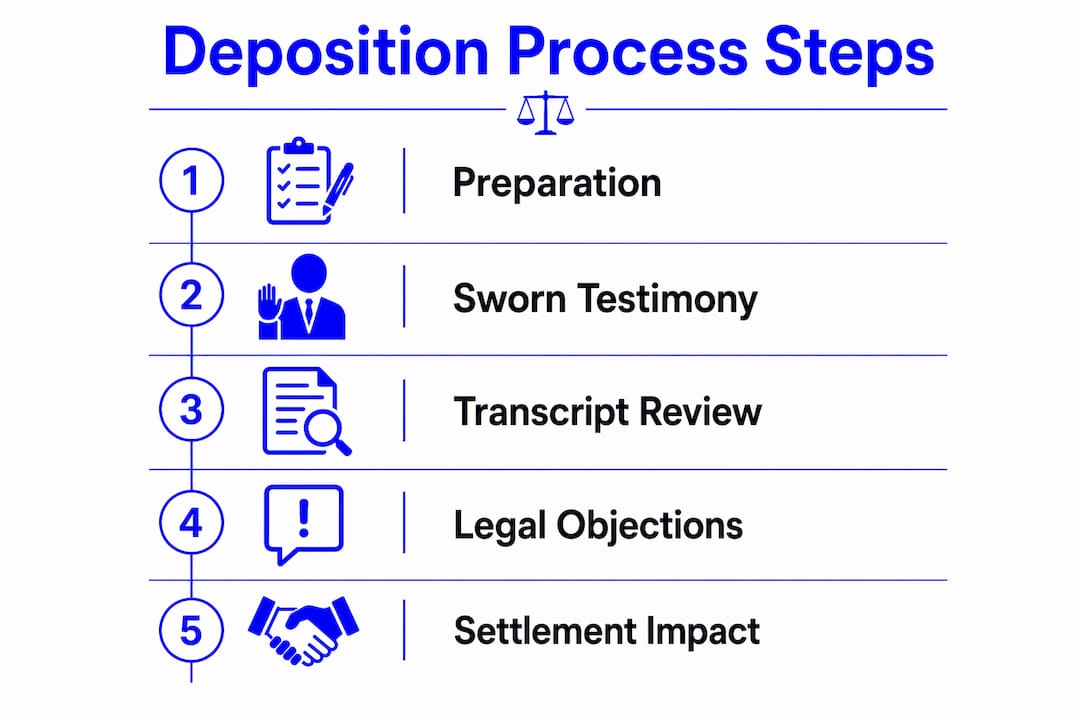
Preparing for your deposition: practical advice and common pitfalls
Preparation is the single biggest factor in how well a deposition goes. The transcript becomes a permanent record, and unlike a casual conversation, you cannot walk it back later. Work through every likely question with your attorney before the session.

Pro Tip: Treat every answer as if it will be read aloud to a jury, because it might be. Short, truthful answers protect you far better than long explanations that introduce details the defense can use against you.
Preparation steps that make a real difference:
- Review your medical records and prior statements so your answers stay consistent
- Practice answering out loud with your attorney, not just mentally
- Clarify the accident timeline so you can describe events in order without hesitation
- Know your injuries specifically: diagnosis names, treating physicians, current limitations
Common mistakes to avoid:
- Guessing when you do not know the answer. "I don't know" is a complete, acceptable answer.
- Volunteering extra information beyond what the question asks
- Contradicting your own prior statements in medical records or police reports
- Reacting emotionally to aggressive or repetitive questioning
- Assuming a friendly tone means the questions are harmless
Your attorney's objections during the deposition protect the record. When your attorney objects, stop talking and wait. The objection may not halt the question entirely, but it preserves your right to challenge improper use of that testimony later. Videographers are increasingly present at depositions, so body language and facial expressions matter as much as your words.
What is a deposition in an accident case?
A deposition is an out-of-court proceeding where a party or witness gives sworn testimony under penalty of perjury. In a car or personal injury case, the plaintiff (the injured person) is almost always deposed by the defense. Witnesses, treating physicians, and accident reconstruction experts may also be deposed.
The Federal Rules of Civil Procedure govern depositions in federal cases, and each state has its own parallel rules for state court proceedings. The court reporter transcribes every word, producing a written record both sides can use throughout the litigation. Depositions are part of the broader discovery process, which is the pre-trial phase where both sides gather evidence.
What happens after the deposition?
Once your deposition ends, the court reporter prepares a written transcript. You typically have the right to review and sign it, noting any transcription errors. Substantive changes to your answers, however, can be used against you as evidence of inconsistency.
After both sides complete depositions, the case usually moves toward one of three outcomes: a negotiated settlement, a pre-trial motion (such as a motion for summary judgment), or a trial date. Defense attorneys often reassess settlement value immediately after depositions, so offers can shift quickly in either direction. Your attorney will use the deposition record to reinforce your strongest arguments and anticipate the defense's trial strategy.
Legal rights during a deposition in an accident case
You have concrete rights during a deposition, and knowing them prevents you from being pressured into harmful answers. Your attorney can object to questions that are vague, harassing, or call for privileged information. You have the right to take breaks, though not mid-answer. You can ask for a question to be rephrased if you genuinely do not understand it.
You also have the right to review the transcript after it is prepared and correct transcription errors. Attorney-client communications remain privileged; the defense cannot ask what your lawyer told you privately. If a question asks you to speculate or guess, you are entitled to say you do not know rather than fabricate an answer.
How depositions differ from other forms of testimony
A deposition differs from courtroom testimony in setting, but not in legal weight. Both are given under oath, and both carry the same perjury consequences. The key differences are procedural.
| Feature | Deposition | Trial testimony |
|---|---|---|
| Location | Attorney's office or conference room | Courtroom |
| Judge present | No | Yes |
| Jury present | No | Yes |
| Objections | Noted but rarely block the answer | Ruled on immediately |
| Format | Question and answer, open-ended | Structured direct and cross-examination |
| Record | Transcript and possible video | Court transcript |
Interrogatories are written questions answered in writing, without the real-time pressure of a deposition. Affidavits are sworn written statements prepared in advance. Neither captures the spontaneous, unscripted quality of a deposition, which is exactly why defense attorneys value them so highly for assessing witness credibility.
Potential risks and pitfalls of depositions for accident victims
The biggest risk is inconsistency. If your deposition answers contradict your medical records, police report, or prior statements, the defense will use that gap at trial to argue you are not credible. Even small discrepancies, like a slightly different description of how the crash happened, can be magnified in front of a jury.
Oversharing is a close second. Accident victims sometimes feel compelled to explain everything, which introduces facts the defense never asked about. Every extra detail is a potential new line of attack. Stick to what the question actually asks.
Other risks worth knowing:
- Admitting fault inadvertently through casual phrasing like "I should have seen them coming"
- Downplaying injuries out of politeness, which the defense uses to argue your damages are minor
- Discussing the case on social media before or during litigation, since posts can surface in depositions
- Failing to disclose prior injuries, which the defense will discover through medical records anyway
Good evidence practices in accident claims before your deposition reduce these risks considerably. The more organized your documentation, the easier it is to give consistent, accurate answers when the questions get specific.
Get legal support before your deposition

A deposition can make or break your accident claim. Carcollisionlawyer connects injured people with experienced attorneys who prepare you for every stage of the process, including your deposition. Get a free case evaluation today and find out what your claim is worth before the other side gets to ask the first question.
Key Takeaways
Deposition testimony is the single most consequential event in most accident cases, directly shaping settlement offers, trial strategy, and your credibility as a witness.
| Point | Details |
|---|---|
| Depositions lock in your story | Sworn testimony becomes a permanent record used in motions, negotiations, and at trial. |
| Many cases settle before trial | Depositions are often the turning point where both sides decide whether to settle or fight. |
| Consistency is your strongest asset | Contradictory answers lower settlement offers and give defense attorneys trial ammunition. |
| Preparation is non-negotiable | Reviewing records and practicing answers with your attorney directly improves your credibility. |
| You have rights during the process | You can refuse to guess, request rephrasing, and rely on attorney objections to protect the record. |