
Yes, families can file civil claims after a fatal motorcycle crash. In most U.S. states, a surviving spouse, children, dependent parents, or the estate's personal representative can pursue a wrongful death claim, a survival action, or both. The clock starts running the moment of death, and most states give families between one and three years to file. Missing that window can permanently bar recovery.
Three things to do right now:
- Preserve all physical evidence: the motorcycle, helmet, gear, and any dashcam or phone footage from the scene.
- Request the police report, autopsy report, and all medical and EMS records immediately.
- Contact a wrongful death attorney or request a free case evaluation before speaking with any insurance adjuster.
How motorcycle fatalities affect family claims goes well beyond a single lawsuit. The legal process involves multiple causes of action, layered insurance policies, state-specific fault rules, and a damages calculation that can run into seven figures. The sections below walk through each piece in plain terms.
Key Takeaways
Families who act quickly, preserve evidence, and connect with experienced wrongful death counsel are in the strongest position to recover meaningful compensation after a fatal motorcycle crash.
| Point | Details |
|---|---|
| Who can file | Spouse, children, dependent parents, or the estate's personal representative, depending on state statute. |
| Act before the deadline | Most states allow one to three years to file; government-entity claims may require notice within 60–180 days. |
| Damages range widely | Fatal motorcycle settlements commonly fall in the high six-figure to low seven-figure range; UM/UIM coverage often determines net recovery. |
| Evidence preservation is urgent | Preserve the motorcycle, helmet, dashcam footage, and witness contacts within the first 72 hours; footage is often overwritten within 30–72 hours. |
| Carcollisionlawyer | Offers a free case evaluation to match families with vetted wrongful death attorneys; no fees unless compensation is recovered. |
Table of Contents
- How motorcycle fatalities affect family claims: who can file
- What's the difference between a wrongful death claim and a survival action?
- What compensation can families recover after a fatal motorcycle crash?
- How fault rules and helmet laws affect what your family can recover
- How long does a family have to file a wrongful death claim?
- What evidence should families preserve after a fatal motorcycle crash?
- How should families deal with insurance companies after a motorcycle death?
- What does the legal process look like from start to finish?
- How do you choose a wrongful death attorney for a motorcycle case?
- What research shows about the long-term impact on families after a fatal crash
- Why early counsel changes more than just the legal outcome
- Carcollisionlawyer connects grieving families with experienced wrongful death attorneys
- Sources
How motorcycle fatalities affect family claims: who can file
Not every grieving family member has automatic legal standing to sue. State wrongful death statutes define a specific list of eligible claimants, and the order of priority matters when multiple family members want to file.
Commonly eligible parties, in typical priority order:
- Surviving spouse — almost universally the first-priority claimant in every state.
- Children (biological and legally adopted) — share standing with or after the spouse depending on the state.
- Dependent parents — eligible in most states when the decedent had no spouse or children, or when parents were financially dependent on the deceased.
- Siblings or other dependents — recognized in a smaller number of states, usually only when no higher-priority claimant exists.
- Personal representative of the estate — files on behalf of the estate for a survival action (see Section 3 below) and sometimes for wrongful death when no statutory beneficiary steps forward.
State law shapes this list significantly. California, Texas, and Florida each define "heir" differently. In states like Georgia, only the surviving spouse and children can bring a wrongful death claim; parents qualify only if the decedent had neither. In contrast, some states allow a domestic partner to sue. If the decedent was unmarried with no children, the rules get complicated fast, and the estate's personal representative often becomes the only viable claimant.
A survival action is procedurally distinct. It belongs to the estate, not to individual family members, and it recovers losses the decedent suffered between the crash and death: medical bills, pain and suffering in the final hours, lost wages during that period. The personal representative files it, and proceeds flow through the estate before reaching heirs. Understanding why families can sue after accidents and which cause of action applies to your situation is the first step toward protecting your rights.
Pro Tip: Open the estate and appoint a personal representative as early as possible. Probate timelines in some states can take weeks, and if the statute of limitations runs while you're waiting on court appointments, the survival action may be lost.
What's the difference between a wrongful death claim and a survival action?
These two causes of action often run in parallel, but they recover different losses for different parties.
| Feature | Wrongful Death Claim | Survival Action |
|---|---|---|
| Who brings it | Statutory beneficiaries (spouse, children, parents) | Estate's personal representative |
| What it recovers | Survivors' losses: income support, companionship, grief | Decedent's pre-death losses: medical bills, pain, lost wages before death |
| Who receives proceeds | Surviving family members directly | Estate (then distributed to heirs per will or intestacy) |
| Governing law | State wrongful death statute | State survival statute |
| Damages cap | Varies by state; some cap non-economic damages | Varies; pain and suffering sometimes excluded |
A single fatal motorcycle crash can trigger both. Consider a 42-year-old father killed by a distracted driver who ran a red light. His wife and two children file a wrongful death claim for the income he would have earned over 25 more working years, plus loss of parental guidance and companionship. Simultaneously, the estate's personal representative files a survival action to recover the $38,000 in emergency medical bills from the two hours he spent in the trauma center before dying. Both cases proceed together, often handled by the same attorney. For a deeper look at how these claims split, the wrongful death versus injury claims guide covers the distinctions in detail.
What compensation can families recover after a fatal motorcycle crash?
The damages in a fatal motorcycle case fall into several categories. Some are straightforward to calculate; others require expert testimony to quantify.
Economic damages:
- Lost income and benefits — calculated using the decedent's age, occupation, salary, projected raises, and work-life expectancy. A forensic economist typically builds this model.
- Lost household services — childcare, home maintenance, and other tasks the decedent performed.
- Medical and EMS bills — costs incurred between the crash and death, recoverable through the survival action.
- Funeral and burial expenses — documented costs are recoverable in every state; recovering funeral expenses after an accident claim requires organized invoices and receipts.
Non-economic damages:
- Loss of consortium (spouse's claim for loss of companionship and intimacy)
- Loss of parental guidance and nurturing (children's claim)
- Grief and mental anguish (where permitted by state law)
- Pain and suffering of the decedent before death (survival action)
Punitive damages are rare and require proof that the at-fault party acted with malice, gross negligence, or conscious disregard for safety. A drunk driver who killed someone at twice the legal limit is a candidate; an ordinary distracted driver usually is not.
Insurance sources that fund recovery:
- At-fault driver's bodily injury liability policy
- Uninsured/underinsured motorist (UM/UIM) coverage on the decedent's own policy
- Household policies covering resident relatives
- Employer vicarious liability if the at-fault driver was working at the time
- Product liability coverage if a vehicle defect contributed
Policy limits often determine what families actually collect, regardless of what a jury might award. Industry settlement data shows fatal motorcycle crash settlements commonly fall in the high six-figure to low seven-figure range, with UM/UIM coverage and policy stacking frequently determining net recovery more than the theoretical case value. When the at-fault driver carries only $25,000 in liability coverage, the decedent's own UM/UIM policy becomes the primary source of meaningful compensation. Reviewing motorcycle insurance coverage options before a crash happens is the best protection; after a death, your attorney will conduct a full policy inventory.
Settlement context: NHTSA data confirms motorcyclists are overrepresented in fatal crash statistics relative to miles traveled, which means insurers are experienced at defending these claims. Documented financial loss and preserved liability evidence are what move settlement numbers.
For a full breakdown of motorcycle injury compensation categories, including how economic and non-economic losses are calculated and presented to insurers, that guide covers the methodology attorneys use.
How fault rules and helmet laws affect what your family can recover
Fault allocation can reduce or eliminate a family's recovery depending on which state the crash occurred in.
Comparative vs. contributory negligence systems:
- Pure comparative negligence (California, New York, Florida, and others): the family recovers damages reduced by the decedent's percentage of fault. If the decedent was 30% at fault, the family collects 70% of the total award.
- Modified comparative negligence (most states, including Texas and Illinois): recovery is barred if the decedent was 50% or 51% at fault, depending on the state's threshold.
- Pure contributory negligence (Alabama, Maryland, North Carolina, Virginia, and D.C.): any fault by the decedent bars recovery entirely. These states are outliers, but the rule is absolute.
Common insurer defenses in motorcycle cases:
- Helmet nonuse — in states with universal helmet laws (California, New York), not wearing a helmet can be used to argue the decedent contributed to fatal head injuries, reducing damages.
- Alleged reckless riding — insurers frequently claim the motorcyclist was speeding or weaving, even without strong evidence. Accident reconstruction experts counter this.
- Intoxication — a toxicology report showing any alcohol or drug presence will be used aggressively. The strength of this defense depends on the level found and state law.
- Lane-splitting — legal in California, illegal in most other states. Where it's illegal, insurers argue it constitutes negligence per se.
- Assumption of risk — rarely succeeds as a complete defense but can influence jury sympathy and settlement posture.
The American Bar Association's negligence framework requires plaintiffs to prove duty, breach, causation, and damages. Insurers attack causation and comparative fault simultaneously, which is why early evidence preservation is so critical.
Pro Tip: Photograph the helmet immediately after the crash, before it moves. Document whether it was worn, its condition, and any impact marks. Helmet evidence cuts both ways: a worn, properly fastened helmet rebuts the insurer's head-injury causation argument; a missing or damaged one needs an expert to explain.
How long does a family have to file a wrongful death claim?
Most states set the statute of limitations for wrongful death claims at two years from the date of death. Some states allow one year (Kentucky, Louisiana, Tennessee); a few allow three (Maine, Missouri). Missing the deadline almost always means losing the right to sue, regardless of how strong the case is.
Common exceptions that can extend the deadline:
- Minor children — many states toll the statute of limitations until a minor claimant turns 18, though the estate's claims may still run on the standard timeline.
- Discovery rule — if the cause of death was not immediately apparent (a defective part that failed, a road hazard that wasn't obvious), some states start the clock when the family discovered or reasonably should have discovered the cause.
- Claims against government entities — if a city or state is liable (road defect, signal failure), most jurisdictions require a notice of claim within 60 to 180 days of the incident, far shorter than the standard limitations period.
- Fraudulent concealment — if the at-fault party actively hid evidence, courts may toll the statute.
Practical timeline for families:
- Days 1–7: Secure the motorcycle, gear, and helmet. Request the police report. Preserve all digital evidence (dashcam, phone, traffic cameras). Contact an attorney.
- Weeks 2–6: Obtain autopsy report, death certificate, medical and EMS records. Begin estate proceedings to appoint a personal representative. Conduct a full insurance inventory.
- Months 2–6: Retain experts (accident reconstruction, forensic economist). Build the damages model. Send preservation letters to insurers and potential defendants.
- Months 6–18: Demand package, negotiation, mediation. File suit before the statute of limitations if no acceptable resolution is reached.
The motorcycle accident legal rights checklist provides a step-by-step reference families can use in the first days after a crash.
What evidence should families preserve after a fatal motorcycle crash?
The strength of a wrongful death case is built in the first 72 hours. Evidence disappears fast: skid marks fade, witnesses forget details, and surveillance footage gets overwritten.
Immediate preservation checklist:
- The motorcycle itself — do not allow it to be repaired, moved to a junkyard, or released to an insurer without your attorney's approval. It is physical evidence.
- Helmet and protective gear — bag and store them. Do not clean them.
- Scene photographs and video — road conditions, skid marks, debris field, traffic signals, signage, and the positions of all vehicles.
- Dashcam and phone footage — from the decedent's vehicle, other vehicles, and nearby businesses. Send written preservation requests to businesses within 24 hours; most overwrite footage within 30–72 hours.
- Witness contact information — names, phone numbers, and written statements if possible.
- Police report — request it from the responding agency as soon as it is available.
- Autopsy report and toxicology results — request from the medical examiner or coroner's office.
- All medical and EMS records — from first responders through the hospital.
- Death certificate — needed for estate proceedings and insurance claims.
- Employment and payroll records — W-2s, pay stubs, benefits statements, and any pension or retirement account documentation.
- Funeral and burial invoices — every receipt, from the funeral home to the cemetery.
To request records, contact the responding police department for the crash report, the county medical examiner for the autopsy, the hospital's medical records department for treatment records, and the decedent's employer's HR department for payroll and benefits documentation. Practice guidance stresses that a full insurance inventory and early damages model are as critical as liability evidence.
Expert witnesses serve a specific function at each stage. An accident reconstruction specialist establishes how the crash happened and who was at fault. A forensic economist calculates the present value of lost lifetime earnings and benefits. A life-care planner (less common in fatal cases but useful when the decedent survived briefly) documents medical costs. These experts are typically retained within the first few months, well before any demand is sent.

Pro Tip: Create one organized folder, both digital and physical, for every document in the case. Label each item with the date obtained, the source, and the person who retrieved it. Chain of custody matters if the case goes to trial.
How should families deal with insurance companies after a motorcycle death?
The at-fault driver's insurer will contact the family quickly. That speed is not courtesy; it is strategy.
What insurers do and why it matters:
- Quick lowball offers — an early settlement offer, sometimes within days of the crash, is designed to close the claim before the family understands the full value. Accepting it releases all future claims.
- Recorded statement requests — adjusters ask grieving family members to give recorded statements. Anything said can be used to minimize the claim. Decline until you have an attorney.
- Emphasizing the decedent's fault — helmet nonuse, alleged speeding, or prior traffic violations will surface early in the adjuster's narrative.
- Requesting medical authorizations — broad medical release forms give insurers access to the decedent's entire medical history, which they mine for pre-existing conditions to argue reduced life expectancy or causation issues.
What families should do:
- Acknowledge the call, get the adjuster's name and contact information, and say you will have your attorney follow up.
- Do not sign any release, authorization, or settlement agreement without legal review.
- Do not post about the crash, the decedent, or the legal situation on social media.
- Conduct a complete insurance inventory: the at-fault driver's policy, the decedent's own motorcycle policy (UM/UIM), any household umbrella policies, and employer coverage if applicable.
UM/UIM coverage is often the most important policy in the stack. When the at-fault driver is underinsured, the decedent's own UM/UIM policy fills the gap up to its limits. Some states allow stacking of multiple UM/UIM policies (for example, if the decedent had coverage on two vehicles), which can significantly increase available funds. Understanding how motorcycle accident compensation works across these insurance layers is essential before any negotiation begins.
What does the legal process look like from start to finish?
A wrongful death case moves through predictable stages, though the timeline varies by state, court docket, and whether the case settles.
Months 1–2: Investigation and estate setup. The attorney conducts a free consultation, reviews available evidence, and identifies all potential defendants and insurance sources. The family opens the estate and appoints a personal representative. Preservation letters go to all insurers and potential defendants.
Months 2–6: Evidence development. Experts are retained. The attorney obtains all records through formal requests and, if necessary, subpoenas. The damages model takes shape: lost income, benefits, household services, and non-economic losses are quantified.
Months 6–12: Demand and negotiation. A formal demand package goes to the at-fault insurer, supported by the full damages model and liability evidence. Most insurers respond within 30–60 days. Negotiation follows, often through multiple rounds of offers and counteroffers.
Months 12–18: Mediation. If negotiation stalls, the parties typically go to mediation with a neutral third party. The majority of wrongful death cases resolve at or before mediation.
Months 18+: Litigation. If mediation fails, the attorney files suit. Discovery, depositions, and expert disclosures follow. Trial preparation takes months. Most cases still settle during litigation, often after key depositions or a court ruling on a contested legal issue.
How motorcycle accident lawyers win cases covers the specific tactics attorneys use at each stage, including how expert witnesses shift settlement posture.
How do you choose a wrongful death attorney for a motorcycle case?
Not every personal injury attorney has handled a motorcycle wrongful death case. The differences matter: these cases involve estate law, multiple insurance layers, accident reconstruction, and forensic economics. A generalist may miss critical steps.
Questions to ask during a consultation:
- How many motorcycle wrongful death cases have you handled, and what were the outcomes?
- Who in your firm will handle day-to-day communications on my case?
- Do you work on contingency, and what percentage do you charge? (Standard range: 33%–40% of recovery, depending on whether the case settles or goes to trial.)
- What additional costs should I expect? (Expert fees, filing fees, and record costs are typically advanced by the firm and deducted from the settlement.)
- What is your honest assessment of the timeline for a case like mine?
- Do you have relationships with accident reconstruction specialists and forensic economists?
Red flags:
- No documented experience with motorcycle or wrongful death cases specifically
- Pressure to sign a retainer at the first meeting without time to review the agreement
- Vague or verbal-only fee terms
- Promises of specific dollar outcomes (no attorney can guarantee a result)
- Unclear about who handles the case day-to-day (some firms sign cases and hand them to junior staff)
Bring your organized evidence folder to the consultation. A prepared family gets a more accurate case assessment and signals to the attorney that the case is well-documented. The benefits of a wrongful death attorney guide explains what experienced counsel actually does at each stage and what families should expect from the relationship.
What research shows about the long-term impact on families after a fatal crash
The legal process addresses financial loss, but the human cost runs deeper. Research on families bereaved by sudden, traumatic deaths shows persistent mental health consequences that last years, not months.
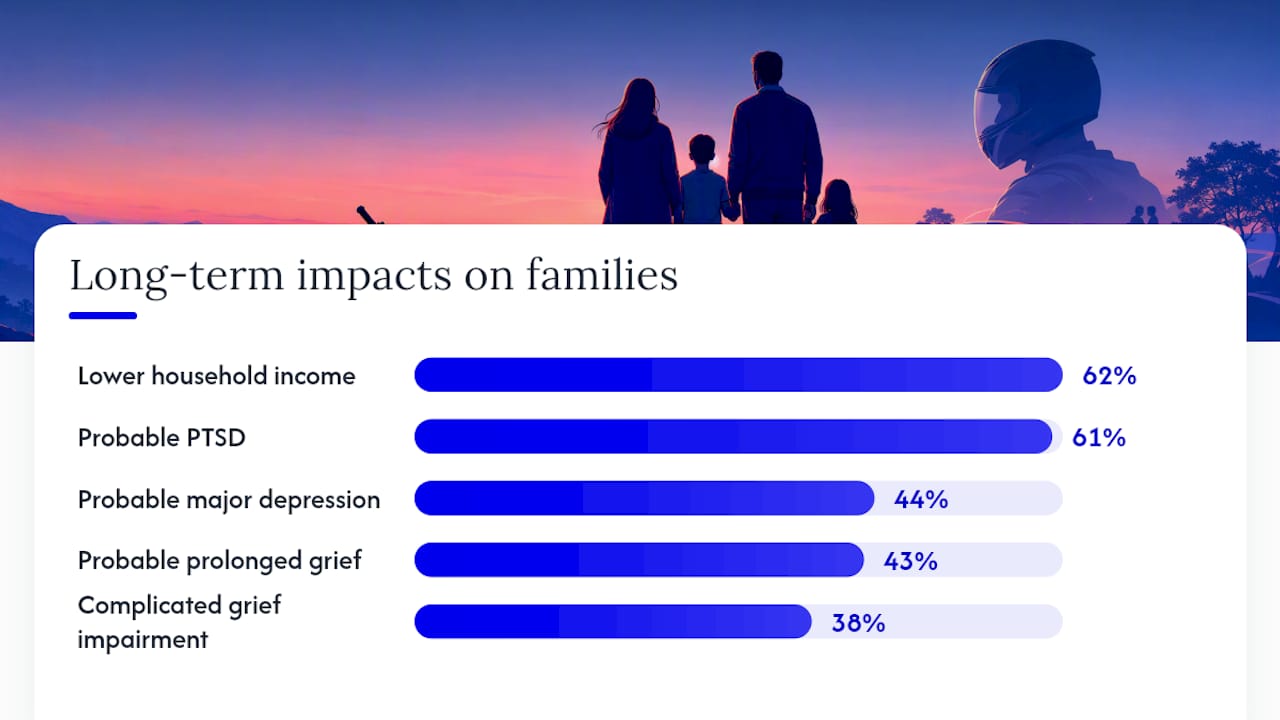
A study of families bereaved by traumatic workplace deaths found that at a mean of 6.4 years after the death, 61% had probable PTSD, 44% had probable major depressive disorder, and 43% had probable prolonged grief disorder. Critically, greater satisfaction with information and support was associated with lower risk of all three conditions. Families who had access to clear guidance and a dedicated support person fared measurably better.
Financial disruption compounds the psychological toll. A mixed-methods study on the impact of caregiver loss found that 62% of affected households reported lower income after the death, and over one-third showed complicated grief scores indicating significant functional impairment. While that study examined maternal mortality in Ghana, the mechanism is consistent with what U.S. research on road traffic fatalities shows: spouses with low personal income and high financial dependence on the decedent face the steepest quality-of-life declines.
| Outcome | Rate in studied sample | Source |
|---|---|---|
| Probable PTSD | 61% | Frontiers in Psychiatry (traumatic bereavement study) |
| Probable major depressive disorder | 44% | Frontiers in Psychiatry (traumatic bereavement study) |
| Probable prolonged grief disorder | 43% | Frontiers in Psychiatry (traumatic bereavement study) |
| Households reporting lower income post-death | 62% | PMC mixed-methods study (caregiver loss) |
| Complicated grief at significant impairment level | 38% | PMC mixed-methods study (caregiver loss) |
What the research makes clear: access to information and support is not just emotionally helpful; it is statistically associated with better mental health outcomes. Families who engage legal counsel early, get clear answers about their rights, and connect with victim advocates show lower rates of chronic grief and depression.
The financial and psychological risks are highest for families where the decedent was the primary earner, where young children are involved, and where the surviving spouse has limited independent income. Legal claims that recover lost income and benefits directly address the financial disruption that drives much of the long-term harm.
Why early counsel changes more than just the legal outcome
Most families who contact an attorney within the first two weeks of a fatal motorcycle crash are in a fundamentally different position than those who wait six months. The difference is not just legal strategy; it is the experience of having someone who knows what to do next.
Grief is disorienting. The paperwork, the insurer calls, the probate filings, and the evidence deadlines arrive simultaneously, at the worst possible time. An experienced wrongful death attorney handles the procedural machinery while the family focuses on surviving the immediate aftermath. That division of labor is not a luxury; it is what keeps claims viable and families from making irreversible mistakes, like signing a release or giving a recorded statement that undercuts the case.
The research on traumatic bereavement is clear: families who receive satisfactory information and support early have measurably better long-term mental health outcomes. Legal counsel is part of that support structure. Knowing your rights, having someone manage the insurer communications, and understanding what the process looks like reduces the psychological burden of uncertainty.
Seeking legal help after a motorcycle death is not an adversarial act. It is a practical one, and it is what the law provides for.
Carcollisionlawyer connects grieving families with experienced wrongful death attorneys
Losing someone to a fatal motorcycle crash leaves families with urgent legal deadlines, insurer pressure, and no roadmap. Carcollisionlawyer's free case evaluation cuts through that uncertainty by matching you with vetted wrongful death attorneys who handle exactly these cases, at no cost to you and with no obligation to proceed.
The intake takes minutes. Before you start, gather what you have: the accident date and location, the decedent's basic personal and employment information, any insurance policy numbers you can find, and the police report number if available. You do not need everything; the attorney will help you identify what's missing.
Attorneys in the network work on contingency, meaning no fees unless your family recovers compensation. Your information is handled according to Carcollisionlawyer's privacy policy and terms of use. To start, submit your case details and get matched with a wrongful death attorney who can evaluate your family's specific situation.
Sources
National authorities and research:
- “There is no joy in the family anymore”: a mixed-methods study on the experience and impact of maternal mortality on families in Ghana
- Nhtsa
- Americanbar
- Motorcycle Accident Settlement Amounts: 2026 Bands & Lane-Splitting Map · MyClaimWorth
Internal guides for next steps:
This article is general information, not a substitute for advice from a qualified lawyer. Consult a qualified legal professional about your own circumstances before acting on anything here.