
Most back injury settlements land somewhere between $10,000 for a minor soft-tissue strain and well over $1 million for a spinal cord injury with permanent paralysis, and the single factor that separates the low end from the high end is medical proof, specifically whether an MRI or surgery backs up the claim. The Bureau of Labor Statistics tracks back injuries as one of the most common workplace and accident injuries in the country, and that volume is exactly why insurers have built such a wide, formula-driven range of payouts.
Before you dig into the ranges below, check these four things first:
- Imaging status: Do you have an MRI or CT scan showing a herniated disc, fracture, or nerve damage?
- Surgical history: Has a doctor recommended or performed surgery, or discussed it as a likely next step?
- Lost income: Have you missed paychecks, and can you document them with pay stubs or employer letters?
- Insurance limits: Do you know the at-fault driver's policy limits, since that number can cap what you actually collect regardless of your damages?
Pro Tip: Get an MRI before you settle anything. Adjusters routinely value an imaging-confirmed disc injury at three to five times the medical bills of an identical injury with no imaging on file.
If your case involves surgery, a disputed fault determination, or an insurer lowballing you before you've reached maximum medical improvement, a lawyer will very likely put more money in your pocket than you'd get negotiating alone.
Key Takeaways
Back injury settlements range from roughly $5,000 for minor strains to over $1 million for surgical or catastrophic spinal injuries, with MRI-confirmed damage driving most of that difference.
| Point | Details |
|---|---|
| Imaging changes everything | An MRI-confirmed disc injury typically settles for three to five times more than an identical unconfirmed injury. |
| Medians beat averages | Use median settlement figures for your injury tier, since catastrophic cases skew averages sharply upward. |
| Surgery raises the ceiling | Fusion and multi-level surgery cases often settle between $250,000 and $1,000,000 or higher. |
| Insurance limits cap recovery | Your realistic maximum settlement can't exceed available policy limits without stacked underinsured coverage. |
| Get matched with an attorney | Carcollisionlawyer offers a free, no-obligation case evaluation to connect back injury victims with attorneys experienced in spine cases. |
Table of Contents
- Average Back Injury Settlement Ranges by Severity
- What Determines How Much a Back Injury Claim Is Worth
- Types of Back Injuries and How They Shape Case Value
- How Insurers and Lawyers Calculate a Fair Settlement
- Why Settlement Amounts Vary by State
- How Long Does a Back Injury Settlement Take?
- Should You Hire an Attorney, and How Do You Choose One?
- Real Settlement Examples Across the Severity Spectrum
- How These Settlement Ranges Were Compiled
- Why We Cover This Topic the Way We Do
- Get a Free Case Evaluation for Your Back Injury Claim
- Frequently Asked Questions
- Sources
Average Back Injury Settlement Ranges by Severity
Settlement value tracks almost directly with how much objective medical evidence exists. A back injury that shows up clearly on an MRI, and especially one that required surgery, moves into a completely different pricing tier than a strain that resolves with a few weeks of physical therapy.
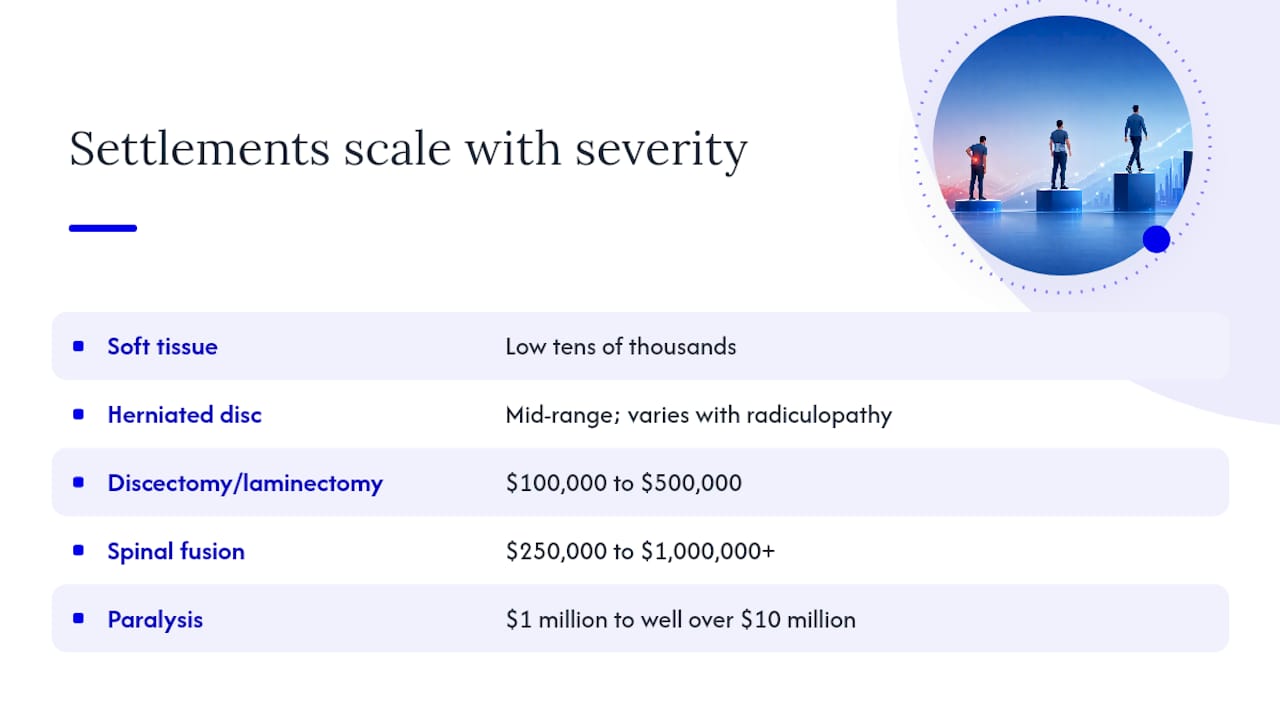
Soft-tissue injuries, meaning strains, sprains, and mild whiplash-type back injuries with no fracture or disc involvement, typically settle in a lower monetary range generally considered to be in the low tens of thousands. These cases usually resolve with physical therapy, rehabilitation protocols that follow standard clinical timelines, and a handful of doctor visits. Without imaging proof of structural damage, insurers treat these as low-tier claims almost by default.
Herniated or bulging discs without surgery generally settle in a mid-range monetary bracket, varying considerably based on pain persistence and objective confirmation of nerve involvement, known as radiculopathy. Peer-reviewed clinical literature notes that disc herniation and radiculopathy are objectively detectable conditions on MRI and EMG, which is precisely why these diagnoses carry so much more settlement weight than a claim built on symptoms alone.
Once surgery enters the picture, numbers jump. Herniated disc cases requiring a microdiscectomy or laminectomy commonly settle in the $100,000 to $500,000 range, while spinal fusion surgery, which involves permanently joining vertebrae and carries a longer recovery and higher risk of future complications, often pushes settlements into the $250,000 to $1,000,000+ range. Spinal cord injuries involving paralysis are the outlier category entirely, frequently settling anywhere from $1 million to well over $10 million, driven almost entirely by lifetime care costs rather than the injury itself.
One number matters more than any single settlement figure: the median, not the average. A handful of catastrophic paralysis verdicts worth tens of millions of dollars will drag any "average settlement" statistic far above what a typical claimant actually receives. If you're trying to set realistic expectations, ask what the median settlement looks like for your specific injury tier, not the average across every back injury case ever filed. Medians filter out the outliers; averages get skewed by them.
What Determines How Much a Back Injury Claim Is Worth
Two claims with an identical diagnosis can settle $200,000 apart, and the gap almost always comes down to a handful of specific, checkable factors rather than luck.
Economic damages form the floor of any settlement calculation. This includes every medical bill from the ER visit through physical therapy, any lost wages from missed work, and, in serious cases, an estimate of future medical care if you'll need ongoing treatment, injections, or a second surgery down the road. A detailed rundown of the factors insurers weigh shows just how many line items go into this calculation before non-economic damages are even discussed.

Non-economic damages, meaning pain and suffering, get calculated two main ways. The multiplier method takes your total economic damages and multiplies them by a number typically between 1.5 and 5, with the multiplier rising alongside injury severity, permanency, and surgical history. Law scholarship on damages valuation confirms that multipliers vary significantly based on permanency and surgical involvement, so a soft-tissue strain might get a 1.5x multiplier while a fusion surgery with permanent restrictions could justify a 4x or 5x multiplier. The per-diem method instead assigns a daily dollar value to your pain and suffering and multiplies it by the number of days you're symptomatic, an approach used less often but still common in some negotiations.
Liability and insurance limits act as a hard ceiling on what you can actually collect, no matter how strong your medical case looks. If the at-fault driver only carries a $25,000 policy and has no meaningful personal assets, that number may be your practical maximum unless you have underinsured motorist coverage to stack on top.
Pre-existing conditions complicate things further. Degenerative disc disease is extremely common, and research on aggravation of pre-existing spine conditions shows why careful medical documentation is needed to separate a new accident-caused injury from a baseline condition you already had. Insurers will look hard for any prior back complaints in your medical history, so being upfront and getting a doctor to clearly document the "new versus aggravated" distinction protects your claim rather than hurting it.
Documentation sequence matters more than most people realize. A claim that starts as "soft-tissue strain" in the ER report can become an "MRI-confirmed disc herniation" claim within two to three weeks, and that reclassification alone can multiply the settlement value several times over.
Pro Tip: If your pain hasn't resolved after two to three weeks of conservative treatment, push your doctor for an MRI referral. That single step is often what moves a case out of the low soft-tissue settlement tier entirely.
Types of Back Injuries and How They Shape Case Value
Not every "back injury" is the same claim, and insurers sort them into fairly distinct categories that each come with their own evidence expectations.
- Strains and sprains: Muscle and ligament damage with no disc or nerve involvement; usually treated with physical therapy and anti-inflammatories, and settlement ceilings stay low without imaging.
- Disc bulges and herniations: Confirmed by MRI, sometimes with radiculopathy verified by EMG testing showing nerve signal disruption down the leg or arm.
- Microdiscectomy or laminectomy: Minimally invasive surgeries to relieve nerve pressure, generally followed by a documented recovery period and functional impairment rating.
- Spinal fusion: A more invasive procedure joining vertebrae together, often tied to permanent range-of-motion restrictions and future revision surgery risk.
- Spinal cord injury and paralysis: The most catastrophic category, involving lifetime attendant care, home modifications, and total or partial loss of earning capacity.
Outcome studies comparing surgical procedures confirm that fusion and multi-level surgeries carry higher lifetime care needs than a single-level discectomy, which is a big part of why fusion cases settle so much higher on average. Our spinal cord injury claim guide breaks down the lifetime cost projections that drive catastrophic settlements even further.
| Injury Type | Diagnostic Standard | Settlement Implication |
|---|---|---|
| Strain/sprain | Physical exam, symptom-based | Lower ceiling without objective imaging |
| Disc herniation | MRI, EMG for radiculopathy | Mid to high tier depending on nerve involvement |
| Surgical repair | Operative notes, impairment rating | High tier, driven by permanency findings |
| Spinal cord injury | Neurological exam, imaging, care plan | Catastrophic tier, driven by lifetime cost |

Conservative care works for a large share of back injury patients, but a meaningful minority don't improve and need surgery or long-term management, which is exactly why settlement ranges stay so wide across the board.
How Insurers and Lawyers Calculate a Fair Settlement
Every settlement demand ultimately runs through some version of the same math, even if the exact multiplier or method differs from firm to firm.
- Add up economic damages. This means every medical bill, all lost wages, and any documented future medical costs.
- Apply a multiplier for pain and suffering. A typical range runs from 1.5x for minor injuries up to 5x for severe, permanent ones.
- Adjust for comparative fault. If you're found partially responsible, most states reduce the total by your percentage of fault.
- Check it against policy limits. The final number gets capped by whatever insurance coverage is actually available.
A quick worked example: say your medical bills and lost wages total $40,000, and your herniated disc required a microdiscectomy. If the at-fault driver's policy limit is only $100,000, though, that becomes your realistic recovery ceiling unless you can access additional coverage.
| Valuation Method | Best Used For | How It Works |
|---|---|---|
| Multiplier method | Most injury claims | Economic damages x 1.5 to 5 based on severity |
| Per-diem method | Shorter recovery periods | Daily pain value x number of symptomatic days |
| Life-care plan | Catastrophic/permanent injuries | Projected lifetime medical and care costs |
For catastrophic cases, attorneys often bring in life-care planners and vocational economists to project decades of future medical costs and lost earning capacity, since a jury or adjuster needs a documented, defensible number rather than a rough guess.
Pro Tip: Ask any attorney you're consulting with to walk you through their multiplier reasoning for your specific injury tier. A vague answer is a red flag; a specific one tied to your imaging and treatment records is a good sign.
Why Settlement Amounts Vary by State
The exact same back injury can settle for very different amounts depending on which state the accident happened in, largely because of three legal variables.
- Damage caps: Some states cap non-economic damages (pain and suffering) at a fixed dollar amount, particularly in medical malpractice cases, though most states don't cap these damages in standard car accident claims.
- Comparative negligence rules: States differ on whether you can recover anything if you're more than 50% at fault, and by how much your award shrinks for any percentage of fault assigned to you.
- Collateral source and lien rules: States vary on whether your settlement gets reduced by amounts already paid by health insurance, and how aggressively Medicaid or Medicare can claim reimbursement from your settlement.
Workers' compensation adds another layer entirely. If you were injured on the job, the Department of Labor's guidance on workers' compensation explains that these claims typically cover medical care and partial wage replacement but don't include pain and suffering damages, which is why a third-party tort claim (against a negligent driver, for example) usually pays more when one is available alongside a workers' comp claim.
If your case involves a six-figure or higher potential value, it's worth confirming exactly which state's law applies, since venue can shift your expected recovery substantially.
How Long Does a Back Injury Settlement Take?
Most back injury claims move through a fairly predictable sequence, and the timeline stretches or compresses depending almost entirely on whether surgery is involved.
- Immediate treatment and reporting (day 1 to week 1): ER visit or urgent care, followed by notifying insurance companies.
- Conservative treatment period (weeks 2 to 8): Physical therapy, chiropractic care, and pain management to see if symptoms resolve.
- Imaging and specialist referral (weeks 4 to 12): If conservative care fails, an MRI and orthopedic or neurosurgical consultation typically follow.
- Maximum medical improvement, or MMI (months 3 to 12+): The point where your doctor says you've recovered as much as you're going to, or that surgery has healed as far as it will.
- Negotiation or litigation (months 6 to 24+): Demand letters, counteroffers, and, if needed, a lawsuit filing.
Moderate soft-tissue cases often settle within six to nine months. Surgical cases routinely take twelve to eighteen months or longer, since you can't accurately value a claim until you know the full surgical outcome and whether permanent restrictions remain.
Pro Tip: Never accept an early settlement offer before reaching MMI. Once you sign a release, you can't go back for more money even if you need a second surgery six months later.
Should You Hire an Attorney, and How Do You Choose One?
An attorney typically becomes worth the cost the moment your case involves surgery, high medical bills, a disputed liability determination, or an adjuster offering noticeably less than your bills already total. Our breakdown of when to hire a car accident attorney covers this decision point in more depth, but the short version is: if the insurer's opening number doesn't cover your medical bills, don't negotiate alone.
When evaluating a lawyer, look for:
- Specific experience handling back and spine injury cases, not just general personal injury work
- A track record of settlements or verdicts in your injury category
- An established network of expert witnesses, including orthopedic specialists and life-care planners
- Clear, responsive communication and a straightforward answer about their strategy for your case
Ask specifically about how case costs (expert witness fees, filing fees) get handled and whether any medical liens will be paid out of your settlement before you see a dime.
Before your first consultation, gather:
- All medical records and imaging reports related to the injury
- Pay stubs or a letter from your employer documenting lost income
- The police report or accident report from the incident
- Photos of the accident scene, vehicle damage, and visible injuries
Preserving the right evidence early often matters as much as the injury itself when it comes to final settlement value.
Pro Tip: Bring a written timeline of your symptoms and treatment to the first consultation. Attorneys can spot gaps in your medical record faster when the story is laid out chronologically instead of buried across a dozen separate documents.
Real Settlement Examples Across the Severity Spectrum
Anonymized case patterns help put the ranges above into context.
- Low end: A driver rear-ended at a stoplight suffered a lumbar strain, completed physical therapy, and settled for a sum typically representative of minor soft-tissue injury settlements.
- Mid range, no surgery: A delivery driver developed a confirmed L4-L5 disc herniation with radiculopathy documented by MRI and EMG, and settled in a mid-range amount after months of treatment.
- Mid-high range, surgical: A rideshare passenger underwent a microdiscectomy following a highway collision, with notable medical bills and lost wages, settling in the higher mid-tier range.
- High range, fusion: A commercial truck crash victim required a two-level spinal fusion, with permanent lifting restrictions, and settled for a high-tier figure reflective of permanent impairment.
- Catastrophic: A motorcyclist suffered a T10 spinal cord injury resulting in partial paralysis and settled for a very high amount driven primarily by projected lifetime attendant care costs.
Our collection of real settlement examples covers additional case patterns across different accident types if you want more points of comparison. Each of these examples tracks closely with the severity ranges outlined earlier: imaging and surgical records consistently pushed values higher, while cases without objective findings stayed near the bottom of their tier.
How These Settlement Ranges Were Compiled
The figures throughout this article draw from a combination of published clinical literature, Bureau of Labor Statistics injury data, legal scholarship on damages valuation, and patterns commonly reported across personal injury case databases.
- BLS data establishes how frequently back injuries occur and how often they cause extended time away from work, which anchors the economic-impact side of the calculation.
- Peer-reviewed medical literature on disc disease and radiculopathy explains why imaging-confirmed injuries settle so much higher than symptom-only claims.
- Legal scholarship on pain and suffering valuation methods provides the multiplier framework used throughout this article.
Medians are cited over averages wherever possible in this article, since verdict and settlement databases tend to be skewed upward by a small number of massive catastrophic awards. A median gives a far more realistic picture of what a typical claimant in a given injury tier actually receives.
Why We Cover This Topic the Way We Do
Carcollisionlawyer exists to connect injured people with attorneys who actually handle back and spine injury cases, through a free case evaluation that doesn't require any upfront commitment. We built our intake process around the reality that back injuries range from a two-week strain to a lifetime of paralysis care, and generic advice doesn't serve either end of that spectrum well.
Our blog covers dozens of related scenarios, from rear-end collisions to bicycle crashes, because the legal principles behind settlement value shift depending on how the injury happened. We'd rather point you toward the specific guide that matches your situation than give you a one-size-fits-all answer.
Get a Free Case Evaluation for Your Back Injury Claim
Carcollisionlawyer is the alternative to guessing at your case's worth alone: instead of negotiating against an insurance adjuster with no benchmark for what your specific injury tier is worth, you get matched with an attorney who already knows the surgical, imaging, and liability details that move a back injury claim from a low offer to a fair one.

Before you start, gather a few key documents so your free evaluation moves quickly: your medical records and imaging reports, wage statements or a lost-income letter from your employer, the police or accident report, and any photos of the crash scene or your injuries. If you're weighing documentation strategy more broadly, a detailed look at serious injury claim documentation covers many of the same evidence-preservation principles that apply here.
There's no cost and no obligation to submit. Start your free case evaluation today, and you'll find out whether you're entitled to compensation and get matched with an attorney who handles back injury claims like yours before you say a word to the insurance company.
Frequently Asked Questions
What is the average back injury settlement amount?
There's no single average that applies across all cases, since amounts range from a few thousand dollars for minor strains to millions for catastrophic spinal cord injuries. Median settlements are more useful than averages, and they vary heavily based on whether surgery or imaging-confirmed damage is involved.
What is the average neck injury settlement compared to a back injury settlement?
Neck injury settlements, including cervical strain settlement values, follow a similar structure to back injuries, with minor cervical strains often settling in the $5,000 to $20,000 range and cases involving herniated cervical discs or surgery settling much higher. Neck injury claim value, like back injury value, depends heavily on imaging confirmation and treatment history.
How do I negotiate a back injury settlement without a lawyer?
Document every medical visit, keep copies of all bills and wage-loss records, and don't accept an initial offer before reaching maximum medical improvement. That said, adjusters routinely offer less to unrepresented claimants, so getting a free case evaluation before you negotiate can clarify whether you're leaving money on the table.
Do I need a lawyer for a back pain lawsuit?
Not always. If your injury resolved quickly with minimal treatment and the insurer's offer already covers your bills fairly, you may not need one. But if surgery, disputed liability, or a lowball offer is involved, an attorney typically increases your net recovery even after fees.
How long does it take to settle a back injury claim?
Moderate injuries without surgery often settle within six to nine months. Surgical cases commonly take twelve to eighteen months or longer, since you generally need to reach maximum medical improvement before a fair value can be calculated.
This article is general information, not a substitute for advice from a qualified lawyer. Consult a qualified legal professional about your own circumstances before acting on anything here.